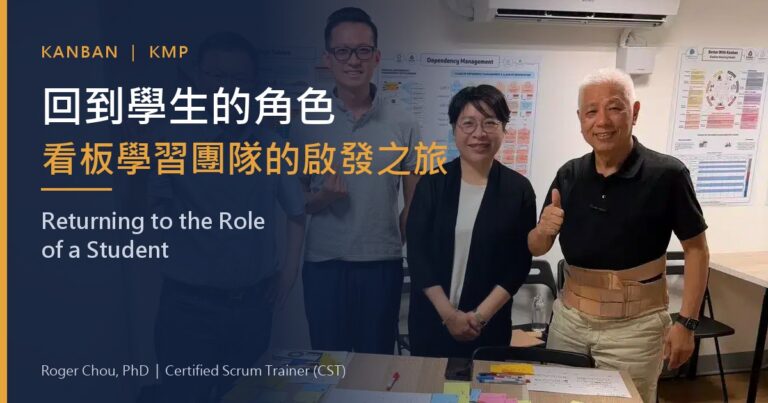
Returning to the Role of a Student: My Journey of Inspiration with the “Kanban Learning Team under the Orange Tree”

After becoming the second Accredited Kanban Trainer (AKT) in Taiwan, I chose to return to the role of a student and retake Kanban University’s KSD and KSI courses. This “reset learning” journey was not about earning another certification, but about rediscovering the true spirit of Kanban—moving from theory to practice, and from teaching back to experience.

During the two-day course, I learned not only about WIP limits, flow design, and workflow management, but also how a trainer can inspire learners through service, storytelling, and games. Afterward, I began reflecting on course design, classroom atmosphere, and the quality of interactions, deciding to integrate the spirit of Kanban into Scrum and corporate training.

This learning journey reaffirmed a simple truth: true professionalism is not about knowing more—it’s about being willing to become a student once again.

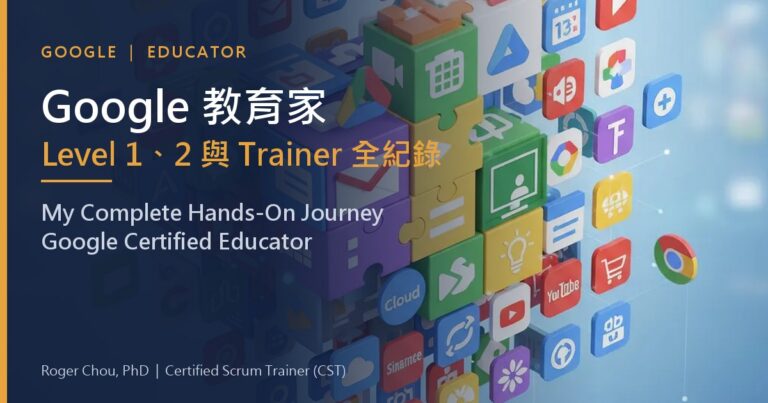
My Complete Hands-On Learning Journey of Google Certified Educator Level 1, Level 2, and Trainer

At first, I just heard that the Google Certified Educator Level 1 exam was now free, and since I was already quite familiar with Google tools, I figured I’d pass it easily. But to my surprise, taking the exams from Level 1 to Level 2 unexpectedly led me on a journey of truly mastering the tools, understanding instructional design, and integrating AI applications.

I scored 97 on Level 1, but had to retake Level 2 before finally passing. It was during the preparation for Level 2 that I discovered not only my enjoyment of learning, but also a deep passion for sharing these skills with others. This passion drove me to continue challenging myself, and I ultimately earned the more advanced certification of Google Certified Trainer—transforming from a learner into a coach capable of training others.

Along the way, I mastered over 30 different Google tools and redefined my own understanding of digital literacy.

If you also want to turn digital tools into your true superpower, this article will provide you with hands-on experience and a replicable preparation strategy.

回到學生的角色:我在「柳丁樹下的看板學習團隊」的啟發之旅

成為台灣第二位看板講師(AKT)後,我卻選擇回到學生的位置,重新修習看板大學的KSD與KSI課程。這趟「歸零學習」不只是為了證照,而是為了重新理解看板的精神——從理論走入實踐,從教學走回體驗。兩天課程中,我學到的不僅是WIP限制、流程設計與流動管理,更學到一位講師該如何用服務、故事與遊戲啟發學員。課後,我開始反思課程設計、場地氛圍與互動品質,並決定將看板的精神融入Scrum與企業培訓中。這場學習旅程讓我印證:真正的專業,不是知道更多,而是願意再次成為學生。

我的 Google 教育家 Level 1 、 2 及Trainer實戰學習全紀錄

本來只是看到大家說 Google 教育家 Level 1 現在免費可以考,想說我平常就很熟 Google 工具,應該輕鬆過關。沒想到這一考,從 Level 1 到 Level 2,意外展開了一段真正深入學會工具、理解教學設計、串接 AI 應用的學習歷程。

Level 1 我考了 97 分,Level 2 則是重考才通過。而正是在準備 Level 2 的過程中,我發現自己不僅享受學習,更充滿了想把這些技巧分享出去的熱情。這份熱情驅使我繼續挑戰,最終順利取得了更高階的 Google 認證講師 (Trainer) 資格,從一個學習者,轉變為一位能培訓他人的教練。 過程中我學到超過 30 種 Google 工具的應用技巧,也重新整理了我對數位素養的定義

如果你也想讓數位工具真正成為你的超能力,這篇文章會給你完整的實戰經驗和可複製的準備策略。

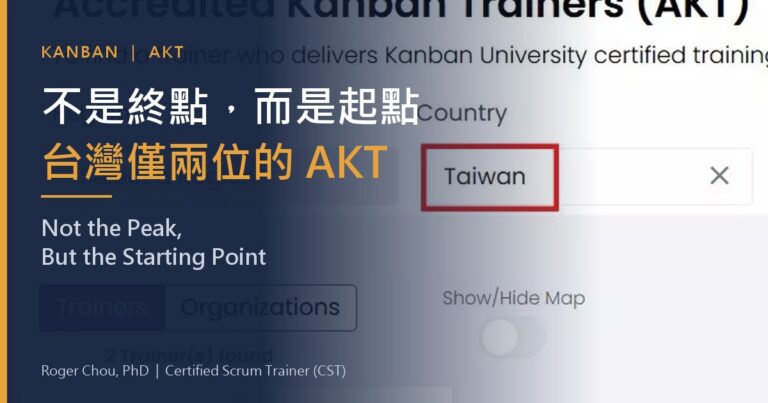
Not the peak, but the starting point: Becoming one of only two AKTs in Taiwan, I see the mission of an Agile champion.

This article documents how I passed the world’s most rigorous Kanban trainer training and officially became one of only two Accredited Kanban Trainers (AKTs) in Taiwan. Scrum Alliance and Kanban University formed their first strategic alliance to launch the brand-new dual-certification course, Scrum Better with Kanban. Together with 18 of the world’s top CSTs, I underwent intense scrutiny and trial teaching challenges. From earning the KSD certification on day one, jointly solved 40 Kanban challenge questions, to gaining recognition from ten peer reviewers, every step was taken with utmost caution. This article will fully share my learning journey from CST, PSM III, PSPO III to AKT, as well as the significance and mission this certification holds for Taiwan’s Agile ecosystem.

不是巔峰,而是起點:我成為台灣唯二的 AKT,看見敏捷推動者的使命

本篇紀錄我如何通過全球最高門檻的看板講師訓練,正式成為台灣唯二的 AKT(Accredited Kanban Trainer)。Scrum Alliance 與 Kanban University 首度策略聯盟,推出嶄新雙證照課程「Scrum Better with Kanban」,我與全球頂尖 18 位 CST 一同接受極高壓的審查與試教挑戰。從第一天取得 KSD 證照、破解 40 題看板難題,到獲得十人同儕評鑑認可,每一步都走得戰戰兢兢。這篇文章將完整分享我從 CST、PSM III、PSPO III 到 AKT 的學習之路,以及這張證照對台灣敏捷生態的意義與使命。

Completing My PMI Certification Puzzle: Reflections on the CAPM Exam

This article documents my journey of filling in the missing piece of the CAPM certification after twenty years. From earning the PMP in 2004, obtaining the PgMP in 2008, to finally completing the PfMP and CAPM in 2025, I have truly completed the PMI certification puzzle. I share why I was unable to take the exam in the past due to eligibility rules, how I prepared for it in just three days, and the experience of discovering that the practice question banks were completely unreliable. I also describe how the CAPM exam has evolved from pure ITTO memorization to scenario-based questions that span the breadth of project management, waterfall, agile, and business analysis. The article also explores the challenges of taking the exam in English, its cost, and the difficulties in the Taiwanese market, while offering recommendations on suitable candidate profiles and preparation strategies. For me, CAPM is not just the final puzzle piece—it is a reminder that certification is not the end goal, but a tool to help one go further on the path of project management.

我的PMI證照最後一塊拼圖:CAPM考試心得

這篇文章記錄了我二十年後補上 CAPM 的歷程。從 2004 年考取 PMP、2008 年取得 PgMP,到 2025 年完成 PfMP 與 CAPM,才真正完成 PMI 證照拼圖。我分享了為何當年因規定無法報考、如今三天準備的過程、題庫完全不準的經驗,以及 CAPM 從單純 ITTO 背誦轉型為情境題、涵蓋專案管理、瀑布、敏捷與商業分析的廣度。文章也探討了英文考試的挑戰、費用與台灣市場困境,並提出適合族群與準備建議。對我而言,CAPM不只是最後一塊拼圖,更是提醒:證照不是終點,而是讓專案管理之路走得更遠的工具。

Witnessing the most beautiful transformation in a long-standing restaurant brand — the most fulfilling CSM class I’ve ever taught

On September 10–11, 2025, during a Certified ScrumMaster (CSM) corporate workshop, Shin Yeh Group—a 48-year-old Taiwanese culinary brand specializing in Taiwanese cuisine with over 1,000 employees and three Michelin-recognized restaurants—embarked on a meaningful agile transformation experiment.

The participants, mostly senior executives with more than 20 years of experience and an average age over 50, initially showed strong resistance to both learning and certification. The course focused on the pain point of "labor shortage," introducing practical applications of Scrum to facilitate cross-departmental collaboration and co-creation of solutions, including the design of an app to address the group’s staffing challenges. During the process, executives anonymously disclosed the real root causes of the labor shortage for the first time, working together to propose viable solutions—demonstrating a positive shift in organizational culture. In the end, all participants successfully passed the CSM exam. This was not merely the adoption of a management tool, but a crucial starting point for a legacy enterprise to reconstruct its communication, decision-making, and learning mechanisms through agile thinking.

在餐飲老品牌裡,看見最美的轉變——我教過最有成就感的一場CSM

在2025年9月10至11日的CSM企業專班中,欣葉集團這家擁有48年歷史的台菜餐飲品牌,員工1千人以上,旗下有3家米其林認可的餐廳。展開了一場別具意義的敏捷轉型實驗。參與者多為年資20年以上、平均年齡50歲以上的高階主管,面對學習與考照初期存有高度抗拒。課程聚焦「缺工」痛點,以Scrum方法導入實作,成功促進跨部門合作、共創解法,並設計App解決集團缺工痛點。過程中,主管們首次匿名揭露缺工真實原因,彼此協作提出可行方案,展現出組織文化的正向轉變。最終,全體順利通過CSM考試。這不僅是一次管理工具的導入,更是促成老牌企業以敏捷思維重構溝通、決策與學習機制的重要起點。