In the Agile field, Scrum Alliance has long been a leader in driving innovative business models. In recent years, they have actively formed strategic alliances with other internationally recognized authorities—one of which is Kanban University. Just as Scrum Alliance represents Scrum, Kanban University is the global authority on the Kanban method.
This collaboration is not merely a merging of market competitors, but a remarkable opportunity to further the development of Agile as a whole. What was once a dilemma of “choosing one or the other” has evolved into a dual-certification learning advantage—thus, Scrum Better with Kanban (SBK) was born.
This certification signifies that an instructor must be equipped to teach both Scrum and Kanban. Such a combination of expertise brings transformative benefits to Scrum teams, helping them overcome practical bottlenecks, and enhancing both transparency and flow efficiency.

What is an AKT? A globally recognized Kanban trainer on par with CST
Scrum Alliance launched this instructor collaboration program with the “Accredited Kanban Trainer (AKT)” at its core, equivalent to Kanban University’s official trainer certification. The bar is extremely high, requiring both hands-on expertise and teaching proficiency.
In 2025, only 38 spots were released globally, fully sponsored by Scrum Alliance, with tuition reaching $6,000 USD. I was fortunate to be among this very small group. Our cohort was truly star-studded—18 of the world’s top CSTs (Certified Scrum Trainers), including three who had previously served as reviewers for my CST certification: Judy Neher, Dave Prior, and Iain McKenna. Sharing the stage with such seasoned mentors naturally came with its share of pressure.


Three Major Challenges to Certification: This Wasn’t Just a Course—It Was a Survival Challenge
To earn the AKT certification, we had to complete three high-intensity tasks:
- Pass the KSD (Kanban System Design) certification in one day: Originally designed as a two-day course, we had to self-study in advance and push ourselves to the limit.
- Jointly answer 40 common Kanban challenges: Covering both core Kanban theory and real-world application.
- Conduct a trial teaching session and pass a rigorous review: Approval from two senior coaches and ten peers was required to pass.
The most challenging part, however, was being placed in the same training group as the three CST reviewers from my previous certification. It wasn’t just pressure—it was an invaluable learning opportunity. This training felt like facing world champions: you either grow, or you fall behind.
What changes will the Scrum Better with Kanban course bring?
After earning the AKT certification, I will be qualified to teach the one-day Scrum Better with Kanban (SBK) course. The core value of this course is to help Scrum teams address gaps in transparency and flow efficiency.
In many teams, what’s commonly referred to as “ScrumBan” is often just Scrum with a task board—without incorporating key Kanban mechanisms like WIP (Work in Progress) limits. The SBK course dives deep into:
- How to build a proper Kanban flow from scratch
- How to solve common issues like overly formal daily stand-ups or task stickers becoming mere decoration
- How to introduce core principles such as focusing on flow over utility, using CFD (Cumulative Flow Diagram), and SLE (Service Level Expectation) for delivery forecasting
This isn’t just a tools-based course—it’s an upgraded version of Scrum that brings teams closer to a more mature Agile practice.
What are the differences between the paths to becoming a CST and an AKT?
| Item | Scrum Alliance (CST) | Kanban University (AKT) |
|---|---|---|
| Teaching Method | Apprenticeship system (co-teaching) | Standardized training process |
| Teaching Materials | Self-designed materials, subject to approval | Official complete materials and handouts provided |
| Time to Qualification | On average 3–5 years of practical experience | Clear process and training requirements |
| Practical Experience | Must demonstrate over 5 years of hands-on experience | Requires more than six months of practical experience |
Both paths are challenging but focus on different strengths: CST excels in personalization and refinement, while AKT emphasizes systematization and consistency.
What does obtaining the AKT represent?
When I successfully earned the AKT certification, I immediately searched online and found that there are currently only two AKTs in Taiwan. The other is Mr. Ge Zhong’an, who has five years of experience.
For me, this is not just an honor but a heavy responsibility. As Taiwan’s first CST and one of the few instructors holding PSM III, PSPO III, PfMP, and PgMP certifications, adding the AKT means I now stand firmly on the two highest peaks of Scrum and Kanban. This will greatly enhance my influence and the completeness of my efforts in driving Agile transformation in Taiwan.

Looking ahead to 2026: The intersection of RSG Taipei, the CEO Awards, and Kanban promotion
In the future, I will fully dedicate myself to:
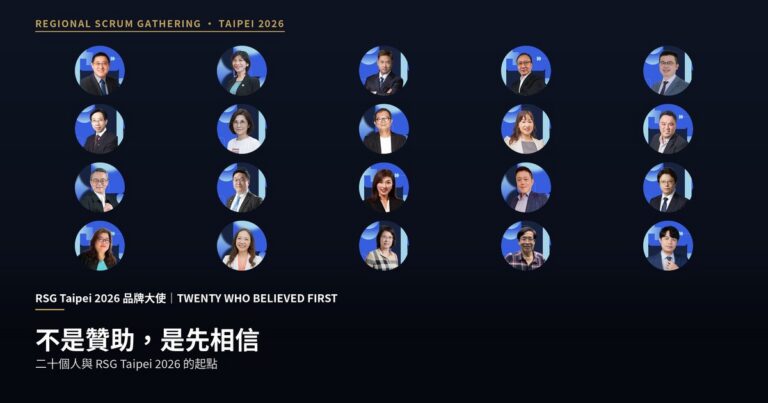
- Organizing the Regional Scrum Gathering Taipei 2026
- The 4th Global Agile CEO Awards
- Promoting the application of Kanban within Scrum
I believe these platforms will be the best venues to promote the spirit of Kanban. Through practical integration and dialogue with senior executives, Kanban will no longer be a mysterious term but a tangible asset.
Path to Further Learning After Becoming an AKT
After obtaining the official Kanban University instructor certification AKT, I didn’t feel ready to immediately start teaching Kanban courses. Instead, I chose to continue deepening my expertise. I especially sought advice from Taiwan’s other AKT, Teacher Chungan Ke, and enrolled in his KSD foundational course, inviting eight fellow enthusiasts to learn together. KSD is a two-day introductory course, followed by the two-day KMP professional course. This four-day comprehensive learning journey laid a solid foundation for my Kanban expertise. I believe that only by continuously enriching myself can I teach with greater confidence and strength in the future.
Conclusion: From Knowledge Certification to Becoming an Agent of Change
Earning the AKT is not the end, but the beginning of another journey. This certification is both a challenge and recognition of my abilities, and also a commitment to the Agile ecosystem in Taiwan. I will continue to cherish this rare status and turn my passion into the driving force for change.
PgMP + PfMP + CST + PSM III + PSPO III + AKT — this is not just my résumé; it is my declaration of action: I am ready to lead Taiwan’s Agile community toward the next milestone.