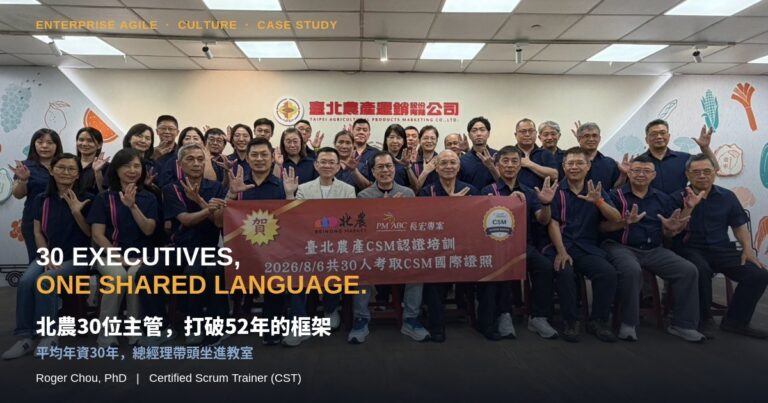
The Shin Yeh CSM corporate class took place on September 10–11, 2025.
Since becoming a Certified Scrum Trainer (CST) and International Scrum Ambassador, I’ve led over a dozen in-house corporate trainings.
But this class was, without a doubt, the most challenging, most unforgettable, and most fulfilling class I have ever taught.

What made it challenging? The challenge lies in the fact that this company has nearly 50 years of history — 48 years old to be exact. Its employees have an average tenure of 20 years and are the most senior executives within the Shin Yeh Group. Shin Yeh consists of three business divisions and eight brands. It is an outstanding restaurant group, with three Michelin-recognized restaurants under its name, primarily focused on Taiwanese cuisine. With annual revenue between NT$2 to NT$2.5 billion, I believe that through this agile transformation, they can break through the NT$3 billion mark and successfully address their labor shortage bottlenecks.
What moved me most about this class was that these senior executives already had stable operations and their own well-formed views. It was entirely possible that they would resist change and stick to their original thinking. But within just two days, they worked together without division, brainstorming collaboratively to tackle their biggest pain point.
These two days of corporate CSM training helped them see that Scrum is not just a course — it can serve as the starting point of true transformation for a company. Even a company that is already fifty years old is no exception.
My testimony: Shin Yeh is the first — and so far the only — restaurant group in the industry with the courage to introduce Agile at this scale. With such a large employee base, a diverse brand portfolio, and three Michelin-recognized restaurants, Shin Yeh stands as the leader. They are also the restaurant group in Taiwan with the highest number of senior executives holding a CSM certification.

From 11 Tables to a 1,000-Person Enterprise: Shin Yeh’s Agile Beginning
The central figure of this company’s story is their Executive Director, Mr. Hung-Chun Lee. He took over the business when he was young, inheriting it from his mother, Ms. Hsiu-Ying Lee, the founder of Shin Yeh.
In the early days, Shin Yeh started as a small Taiwanese restaurant with just 11 tables, and gradually expanded to a group with 23 branches across Taiwan, eight brands, and around 1,000 to 1,200 employees.
You might assume that with so many employees, most of them would be part-time or servers. But it’s actually the opposite. They have more than 700 full-time employees, and around 500 part-time workers. This high percentage of full-time staff is very rare in the food and beverage industry.
However, when it comes to part-time staff — such as front-of-house servers and back-of-house kitchen apprentices — the turnover rate is extremely high. The company faces a major challenge with manpower shortage, with about 200 vacancies every year, and even when new people are hired, more than 250 might leave.
This has also made it hard for senior leaders across departments to reach consensus, and blame-shifting has become more frequent. Scrum became the turning point to break through these issues.
Supplementary note: Only managers, strategic-level leaders, and senior executives attend the CSM training. Frontline staff (such as servers, chefs, and kitchen/back-of-house workers) will receive other forms of training or support, and are not required to get the CSM certification.
The Chief Knowledge Officer learned CSM first, igniting the flame of Shin Yeh’s transformation
The turning point of the story happened with the group’s Chief Knowledge Officer, Ms. Tzu-Hui Wang. She was the first to take the CSM course, and after returning, she told the Executive Director: This course might be the solution to our problems.
The Executive Director then signed up for a public CSM class, bringing along the Vice President of the Japanese Cuisine Division and his executive assistant.
After completing the course, not only was the Executive Director’s perspective broadened, he even made a phone call to the Executive Vice President while traveling abroad, excitedly sharing agile applications he had seen in other countries.
His curiosity and initiative showed us the first glimmer of agile culture taking root. However, he is not an authoritarian leader. He never forces anyone to learn something they’re not ready for.
So, he asked Executive Vice President Shih-Kuang Sun to test the waters first — to attend a CSM class.
As a result, Mr. Shih-Kuang Sun bravely attended the public CSM course on his own.
Before the corporate class was launched, it all began with a phone call — and the agile transformation quietly took root
CSM can solve problems that Shin Yeh has struggled with for years. After passing the CSM exam, Executive Vice President Mr. Shih-Kuang Sun said:
The CSM course was absolutely worth the challenge! Because after completing it, my biggest realization was — our company has long been missing a “shared way of working.”
In the past, we experienced a lot of “internal friction.” But what is internal friction really? It comes down to unclear roles and vague responsibilities: Who is the SM? Who is the PO? What exactly do the DEVs do? When roles are unclear, communication costs become very high.
So I suggested to the Executive Director that we must bring this course into the company — the sooner, the better.
After that class, EVP Mr. Shih-Kuang Sun and I had a 30-minute phone call.
At the beginning, he told me: In the restaurant industry, most senior executives don’t have high academic degrees. They don’t like studying, they dislike exams even more, and they don’t think it’s necessary to get an Agile certification.
I listened quietly, then asked him: If we don’t require certification at all, and just finish the course — do you believe people will actually bring Scrum back and apply it? Without going through the challenge of the exam, what do you think would happen?
After a 30-second silence, he replied: Then I think there would be no pressure at all during the class. People wouldn’t focus, and Agile thinking would just be something they heard once and quickly forgot.
I followed up with: If that’s the case, and you still hope to bring Agile into Shin Yeh in the future — what do you think would happen?
He paused again, then said: Wow… then it would be even harder.
I didn’t give him any instructions. Instead, I let him make the decision himself.
In the end, he bravely said: Alright, let’s change the Agile practical workshop into the official Shin Yeh CSM corporate training.
That decision took real courage — because from that moment on, he would have to face a great deal of resistance and challenges from other senior executives.
Before the corporate class officially started, Mr. Sun and I spent over a month preparing.
We translated the entire course content into Shin Yeh’s language — to make sure this was not just a class to learn Scrum but one designed to solve real pain points.
When we first began discussing the course design, I asked him: What do you think is Shin Yeh’s biggest problem? He thought about it for a week, and then replied: Our biggest pain point is the labor shortage.
So, we decided to build the course activities and hands-on sessions around this challenge — to tackle the issue of manpower head-on using Scrum.

But when they broke the record for the “Zero-Ball” game, they felt a strong sense of inspiration — as if they were finally breaking out of long-held constraints and stepping beyond the boundaries they had always operated within
The Three Psychological Barriers Faced by Shin Yeh’s Executives — How Were They Overcome One by One?
In fact, among Shin Yeh’s senior executives, there were three major internal barriers they faced before attending the CSM course

Barrier #1: Age Gap
Their average tenure was over 20 years, and many had successfully managed their own brands and restaurant branches.
At this stage in their careers, they couldn’t help but wonder: Why should I still be learning something new — especially something as abstract as agile thinking?
Barrier #2: Self-Limiting Beliefs About Learning
They were able to rise to the level of senior executives because they worked their way up from the bottom. If they had been academically inclined when they were young, they probably wouldn’t have chosen to enter the restaurant industry in the first place.
Their career path looked more like this: Apprentice → Cook → Head Chef → Manager → Operations Lead.
Every step was earned through craftsmanship and hands-on experience, not through exams, academic degrees, or certifications.
Barrier #3: Certification Pressure
These senior executives were not used to studying, let alone taking exams.
Some even asked, Why do we have to take a CSM certification exam?
So when they found out there would be a test at the end of the course, their inner resistance skyrocketed, and the pressure was intense.
In the restaurant industry, the logic they’re used to is based on highly specialized LEAN workflows, such as:
- Order a dish → Deliver a dish.
- Washing, filleting, stir-frying, steaming — each step is handled by a different person.
This is a sequential, highly segmented production system.
But Scrum emphasizes cross-functional teams — hoping that each member can handle multiple skills, iterate quickly, and take collective ownership. This is the complete opposite of their usual operating rhythm.
However, Scrum turned out to be useful in helping senior executives establish a shared language, clarify vague roles (such as PO, SM, and DEVs), and create a structured way of working — dramatically reducing communication costs.
It became clear that Scrum could be applied to projects outside of daily operations with great effectiveness.
Note: This set of three psychological barriers mainly applies to senior management. Frontline or back-of-house staff will not be required to attend the same course or take the certification exam.
I used CSM facilitation techniques to surface the real pain points and guide the team in writing down unframed, creative solutions.
In class, I didn’t give them the answers directly. Instead, I applied facilitation techniques and asked everyone to anonymously write down two cards.
What do you think is the real reason behind Shin Yeh’s labor shortage?
Please write it anonymously on a blue card. Since your name won’t be shown, feel free to write what you truly believe is the root cause.Now, for that cause, what do you think is the best possible solution?
Don’t worry about whether it’s feasible or not — just write down the solution you believe would actually work.
This seemingly simple activity was, in fact, the first time Shin Yeh’s internal managers truly voiced what they had never dared to say out loud.
From the cards, we identified four core root causes, and then formed four cross-functional groups. Each group selected one theme to discuss, break down, and brainstorm around.
Together, we began addressing the real pain points behind the labor shortage — one by one.

The Cake Metaphor: Making Scrum No Longer Just an IT Language
I shared a metaphor with them — the “cake slicing” approach.
I asked everyone to imagine this:
If you’re developing a new cake product, you don’t start by separately making the cream, the sponge, and the decorations. Instead, you first create a small, complete sample of the cake — so the customer can taste it, give feedback, and then you make adjustments.
That analogy instantly lit up their eyes.
Then I asked a follow-up question: So, where do you think Scrum could be applied in your context?
That’s when they started speaking from their own real-world experiences, offering brilliant answers:
- We could use it for developing new menu items.
- Every year we design new set meal combinations — we could use Scrum to experiment and iterate.
- Sometimes we open new branches or launch seasonal specials — Scrum could help us manage those too!
These responses confirmed something for me: When the method is right, the language is right, and the metaphor is right — there’s no such thing as someone who can’t learn.

Scrum allowed them to “break down departmental walls” for the very first time
In the past, whenever the topic of labor shortage came up, everyone would point fingers at the recruitment team, while no one took a hard look at the work environment or cultural issues within operations.
But this time, each group included operations managers, HR recruiters, and training leads, and for the first time, they all sat down together to think about one thing: We are here to solve the problem — not to blame each other.
Every team produced impressive results, and every proposed solution was surprisingly innovative.
What moved me the most was what happened after the presentations: participants started applauding each other, and some even said: Why didn’t we think of these solutions before? It took this class for us to come up with them.
At that moment, I was truly touched. It wasn’t that Scrum taught them the answers. It was that Scrum enabled them to face the problem together, seek solutions together, and take action together.

Creating the “Impossible”: From App Design to Team Culture Rebuilding
When they first learned that the final part of the course would involve designing an app to solve the labor shortage problem, many managers instinctively reacted with: This is too hard — there’s no way I can do that.
But within just one hour, they actually made it happen.
Not only did they exceed their own expectations, they also created a highly practical prototype that could serve as a real case study for future internal implementation.
It wasn’t just an app. It was a moment when they began to understand: The answer to a problem isn’t always a policy or process — it can also be innovative design and team co-creation.


They were no longer solving the problem from the company’s perspective, but instead through the eyes of their employees
The CSM Exam — A Challenge, and a Catalyst for Transformation
The climax of the entire course happened on the day of the CSM exam.
Their learning journey wasn’t smooth. At first, during practice tests, almost everyone failed.
Some even said: We haven’t studied for years… There’s no way we can pass this exam.
But something powerful happened in the process.
Those who scored higher in practice — the early achievers — were generous in helping others. They taught their peers one-on-one, without hesitation.
And when someone failed their first attempt, no one judged them. Instead, the team encouraged each other: “It’s okay, we’ll go again — one step at a time, we’ll all get through this.” This was the most united class I’ve ever seen.
We originally scheduled the exam for 5:45 PM, and most classes would finish before 7 PM.
But this class kept going — all the way until after 8 PM — when finally, everyone passed.
When the last participant who re-tested successfully stood up to speak, they said with deep emotion:
I’m truly grateful to those who helped me so selflessly. Without them, I couldn’t have passed.
I also feel sorry for delaying everyone else’s evening…
The room erupted into cheers and applause. Because in that moment, they truly felt what it meant to work together and support one another.
In the end, they didn’t just walk away with a certificate. They walked away having learned an entirely new mindset.


Scrum isn’t about being perfect — it’s about learning to fail fast and adapt quickly
In the past, they were only familiar with the Waterfall approach: Think through every detail, finalize everything, then execute.
But now, they’ve begun to embrace a new mindset: Try quickly, move in small steps, and adjust immediately if it doesn’t work.
Even if the solutions they designed for the labor shortage don’t work at first, they don’t get discouraged. Instead, they say: It’s okay — that just means this solution isn’t the right one. Let’s try another! This kind of flexibility and mindset is exactly the seed that Scrum aims to plant.
To the Agile Warriors of Shin Yeh
Before ending the course, I sincerely shared three things with everyone:
You are the creators of Shin Yeh’s culture.
Although Shin Yeh is an established company, and many of you have worked 20 or even 30 years to reach your current positions, the ones who truly create and shape Shin Yeh’s culture are not the Executive Director, nor the Executive Vice President — it’s you, the senior leaders standing right here.
So when we talk about improving the environment, it starts with us.
The spirit of Scrum says: The best architectures, requirements, and designs emerge from self-organizing teams.
And this time, the solutions didn’t come from consultants or outsiders. They came from you. That’s why I believe the chances of these ideas succeeding in the real world are very, very high.
CSM is not just a certificate — it’s a mission.
Shin Yeh has over 1,000 employees, but only 25 of you now hold the CSM certification — including the Executive Director, the Executive Vice President, the VP of Japanese Cuisine, the Executive Assistant, the Chief Knowledge Officer, and you 20 senior leaders.
This means that this CSM certificate is not just a credential — it is a badge of honor, a responsibility, and above all, a mission.
I hope you will carry it forward, and help this culture take root and grow within Shin Yeh.
If you want Agile to truly take root, you must first build a shared language
If you understand Agile but the team you lead doesn’t, then Agile won’t move forward.
That’s why, in the future, we need to build more shared language. Once you understand Agile, you need to help those under you gradually understand it too — so that Scrum is no longer just knowledge, but becomes a part of the organization’s language.
In the end, what you’ve transformed is not just a process —
it’s the soul of the organization
Shin Yeh has a rich 48-year history as a deeply rooted restaurant group.
Through this CSM corporate training, we witnessed a powerful transformation — from initial resistance and skepticism, to openness, collaboration, applause, and even heartfelt embraces.
This CSM corporate training started with resistance and skepticism, but ended with openness, collaboration, applause, and even embraces — truly demonstrating the learning courage and leadership spirit of seasoned corporate veterans.
Let’s Scrum On!

Reflections from Shin Yeh’s Senior Leaders
Executive Director Mr. Hung O Lee:
Although I didn’t participate in every activity over the past two days, the moment I saw everyone in the classroom smiling and exchanging ideas, I felt a sense of team energy and connection that we haven’t experienced in a long time. This was not just about acquiring knowledge, but about practicing mutual respect and co-creation. Colleagues from different departments and fields were able to sit at the same table, speak up about shared challenges, and contribute to one another’s future — this is the true spirit of “learning together,” and the organizational culture we hope to build.
I’m especially grateful to the instructors for providing not only substantial content but also thoughtful care and support. From methodology to mindset, they made every participant feel valued and respected. The end of this course is not a conclusion, but the starting point of our journey toward real team transformation. The road ahead will not be without challenges, but as long as we are willing to move forward together, we will find a way — and create our own path to success.
Executive Vice President Mr. Shih O Sun:
As one of the first-level executives, I fully understand that this course has been a real challenge for everyone — not only because of the intensive content, but also because of the rigorous exam. I went through the same journey myself just three months ago, from failing, doubting, and feeling the pressure, to finally reaching a breakthrough. I realized that this is not just about knowledge delivery — it’s the starting point of our organizational transformation. I’m deeply grateful that you all chose to go through this journey — even if you were silently cursing inside — and even more thankful for the determination and team spirit you all demonstrated.
The greatest value of this course is not simply earning a certificate. It’s about bringing a shared language and role clarity to our organization. From now on, we can reduce communication friction and improve collaboration efficiency.
Introducing this kind of systematic thinking into the restaurant industry is no easy task.
To make the course relevant to our operations, we spent a great deal of time customizing the cases and questions. All of this effort was for one purpose: So that starting tomorrow, we’ll have a unified way of working. Thank you again — this is not the end. It’s the beginning of a brand new chapter.
Vice President Ms. Lily O Huang
I am someone who has a very hard time adapting to collaborative learning. At first, I even explicitly refused to participate in the course, and the pressure was so great that I joked with my supervisor, “Look how much weight I’ve lost already,” trying to get out of it. But after these two days of actual participation, my perspective completely changed. The course was not just about transferring knowledge — it opened up a new way of conversation, allowing us to rethink the long-standing issue of “internal friction.” I truly felt that if each of us is willing to start the change from within, then that change really has a chance to take root. The real value of this course is not about whether we passed the test or learned a new tool, but about whether we are willing to take the first step together and turn “internal friction” into history.
Associate Director Ms. Ling O Lin
As someone who cares deeply about return on investment, I was initially skeptical about the intensity of this course. I even discussed with our CFO whether the program could be designed to be a bit more “middle-ground,” making it easier for more people to pass. But as the course progressed, I began to see the higher-level logic behind it: this was an intensive training program designed to cultivate trailblazers. Not everyone needs to pass the exam right away — the goal is to develop a group of early adopters who can go back to the field, co-create, experiment, and lead the change.
What impressed me most was the course design itself. It wasn’t just content-rich — it was precisely timeboxed, allowing every concept in the textbook to come alive through hands-on experience. The facilitation from the instructors and the seamless collaboration of the teaching team were truly admirable. The level of detail and the energy behind it all showed me what high-level professional education looks like. And all of this wasn’t for the sake of performance in the classroom — it was meant to equip us to create real change in our day-to-day work.
I’m truly grateful to have been part of this journey, and I’m ready to be one of the forces that drives transformation forward.
Training Director Ms. Mei O Li:
Although the past two days of training were a mix of enjoyment and nervous energy — especially with the pressure building up toward the final presentation — what I truly saw was the unlimited potential of the team. When everyone shares a common direction and embraces the spirit of “moving forward and succeeding together,” even when unexpected variables arise, they can be overcome through collective effort.
What moved me the most was seeing everyone willing to face the issues of “recruitment” and “retention” together — topics that may seem like they belong to different departments, but are in fact deeply intertwined.
Whether it was during the ideation of app concepts or the positive energy during discussions, everything felt completely different from the past. It revealed a new kind of cohesion and collaborative attitude.
Thank you to every team member for your dedication over these two days, and thank you to the instructors for your guidance.
Associate Director Mr. Yu O Wang:
The biggest shift this course brought me was changing my mindset from “think a lot before taking action” to “take action first, then improve along the way.” In the past, I often overthought things and hesitated. Now, I’ve learned to take the first step, and then continue refining through iteration.
During team interactions, I also deeply realized that when everyone feels heard and respected, team cohesion naturally emerges.
This isn’t just a change in how we work — it’s a whole new understanding of collaboration and growth.
Associate Director Mr. Da O Chiu:
Initially, I came into the course with hesitation and resistance. I even thought this was something completely irrelevant to me. But after actually participating in the two-day training, my mindset and perspective shifted dramatically — it felt as if I had leaped from a confined space into a vast open field.
The course didn’t just “show me the picture” — it made me realize that moving from chaos to clarity, from nothing to something, is something that can be guided and achieved.
During the group work, I was deeply moved by everyone’s level of engagement and honest sharing. This kind of interaction revealed to me the true power of teamwork. Now, the anxiety and fear I felt at the beginning have transformed into a sense of calm, openness, and growing anticipation.
Associate Director Mr. Kang O Huang:
What I felt most deeply in this course was the sense of unconditional and voluntary support. That feeling of being surrounded by genuine support was comforting, sincere, and gave me a complete sense of security.
I finally realized that this isn’t just about techniques or processes — it’s a spirit. A culture of mutual support and heartfelt encouragement. If, in the future, our teams — or even every branch — can spread this kind of supportive atmosphere, the energy and trust within our organization will be transformed.
Although I was quite nervous at one point, I’m truly grateful for everyone’s patience and companionship, and I’m relieved that I was able to pass in the end. Really, thank you all — for giving me such a precious experience.