On the afternoon of June 30, an email arrived. Ordinary subject line, three lines of body text: the vote count, congratulations, next steps. I read it twice to be sure I had it right — the seat chosen by 1.5 million certified members worldwide had landed in Taiwan.
Ten days later, I wrote back and returned the entire board salary that comes with the position to the organization.
This article is not about how I won. It is about why, the moment I had won, the first thing I did was push away everything the seat could give me.
3,000 Against 1.5 Million Was Never a Probability Problem
Scrum Alliance is the largest agile professional organization in the world. Its board holds a minimum of nine seats, three of which are elected directly by the global membership. This election was for one of those three.
There is exactly one requirement to vote: you must hold a valid certification from the organization. About 1.5 million people worldwide qualify. In Taiwan, roughly 3,000 do. Two in a thousand.
On probability alone, this is not an election. It is a bet.
But I never played it as a probability problem. For 3,000 votes to move a base of 1.5 million, only one thing can be true: behind every one of those votes is a person who thought, I know this man, and I know what he has done. That cannot be bought. It can only be accumulated. I spent ten years accumulating it.
The official announcement is here: Meet the Board Directors: Roger Chou and Joe Falcao

Scrum Alliance’s official site also lists this board on its We Are Scrum Alliance page.

The Letter on June 30, and the One I Sent Back on Day Ten
Voting closed on June 24. The notification arrived on June 30. It was short — the vote count, congratulations, next steps. That was it.
Only then did I learn the seat is a paid position. Roughly thirty thousand US dollars a year. Close to a million New Taiwan dollars.
I will be honest: I sat still for a moment. From the day I decided to run to the day I won, not one second of it had been about money.
On day ten, I wrote to Scrum Alliance and returned the entire board salary for my term to the organization.
I Kept None of the Board Salary. This Isn’t Virtue, It’s Engineering.
I know how this sounds. So let me give you the actual reason.
Once a position starts feeding you, every judgment you make at that table quietly begins to serve the position — and you are usually the last person to notice. You will still feel objective. You will simply feel that you are “considering things more holistically” now.
There is an old phrase in Chinese: a man who wants nothing cannot be bent. It sounds antique. Put it inside a boardroom and it becomes a very concrete engineering problem: how do you guarantee that the vote you just cast was for the organization, and not for whether you get to keep sitting there?
The last vote you cast in a meeting room — was it for the company, or for your position in it?
I am not asking you to answer me.

My Opponents: One Trained 12,000 People, One Spent 15 Years at Microsoft
Neither of the other two finalists was a lightweight.
Mark Palmer: twenty-five years in the field, more than twelve thousand professionals trained, a client list that includes SWIFT and Capital One. Alex Sloley: fifteen years at Microsoft, author of a book on agile communities, based in Sydney.
Both are veterans of the English-speaking world, with community bases in North America and Australia — vote pools many times the size of Taiwan’s.
After years of coaching enterprises, the reaction I see most often is this: when the resources are unequal, shrink the goal. But what decides the outcome has never been the total volume of resources. It is which battlefield you choose to fight on. I did not compete with them on how many people I had taught. I competed on something neither of them had — and I will come back to what that was.

This Seat Expires on December 31
The official announcement is explicit: the winner serves out the remaining term of the vacant seat, ending December 31, 2026. Continuing into a subsequent three-year term requires fresh approval from the board.
Which means: I won a global election across a base of 1.5 million people, and what I hold is a six-month ticket.
Six months. Subtract the time it takes to learn the agenda, build trust, and understand the financial structure, and the window for actually moving anything is shorter still.
Someone asked me why I bothered fighting this hard for that. My answer: the length of a term decides how much I can finish. It does not decide whether I give it everything. The moment those two things get confused, the ten years before this were pointless.
Fifteen Years of Agile in Taiwan, Stuck on the Same Floor
Taiwan has been adopting agile for fifteen years. For most of those fifteen years, it happened almost entirely inside IT departments. Engineers learned it, engineers used it, and senior executives neither understood it nor felt they needed to.
I spent a long time asking where exactly it was stuck. Eventually it became clear — the method was not failing. The people using the method had no decision rights.
However good a Scrum Master is, he cannot change how the budget is drafted, how bonuses are awarded, or why a project absolutely must ship by December 31. Those decisions live two or three floors above him.
I have watched more than one company run agile adoption for three years, switch tools twice, run four rounds of training, and end up running meetings exactly the way they did three years earlier. The real cost of those three years was not the training budget. It was three years of market time — and the market does not stop and wait while you are still adopting.
So I made a decision that looked strange at the time: I stopped teaching engineers. I went and taught the general managers.

Four Hundred General Managers Sat in That Classroom. That’s Where the 3,000 Votes Came From.
I finished my doctorate in business administration at National Sun Yat-sen University (NSYSU) in three years; most people take five to seven. NSYSU’s College of Management was the first business school in Taiwan to earn AACSB accreditation, placing it among the top 6% of accredited business schools worldwide. My research there focused on executive-level strategy.
My doctoral advisor was Professor Hero Lin, now Dean of the College of Management at NSYSU and Taiwan’s leading authority on competitive dynamics. Competitive dynamics asks three questions: does a firm notice a rival’s move, does it have the motivation to respond, does it have the capability to respond. Transplant those three questions into today’s market and you are asking exactly what agility asks — except agility compresses the cycle to two weeks. Everything I teach executives today sits on that foundation.
The CST trainer certification, though, took me ten years to earn. The hard part is not the exam. The hard part is proving you have actually changed something. I walked that road myself.
Once I had it, the first thing I did was not open a paid course. I wrote a letter to five communities I had spent ten years building, more than twenty thousand people: I will run a CSM certification course for 100 CEOs at no charge. Two days, sixteen hours. I will teach you agile, and I will put you through the international certification exam.
I estimated it would take a month to fill. It sold out in four days.
These general managers do not need to save the tuition. What they lack is two days. There is only one reason a person hands over two full working days to sit in your audience: trust.
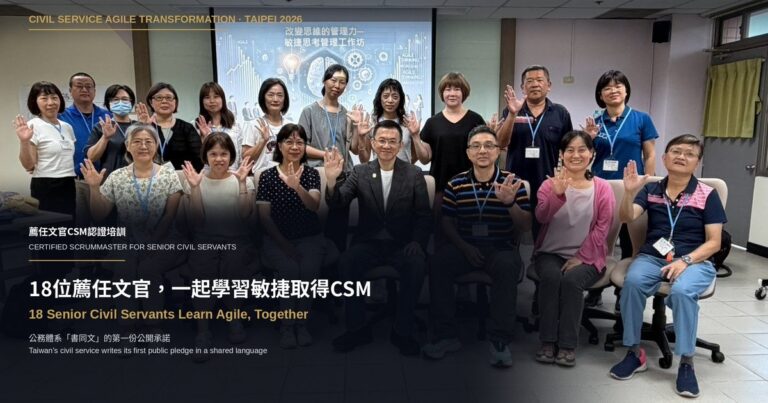
Year one, the target was 100 CEOs certified as CSM. We finished at 235. Year two, 100 CSPOs. Target met. Chunghwa Telecom ran four cohorts in a single month and put 111 senior executives through to completion; a multinational pharmaceutical company and a southern Taiwan construction group with over ten billion NTD in annual revenue have sat in the same room.
And the moment I see most often in those classrooms is this: sometime on the afternoon of day two, a vice president stops mid-sentence and says, so the thing that’s stuck is me. For those few seconds, the room goes completely quiet.
That moment is where those 3,000 votes actually came from.
One number I care about more than most: as of July 10, 2026, my teaching holds a rating of 4.99 out of 5 across 457 participant reviews. Out of 457 people, almost no one gave a different answer. I do not cite that figure to boast. I use it as my own test of whether I have earned the right to sit at that table.
That Hand Gesture in the Photos Is 3-3-3-5-5
Anyone who has been around the agile community for a while has probably noticed the hand gesture I make in photographs — the Vulcan salute from Star Trek.
It is not only a nod to pop culture. I rebuilt it into a memory device: one hand, and the entire skeleton of Scrum is sitting on it.
Three pillars, three accountabilities, three artifacts, five events, five values. 3-3-3-5-5.
Scrum is hard to learn not because it is complicated, but because it is so simple that you assume you have already memorized it. Then you try to use it and discover you cannot name the whole set. I want participants to be able to raise one hand in any meeting and recite Scrum end to end in five seconds.
A framework that cannot be delivered in five seconds never makes it into a CEO’s head. This gesture is the door I built for it.
Next time you see that hand in a photo, you will know what it is saying.
Influence Isn’t What You Get When You Take the Seat. It’s What You Get Back When You Let Go.
Most people assume influence arrives with the seat.
My experience is the reverse.
It was precisely because I let go of what the seat could give me — the salary, the title as a monetizable asset, the security of being re-appointed — that I got back the freedom to judge at that table.
If you are a CEO, this has a direct translation: how many people in your decision-making layer have judgments already bound to their own positions? They will not tell you, because they do not know it themselves. What you will see instead is meetings running longer, consensus getting thinner, and the real problem surfacing only in the hallway after everyone has left.
If you are a middle manager, that feeling of having raised something three times with no response is usually not a sign that your proposal was weak. It is a sign that on the way up, it hit a position that cannot admit it is bound.
That is not a communication problem. That is a decision-making environment where no one can speak freely anymore.

Closing: The Seat Expires. The Change Doesn’t.
My first objective in office is to send one Taiwanese case study to Scrum Alliance for global publication every quarter. The first comes from construction. The second from telecommunications. Neither from the tech sector — which is precisely the point I intend to prove.
Whether the board renews me after six months, I do not know.
But the seat expires. What you actually changed while sitting in it does not.
If you are waiting for a better moment before you move your decision-making layer, let me offer one reminder: your organization is not going backwards, but your market is moving forward. Put those two facts together and do the arithmetic yourself.
So where do you start? Honestly, not with another strategy offsite. Pick one day. Put your senior team in the same room, give them one shared language, and take the same problem apart again from the beginning — you will see very quickly which layer it is stuck on. This does not require luck. It can be designed.
Three thousand votes, one seat on the global board. This is not my win. This is Taiwan being seen.
For the next six months, I intend to use every bit of it.
附錄:媒體報導
In July 2026, this story was reported by the following media outlets:
- Taiwan Police Times 警政時報
- Yahoo News Taiwan
- yam News 蕃新聞
- PChome Online News
- OwlNews
- ATA News 亞太新聞網
- Watch Media 觀傳媒
- New Reporter 記者爆料網
- MetaNews 產經新聞
- Global News 全球新聞
- Perspective News 透視網
- Taiwan News 台灣新聞
- Economic Daily News 經濟日報
- Taoyuan Post 桃園報
- YouYi Net 游藝網
- Chinese Community Press United News 中華社區報刊聯合新聞網
- People Spectrum 人物光譜
Official announcement: Scrum Alliance — Meet the Board Directors: Roger Chou and Joe Falcao