PSM III is one of the most challenging agile coach certifications offered by Scrum.org, with only 1,251 people worldwide having passed it to date. PSPO III is even more difficult—only 557 individuals across the globe hold this certification. I am proud to be the 557th person in the world to achieve this top-level Product Owner credential.

These two certifications represent the peak of my knowledge and practice in Scrum. However, the journey was far from easy. When I was preparing for the CST certification, the reviewers pointed out that my understanding of Scrum was still insufficient. To address this feedback, I made the firm decision to challenge the PSM III.
In my first attempt, I failed. It was a painful lesson, but I did not lose heart. Instead, I tried again and successfully passed on my second attempt. As for the PSPO III, while the exam process went more smoothly, it did not mean it was easy. The real reason was that during my preparation for the CSPO materials, I had already delved deeply into the “PO Bible.” The experience of being rejected three times by the Scrum Alliance actually helped me internalize the tools and spirit of a Product Owner.

In addition, having long served as an outstanding Product Owner, I was able to approach the PSPO III exam with ease.
Dual certifications are not just an honor —they mark the beginning of a mission.
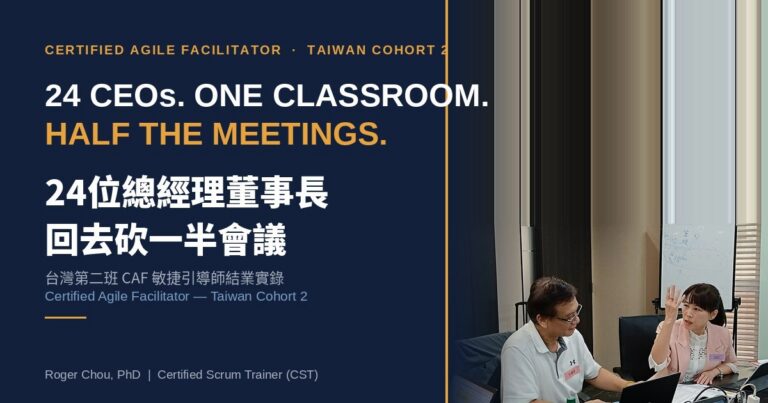
For me, these two certifications are not merely symbols of personal achievement—they represent the starting point of my responsibility to nurture 100 CEOs into becoming CSPOs. Beginning this year, I launched the CEO CSPO program, which has now progressed to its third cohort. With around 24 participants per cohort, we already have 74 certified CSPOs, more than 50 of whom are current CEOs. Looking ahead, I still have half of my mission to complete.
Holding the PSPO III certification serves as a powerful endorsement of my role as a CSPO instructor. Through my expertise, I aspire to help more organizations realize that the role of the Product Owner is far more critical than they might imagine.
A Product Owner is the CEO of the product, not merely a product manager.
Many people misunderstand the role of a Product Owner as merely managing the product backlog. In reality, a truly outstanding PO must possess both business acumen and decision-making capabilities. A PO is essentially the mini-CEO of a product, accountable for its success or failure.
Think of Steve Jobs, who invented the iPhone and changed the rules of the world; Sam Altman, who propelled OpenAI and ChatGPT, redefining the AI ecosystem; Elon Musk, who drove Tesla and SpaceX to break through the boundaries of innovation; and Jensen Huang of NVIDIA, who has led the wave of technological transformation with his unique foresight.
These individuals embody the essence of a Product Owner. Their influence stems from profound product intuition and sharp market insight. While they may be regarded as “genius POs,” I firmly believe that through learning and internalization, each of us also has the potential to become an exceptional Product Owner.
Deepen your expertise and embark on two new areas of learning.
I am not satisfied with merely holding the top certifications for SM and PO. The journey of learning Scrum has no endpoint, and I have identified two knowledge gaps that are worth addressing:
一、Learning Kanban to make Scrum more flexible.
The “Scrum Better with Kanban (SBK)” course offered by Scrum Alliance sparked my interest in the value of Kanban. I enrolled in the Kanban instructor certification program, a first-time collaboration between Kanban University and Scrum Alliance, with a tuition fee of $6,000.
My goal is not only to integrate Kanban techniques into organizations to enhance the flow of Scrum but also to become a professional instructor in the field of Kanban, addressing the gap in Kanban expertise among Scrum trainers.
二、Learning Agile facilitation techniques.
In Scrum, whether as an SM, PO, or developer, one needs the ability to facilitate various team meetings—making facilitation skills essential.
Facilitation is not merely about running meetings; it is a critical skill for creating psychological safety, encouraging participation, and guiding the team toward consensus. Agile instructors also need this capability. Therefore, I aim to obtain the Scrum Alliance Agile Facilitation instructor certification in the future, aspiring to become an expert in this field.
Building a Personal Learning Strategy with a Triangular Approach.
Why did I choose these two directions? Because I approach my learning with the following triangular strategy:
- Self-Awareness: Identify and address my own blind spots in Scrum—whether in process mastery, value realization, or team interaction. There is always room for improvement, and refining these areas presents a prime opportunity for growth.
- Market Observation: While Scrum continues to develop steadily, the market is witnessing a new trend—Kanban and facilitation act as complementary “wings” that enhance agile practices, taking team collaboration and process management to the next level.
- Customer Needs: Organizations want to successfully implement Scrum—not just “doing Scrum,” but “doing the right Scrum.” They expect teams to grasp core values and generate tangible outcomes, rather than merely following processes by rote.
The intersection of these three factors defines the direction of my ongoing learning journey.
Making an Action Statement:The First Curve of Scrum Is the Starting Point of Another.
I am addressing two main communities: the 20,000 PMP learners at Chang Hong, and the 5,000 members of Taiwan’s Agile community. I want to declare to them that even though I have reached the pinnacle of Scrum, I continue to learn humbly. In this VUCA and AI-driven era, agility is not just knowledge—it is an attitude toward the future.
As CSPO student Tong Hsin-Ruei shared on LinkedIn, he once felt anxious learning AI, always worried about falling behind. Later, he realized that by embracing the spirit of Scrum—Transparency, Inspection, Adaptation—and focusing on his core abilities, he could truly adapt to change.
No matter how fast AI progresses, it cannot replace someone who knows how to self-adjust and continually improve. This is the “core capability” we aim to cultivate—a capability that withstands the test of time, avoids obsolescence, and positions us as leaders riding the wave of change.
Appendix:Recommended Reading List for the PSPO III Exam
During my preparation for the PSPO III exam, I read numerous essential books. Among them, I particularly recommend eight classics, including my own “The Yellow Book” (2nd edition, available in Chinese on Books.com.tw and in English on Amazon). The Yellow Book offers key insights that can make a significant difference when preparing for the PSPO exam. I encourage everyone to take a look.
Recommended Reading List:
- 01_RomanPichler_Agile Product Management with Scrum
- 02_The Professional Product Owner_ Leveraging Scrum as a Competitive Advantage
- 03_Practical Product Management for Product Owners (The Professional Scrum Series)
- Scrum – A Pocket Guide – 3rd edition
- Scrum Mastery (Geoff Watts_ Agile Mastery Series)
- Evidence Based Management Guide 2024
- 成功的敏捷產品管理:打造暢銷產品的祕訣(最新增訂版)
- Successful Agile Product Development: Secrets to Building the Best Products

Conclusion: Becoming Your Own Navigator Amid the Waves
These two certifications are not just the pinnacle of my personal achievements—they are my response to the demands of this era. I firmly believe that in today’s volatile, uncertain, complex, and ambiguous (VUCA) world, accelerated by AI, every professional needs a guide to lead themselves and their teams forward. Scrum is precisely that guide.
This journey has reminded me that true professionalism is not measured by the number of certifications one holds, but by the willingness to keep learning, continuously improve, and transform knowledge into action that drives growth and change in others. This is also the motivation behind my commitment to CSPO instruction and my goal of nurturing “100 CEOs.”
If you aspire to be the person who leads products, teams, and organizations into the future, now is the time to embark on that journey.
Join Roger’s CSPO course and become the starting point of change.
Together, let’s leverage product thinking and agile action to create meaningful improvements for the world.