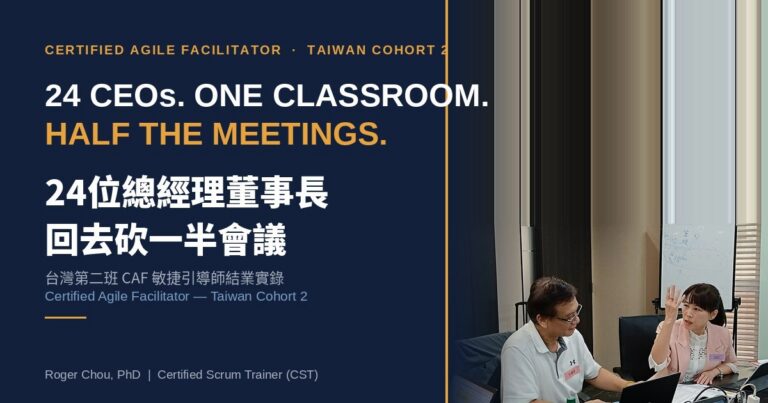
When the CEO Speaks, the Meeting Dies—That’s the Real Problem
On day one of CAF, I showed the class a single image: a giant elephant stuffed inside a meeting room, people on all sides gasping for air. There was no caption. I only asked one question: “What is this elephant in your company?”
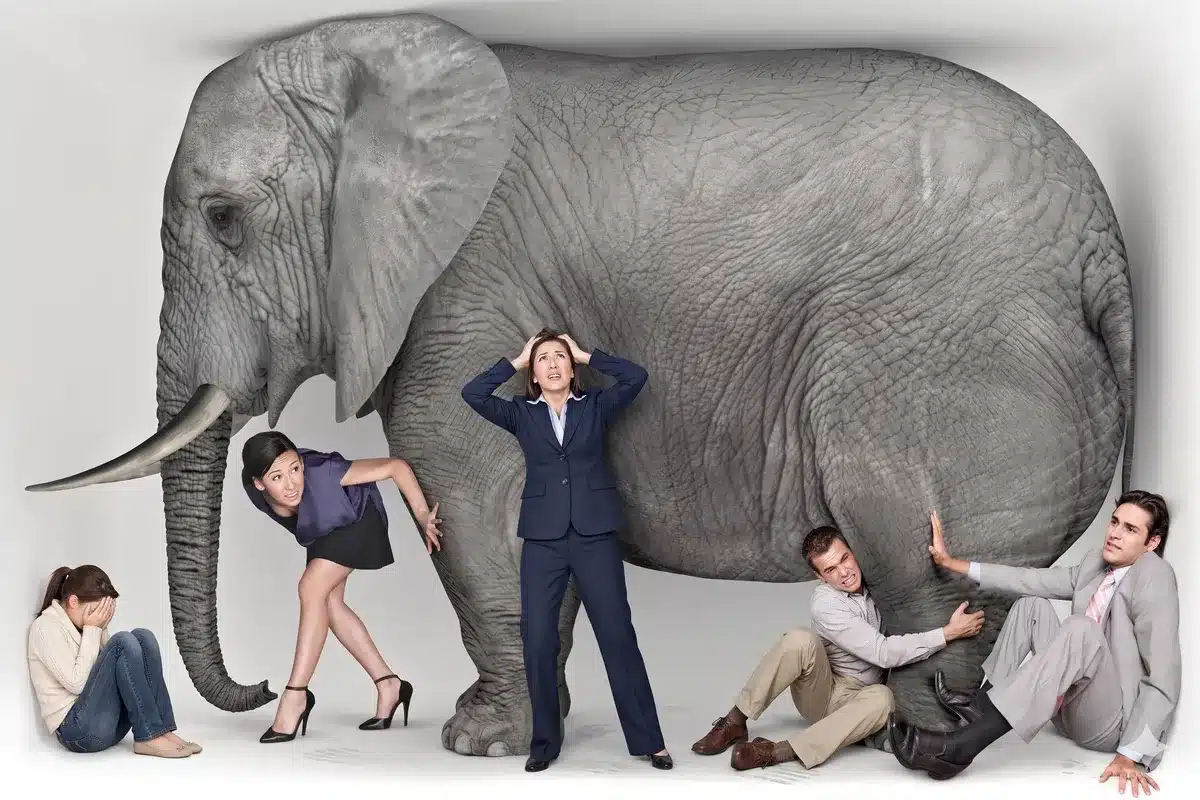
The room went silent for three seconds.
One of the executives texted that image to a friend that same night. The reply came back: “Isn’t this exactly what happens in our company every single day?”
Most CEOs don’t realize that they themselves are the elephant in the room. The moment you speak, the meeting collapses too quickly. The moment you make the call, people agree on the surface and dissent in private. The moment you take on every decision, the organization ends up with only one person carrying the weight.
And this elephant cannot be chased out with better meeting facilitation tricks.
If, at the end of every decision, you’re the only one still holding it up—that’s not leadership. That’s an organization that hasn’t yet learned how to decide.
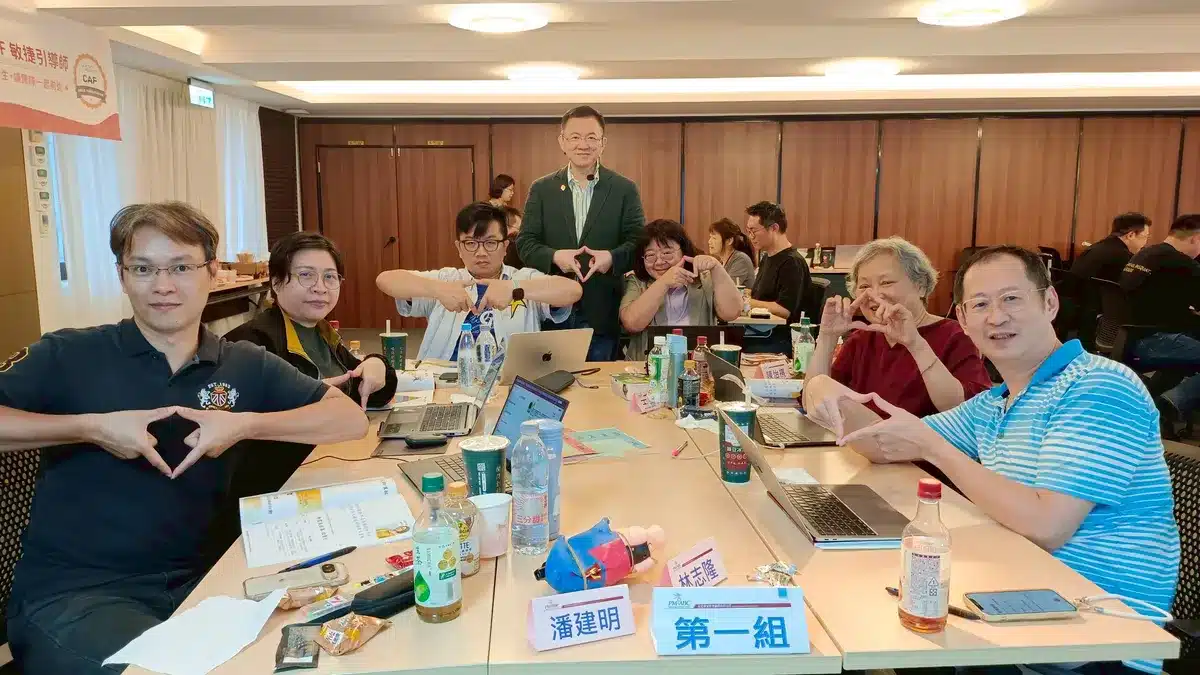
CAF Isn’t About Running Meetings—It’s About Designing Decisions
When senior executives first hear about CAF, the reaction is usually the same: “It’s just running meetings, right? Why does that need two full days?”
By the end of day two, they discover something different. CAF doesn’t train you to “make meetings run smoother.” It trains you to help a team produce shared understanding and real commitment inside complex, divided, power-imbalanced rooms.
A chairperson asks: “What’s the next agenda item?”
A facilitator asks: “What’s actually stuck right now?”
The chairperson keeps order and lets the agenda finish. The facilitator designs the process so truth surfaces, differences get understood, and commitments form.
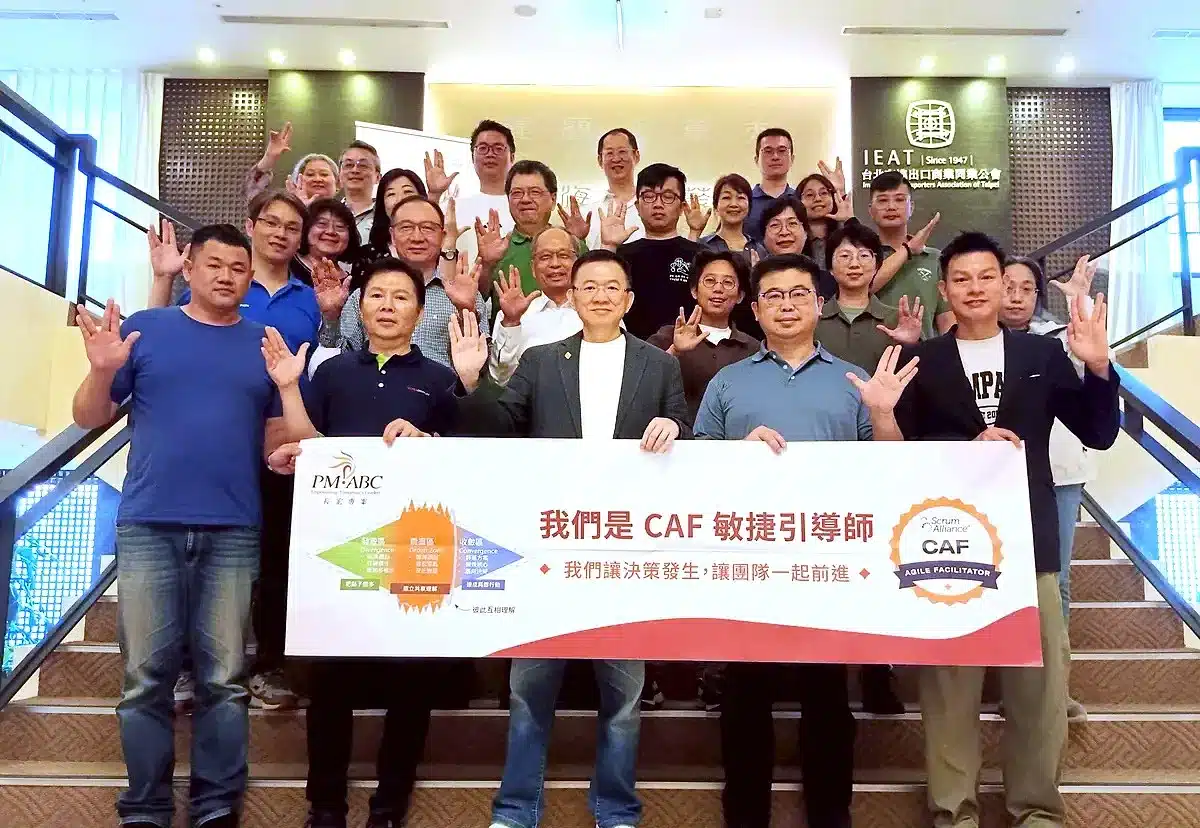
CAF is a rare certification worldwide.
Only 21 trainers in the world can teach this class. Taiwan has one. China has three, but the market hasn’t been able to open a single one.
Taiwan’s first class filled all 24 seats in one go, with 23 graduates—14 of whom were senior executives. That number is a signal across Asia: Taiwanese companies are starting to recognize that future leaders cannot just decide. They have to design how decisions get made.
The More Power a Senior Executive Has, the Less Truth They Hear
Most people assume the most important quality for a senior executive is judgment.
I’ve coached executives across very different industries, and the bottleneck almost always shows up in the same place: power brings efficiency, but it also silences truth.
The cost of a missed alignment at the top is not “we’ll re-run the meeting.” It’s an entire team executing in slightly wrong directions for the next quarter. By the time you notice the signal has been distorted, six months have already passed.
So the reason senior executives study CAF is not so they can chair every meeting themselves. It’s so they understand how to design a room where the organization can actually make high-quality decisions.
There are two practical ways to do this.
First, bring in a neutral facilitator—an HR manager, an internal agile coach, anyone who isn’t part of the decision power structure.
Second, wear both hats yourself, but switch cleanly. I demonstrate a small move in class: pick up a pen and announce, “I’m speaking as the CEO right now.” Put the pen down and you’re back to being the facilitator. The team instantly knows whether what they just heard was a directive or just a thought.
If you still need a vote, you don’t have to default to one-person-one-vote. You can weight it—everyone gets 1 vote, the senior executive gets 5—after you’ve heard every honest opinion. That’s not democracy theater. That’s letting honesty and authority each play their proper role.
From Understanding the Diamond Model to Guiding a Team Through the Groan Zone
On day one, I taught the diamond model: diverge, groan, converge.
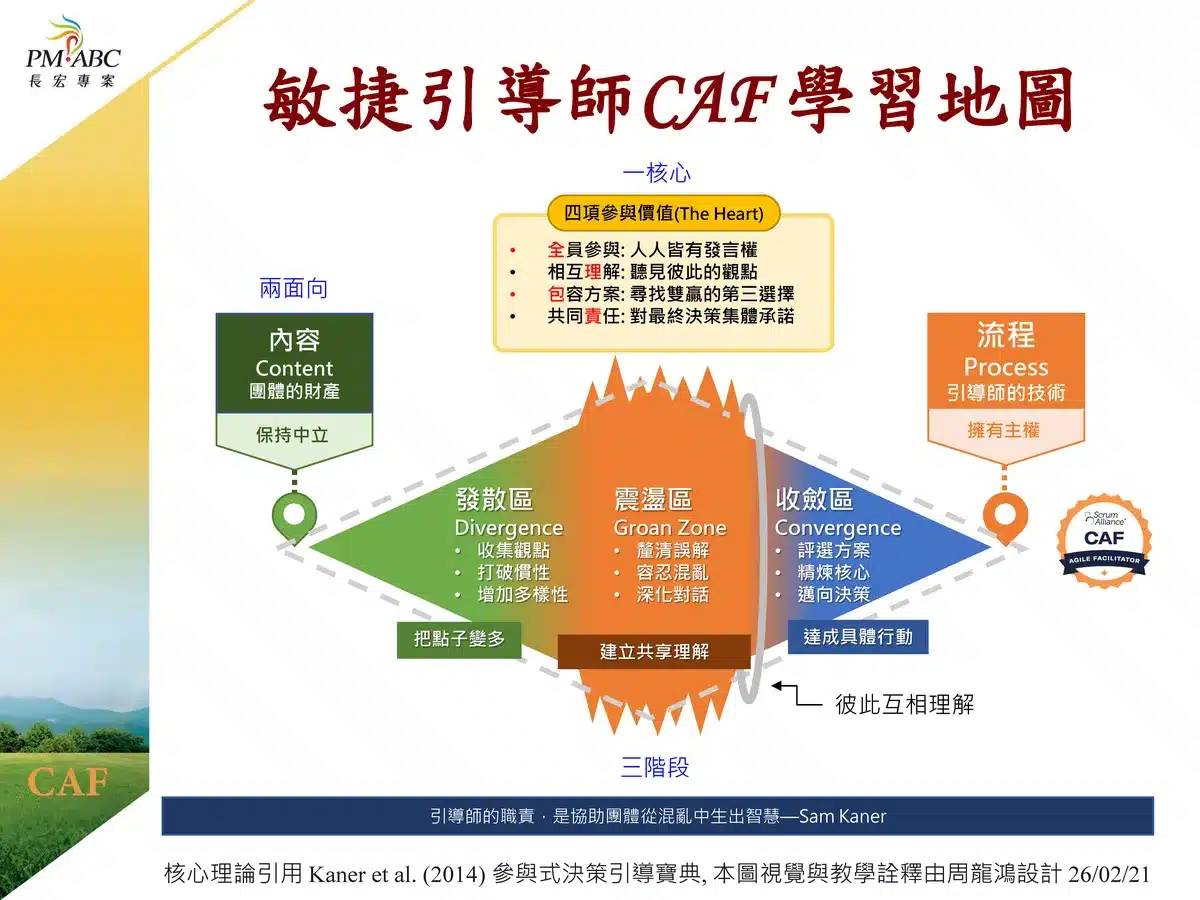
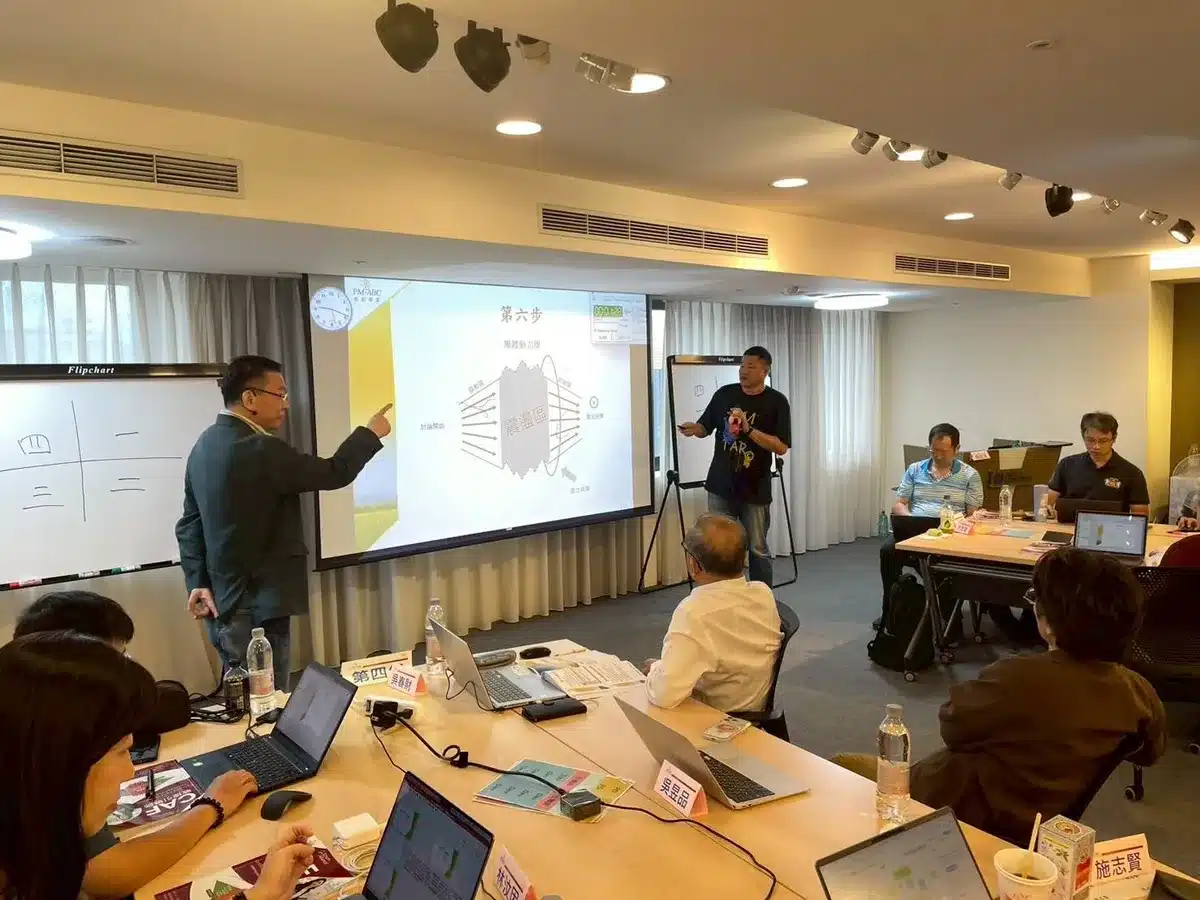
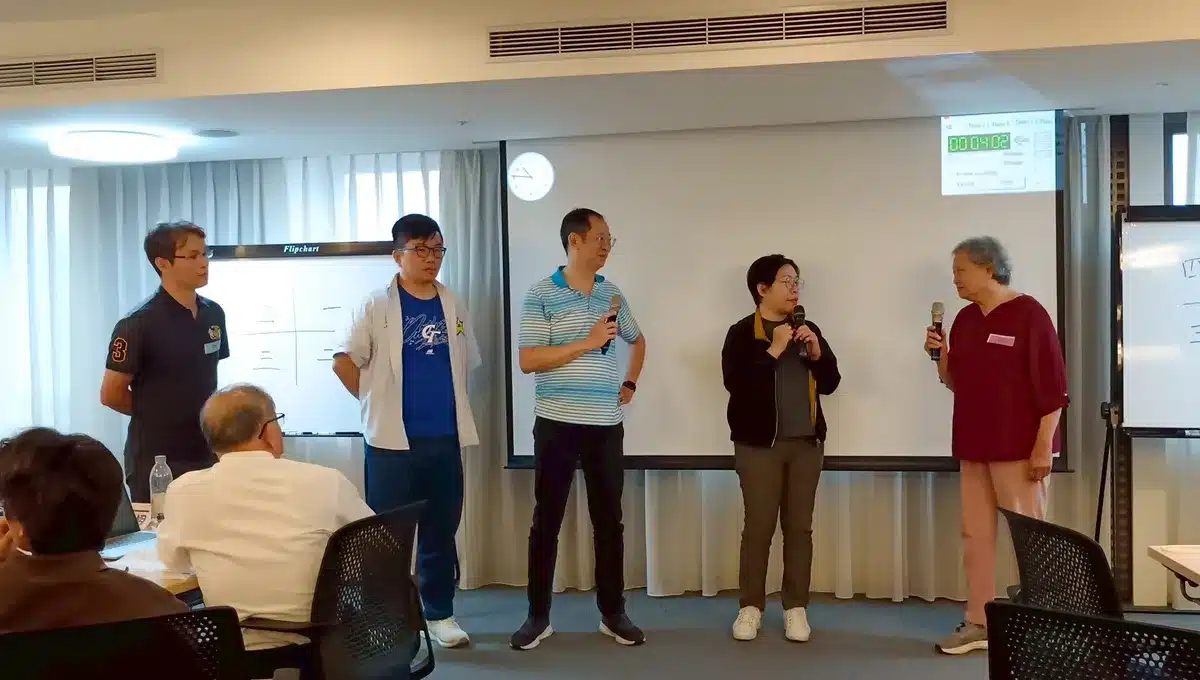
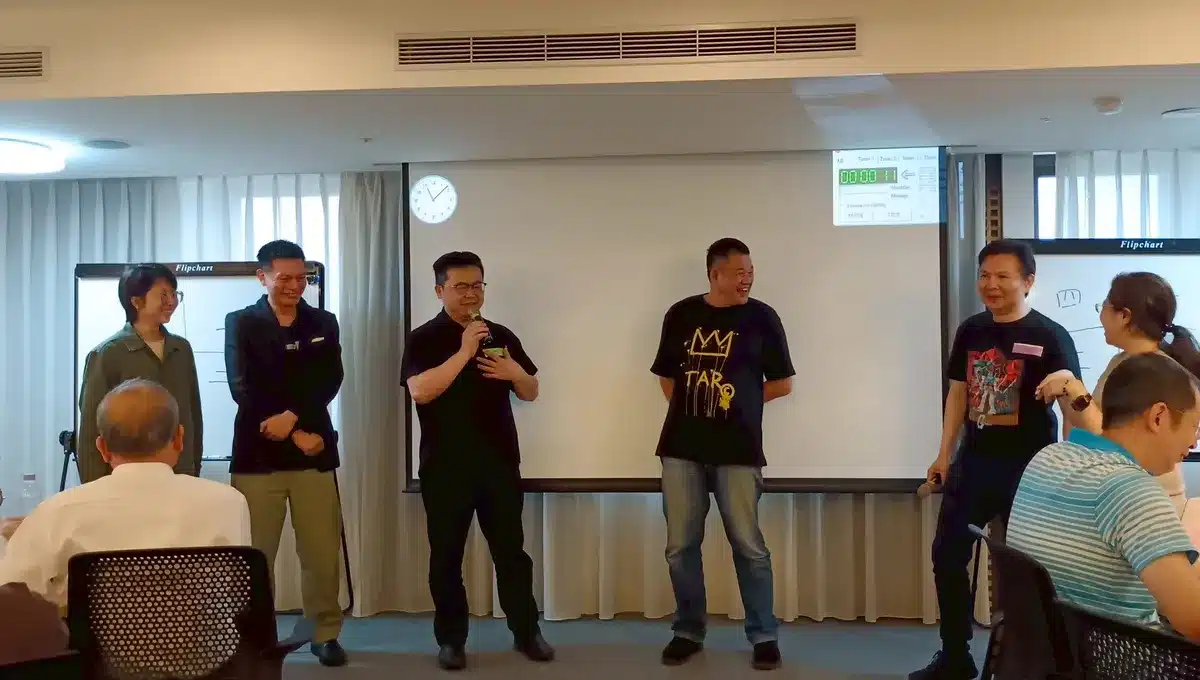
On day two, I made a deliberate design choice: I stopped teaching the model and asked students to take the stage and teach it themselves.
Because CAF isn’t about understanding the model. It’s about being able to help a team, mid-meeting, see what they’re actually going through.
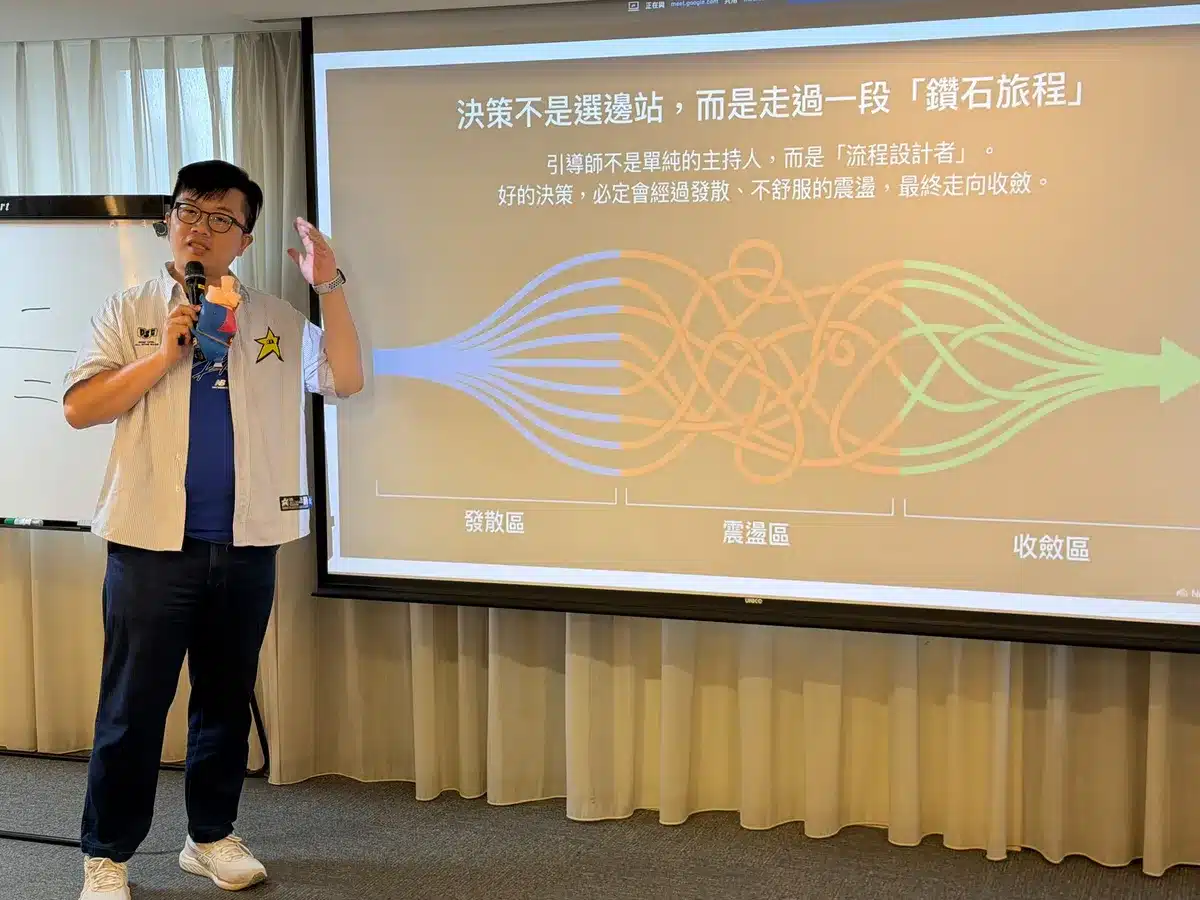
One student applied the diamond model to team conflict. Most people assume good discussion should move in a straight line—surface problems, decide, ship next steps. In reality, good decisions almost always pass through chaos, blockage, anxiety, and people talking past each other. That doesn’t mean the team is broken. It means the team has entered the groan zone. Push through the groan zone and the convergence is real. Skirt around it and the convergence is fake.
Another student used a more relatable example: a family deciding what to eat. Mom wants a proper sit-down meal. Grandma is afraid of the heat but wants to get out. The kid only wants McDonald’s. On the surface they’re choosing a restaurant. Underneath, three needs are not being heard. The value of facilitation isn’t to eliminate differences. It’s to make differences understood.
That’s the structural value of CAF inside an organization. It lets executives stop looking only at meeting outcomes and start seeing meeting structure.
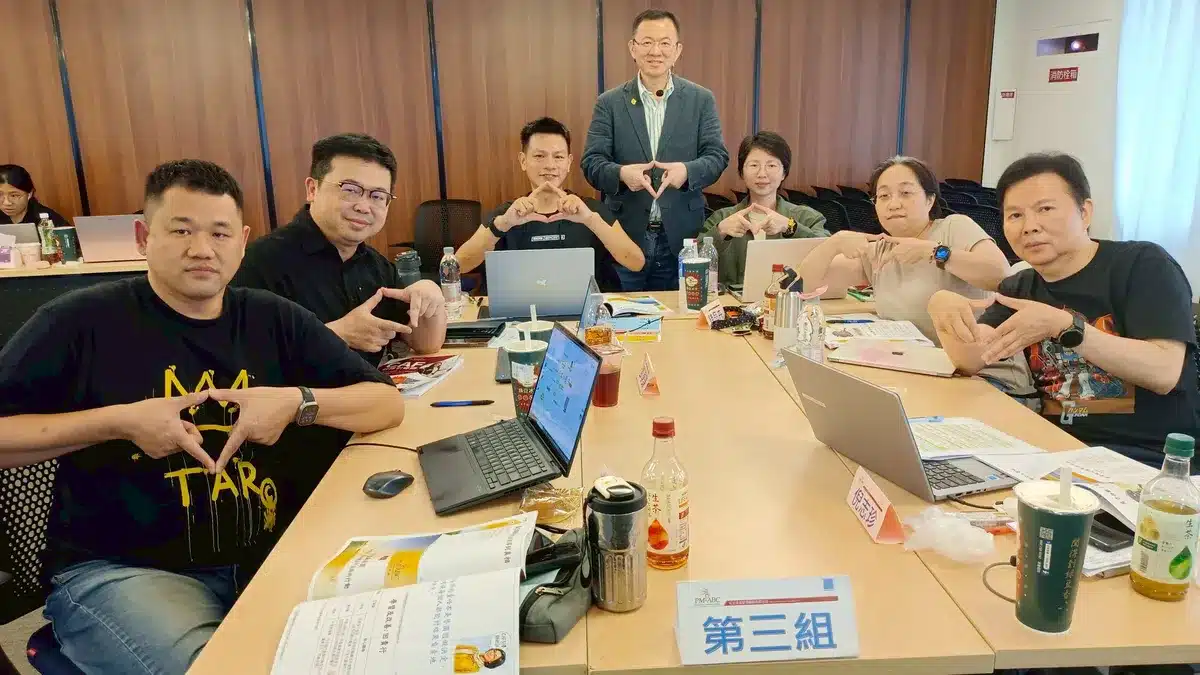
A Facilitator’s Presence: Like a Connoisseur Savoring a Michelin Meal
Of all the student reflections from this class, the one that moved me the most came from Master Wang Jin-Zhu, often called “the mother of coaching in Taiwan.” She said a facilitator’s presence is like a connoisseur savoring a Michelin meal—every sense wide open in the moment, every gesture, every silence, every turn felt with full attention.
I sat with that line for a long time.
A facilitator’s most important tool isn’t a sticky note, isn’t Miro, isn’t any one method. It’s the facilitator themselves. If you’re not grounded, the room won’t be grounded. If you rush to give the answer, the team will never grow its own.
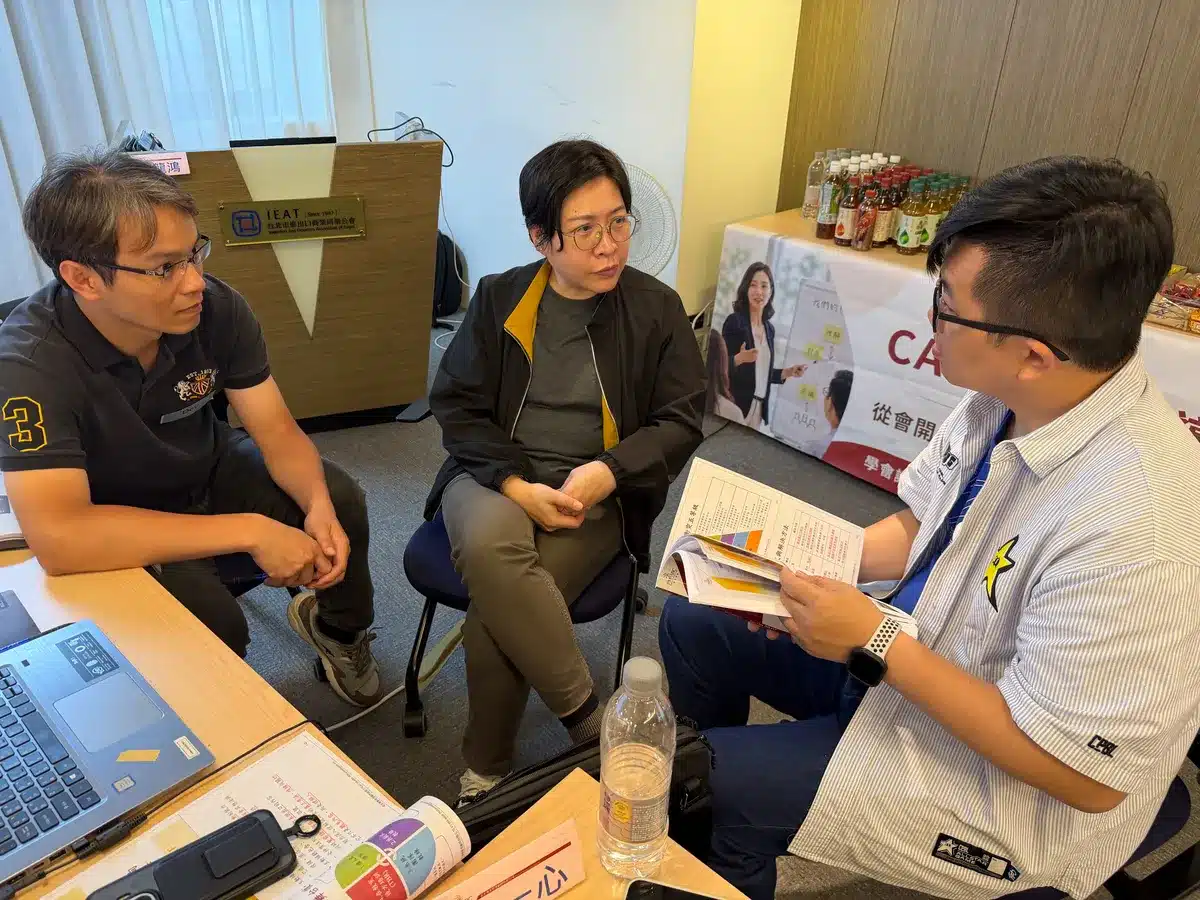
One student wrote that he used to be quick-tempered and linear in his thinking, and the two days made him look again at his own reactions, his own tone, the way he made others feel inside a team. CAF doesn’t just teach external technique. It’s also internal practice.
What’s Scarce in the AI Era Isn’t Answers—It’s the Ability to Help a Group Think Together
This class confirmed something I’ve been saying for a while: in the AI era, knowledge gets easier to access by the day, but agreement between humans becomes more precious by the day.
Companies are pouring budget into AI right now. But almost no one is also asking the parallel question—is your organization investing equally in the ability to keep people willing to speak the truth in the room?
AI can organize information, generate content, and propose options. AI cannot make a group of people willing to commit to one path. AI can amplify your capability, but only if you already have the foundation underneath—the ability to ask, to think, to listen, to guide.
One of our students works directly in AI. She said it best: repetitive work should go to AI, and the time we save should be the time we actually spend with people. In the room where alignment, mutual understanding, and shared solutions get built—AI can’t help.
The AI era isn’t short on answers. It’s short on people who can help a team see, understand, and commit to an answer together.
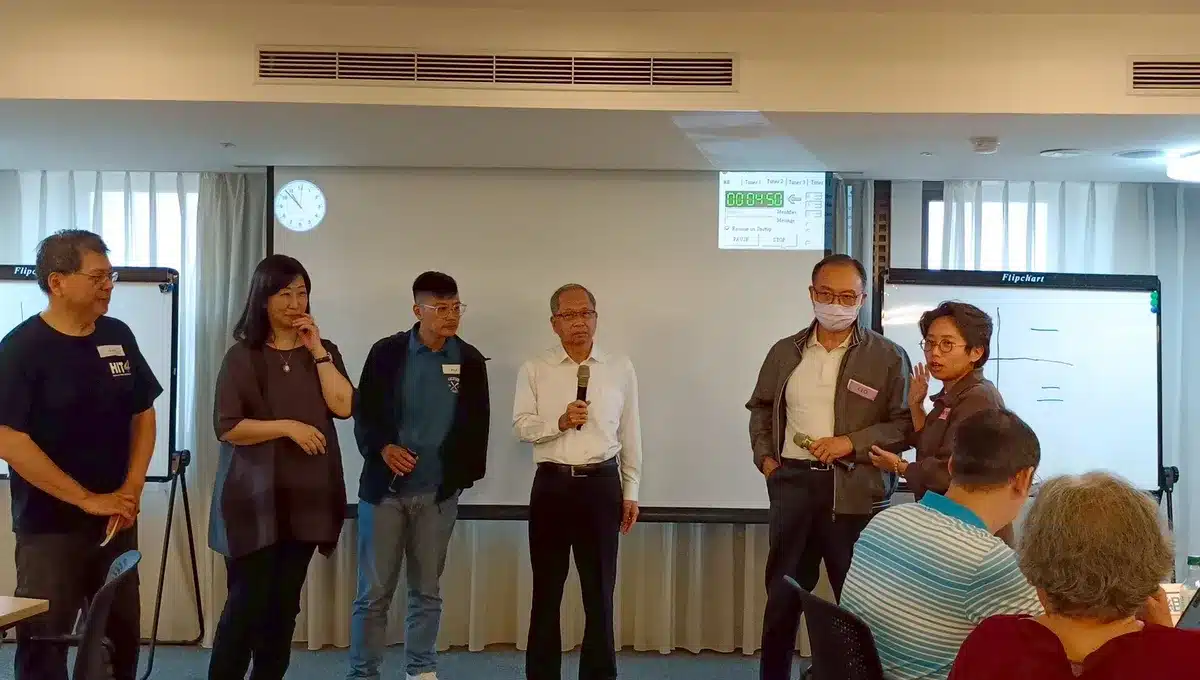
CSM, CSPO, CAF: The Three Languages of Modern Leadership
Over the past few years, I’ve run CSM and CSPO corporate cohorts in Taiwan, helping many senior executives rebuild their understanding of Scrum and agile.
CSM teaches executives how a team collaborates and delivers. It’s the language of team collaboration.
CSPO teaches executives how a product creates customer value and business outcomes. It’s the language of product decisions.
CAF completes the third piece: when people of different roles, different stakes, and different authority sit in the same room, how do you produce dialogue, consensus, and commitment? It’s the language of organizational conversation.
Together, these three aren’t just a learning path in agile. They’re a career upgrade path for any modern executive—or any ambitious individual contributor.
This is why our CAF class ended up with senior executives and ambitious team members studying side by side. If you’re not yet a manager, CAF may matter even more to you. Because without formal authority, you need influence even more. You need leadership to be willing to hear you, you need cross-functional partners willing to collaborate, you need teams to move from talking past each other to acting together.
On day two, one student applied the diamond model to her own career change and job interview—not just introducing herself, but stepping into the hiring manager’s perspective to think about how to make them want to sit down and talk about product delivery. Facilitation isn’t a skill you only need after you become a manager. The moment you want to be seen, trusted, or handed bigger responsibility—that’s when you already need it.
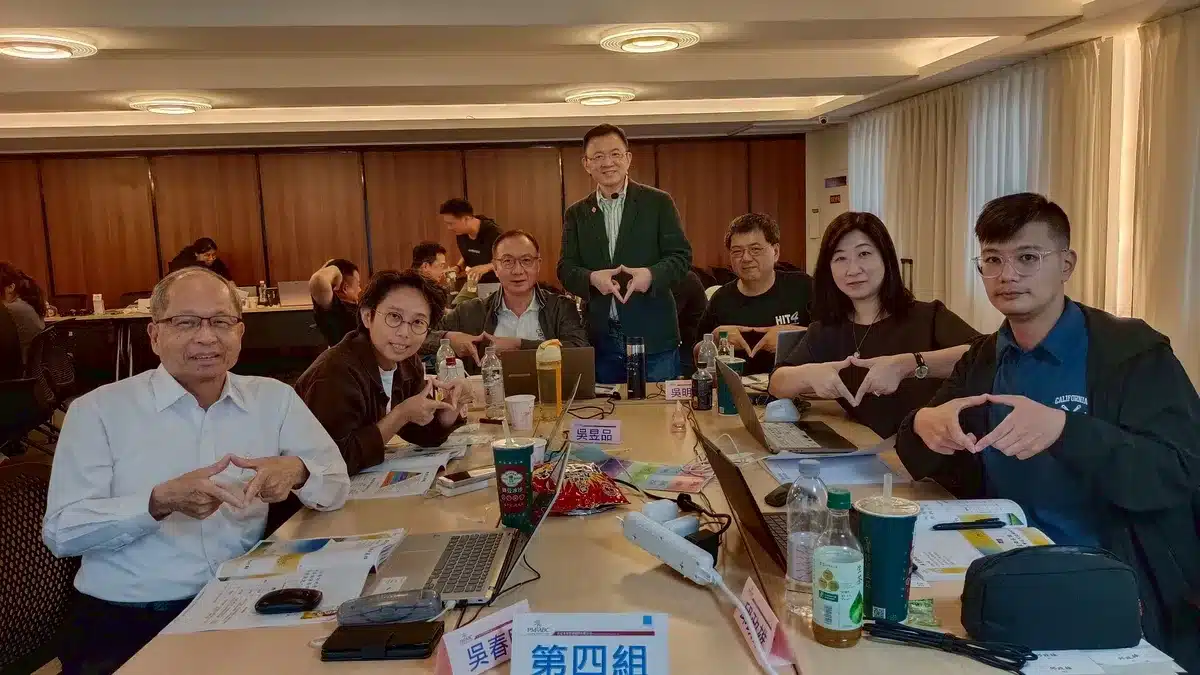
Two Days of CAF Cannot Be Allowed to Become an Expensive Tablecloth
On the last day of the class, I told the whole room something.
If two days of CAF leaves you fired up for one day, vaguely recalling it for three days, and doing nothing about it by the end of the week—then all it was, was an expensive tablecloth.
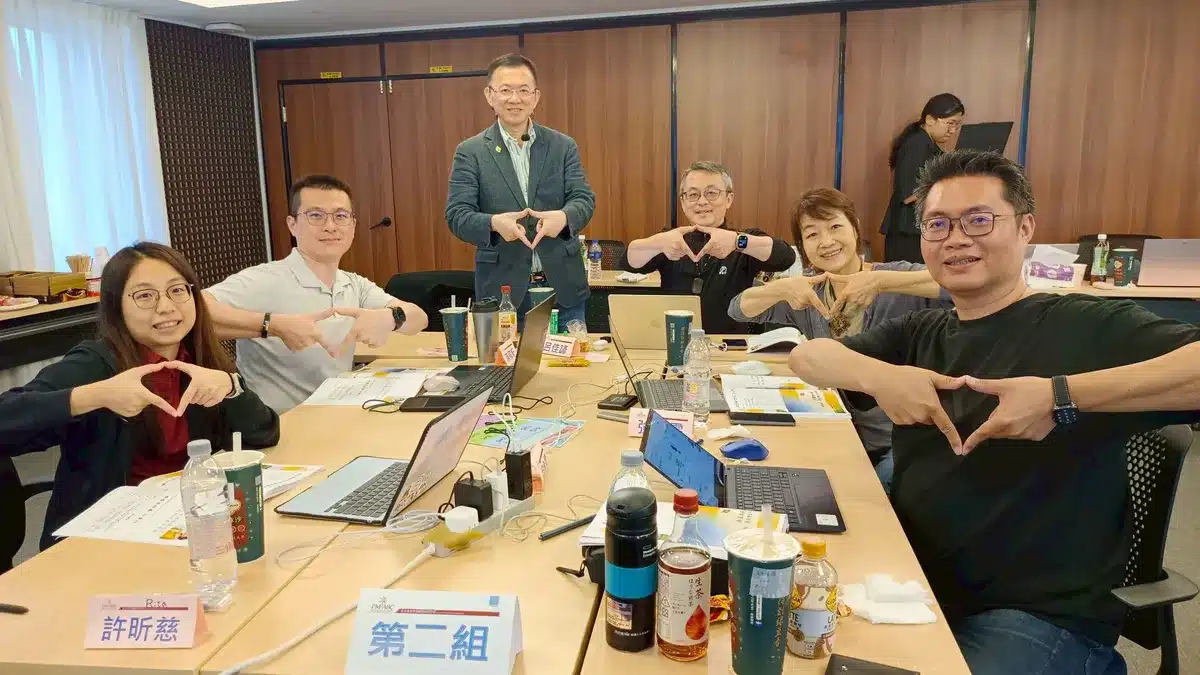
So we paired everyone up as Scrum Buddies and asked them to coach each other for ninety days. Every two weeks, they connect, share the facilitation they ran in the last two weeks, the places they got stuck, and what worked.
Why ninety days? Because ninety days is exactly the window for a capability to move from “external tool I learned” to “core capability I own.” Miss the window and CAF becomes a line on your résumé instead of a real change in how you lead.
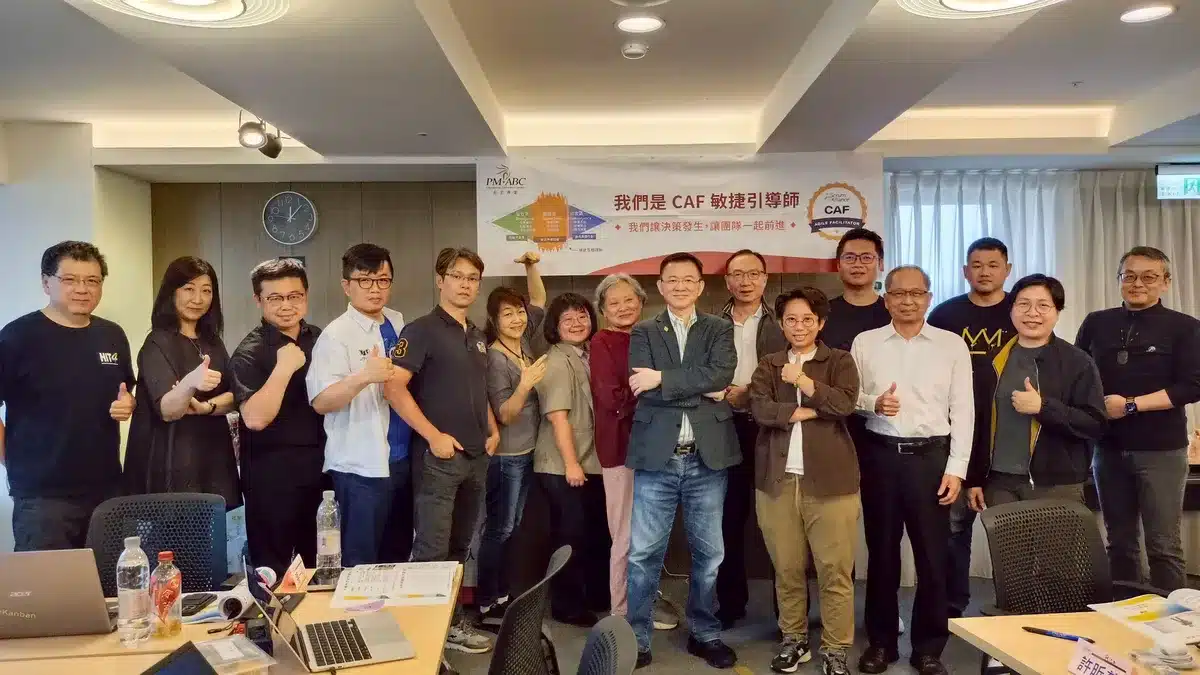
If you’re a CEO or CXO, the question is not “should I learn facilitation?” The question is—does your top team actually speak the same language right now? If not, every meeting you walk out of thinking “we have alignment” might just be collective signal loss.
If you’re a mid-level manager, the friction you keep feeling is usually the language above you not aligning. You probably need this capability more than you think, because you’re the one stuck between the layer above and the layer below.
If you’re not yet a manager, CAF matters most of all. What you’re building is not technique. It’s the foundation that gets you trusted with bigger responsibility over the next ten years.
A lot of CEOs tell me they’re waiting for a better moment to face their organizational decision structure. My observation is the opposite: waiting itself is one of the most expensive decisions an organization makes.
This is something that can be designed.
The organizations that survive the next decade won’t be the fastest at deciding. They’ll be the ones that can let real signal into the decision.
The leaders who go far won’t be the ones with the best answers. They’ll be the ones who can let answers grow from the team.
Taiwan’s first CAF class graduated. Fourteen senior executives put their answers down and re-learned what it means not to give the answer.
This is not just an event. It’s a quiet turning point for leadership in Taiwan.
Companion Mandarin article: 中文版本
You’re welcome to register for the next CAF: https://www.pm-abc.com.tw/Member/Registration_SCRUM
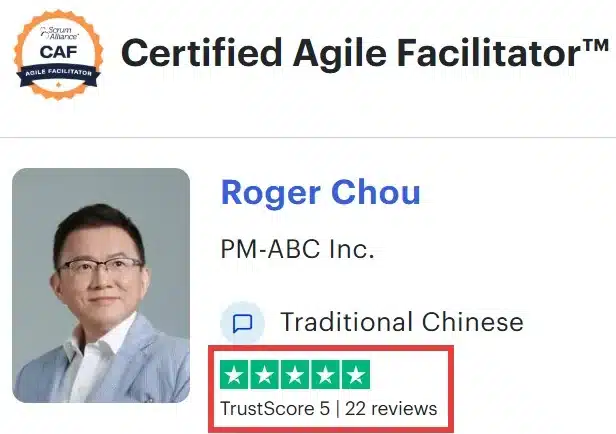
What the Students Themselves Said: 22 of 23 Gave a Five-Star Verdict (96%)
After completing the course, 22 of the 23 students went to the Scrum Alliance instructor evaluation page and gave a five-star rating—96% of the class. That’s the most honest verdict on what these two days actually left behind.
Appendix: Reflections from the First CAF Class (Categorized by Role)
A. Senior Executive Perspectives
Mr. Shih O. Hsien / Chairman, Hsieh-Tzu Magnetic Industrial Co., Ltd.
This class made me rethink what “facilitation” really comes down to at its core. When I first saw the course title, I didn’t expect to get this much out of it. But once I was actually in the room, I realized the class isn’t just about learning a method or a process—what matters more is the judgment and empathy that happens between people. A lot of the time, facilitation isn’t a technique. It’s about how you make someone resonate enough to actually engage in the discussion. Even though I work with agile in my day-to-day, and even though much of what we do already lines up with these ideas, I never knew the underlying framework. This class let me see the full architecture of facilitation again, and I picked up plenty of new perspectives along the way. The in-class interaction and exchange left a particularly deep impression on me. The ideas, the presentations, the way every student showed up—it was all excellent, and went well beyond what I had expected. Even with AI tools helping, in the end you still need your own thinking and your own judgment. That’s also a critical capability. For me, one of the biggest takeaways from this class is a re-understanding of the value of the “facilitator” role across different contexts. Whether you’re a coach, a consultant, a facilitator, or just collaborating with a team in everyday work, all of it applies. The class also reminded me that learning has no age limit. Even at different stages of life, you can still absorb new things and exchange with different generations. I’m grateful to Roger and to everyone in the class for creating this kind of learning atmosphere. I got so much out of it.
Mr. Wu O. Tsai / Vice President, Nani Book Co., Ltd.
Taking the CAF class reminded me, all over again, that learning is a lifelong thing. Our company is in the education industry, and we’ve always believed in the importance of continuous learning, so even at this stage of my career, I keep signing up for courses. I want to keep growing, and I want to lead the team by example. I love reading—I often share that I’ve read a lot of books, and many of those books I’ve read again and again, because every re-read gives me something new. But what I felt most strongly about CAF is that some things you simply cannot learn from a book. A book gives you knowledge, but actually being in the room, with the instructor’s facilitation and the back-and-forth and practice between classmates, the experience is completely different. What struck me most about this class is that every student brought genuinely valuable experience and perspective. In the exchange, you get sparked by people from very different backgrounds. You’re not just learning one method—you’re learning, through interaction, how to facilitate a team, ignite discussion, and build consensus. These are extremely practical capabilities when you’re leading work or leading a team. The happiest thing for me is that, even at this age, I can still keep my curiosity and energy for new things, and I can still grow alongside a group of people who want to learn. I’m grateful to Roger and to everyone in the class for creating this learning environment—turning the class from “learning” into a deeply rewarding exchange and experience.
Mr. Hu O. Yun / Senior Vice President, Hewlett Packard Enterprise Taiwan
Honestly, when I first heard about CAF, I was puzzled. After finishing some other classes, Roger had mentioned this course, but at the time I thought it was just about “meetings.” I genuinely couldn’t understand why an everyday thing like running a meeting needed a two-day course with a meaningful price tag. I really didn’t know what made this class special. But then I started seeing many seniors, community peers, and classmates signing up, and I began to sense its importance—and to recognize that Roger wouldn’t have introduced this course without a real reason. For me, rather than waiting until I get pushed forward, I’d rather take that first step myself. So I signed up. After actually completing the class, my biggest takeaway wasn’t “how to chair meetings.” It was a re-understanding of what facilitation is, and what it takes to become a real facilitator. The class made me realize that facilitation isn’t running activities by a script—it requires design, observation, and interaction so participants can genuinely engage and exchange. I also set myself a goal coming out of the class: in the next three months, I want to find a real arena and a partner, and put what I learned into practice. Whether the results turn out well or not, that itself is important learning. That’s what I think makes this class so valuable.
Ms. Chang O. Hsin / Executive Vice President, EY Financial Technology Co., Ltd.
I came across Chang Hong’s courses a long time ago, but it wasn’t until last year that I started showing up again—CSPO, CSM, and now CAF, one after another. The further along I’ve gone, the more I feel this: in today’s AI era, what really matters is no longer just knowledge. It’s how you use knowledge, how you ask, and how you communicate with people. I deeply agree with what came up in class: AI does amplify your capability, but only if you have the foundation. AI is like someone who has read many books; if you don’t know how to ask the right questions, you won’t get answers that have real value. So continuous study and continuous practice are, in a way, training in how to think and how to question, so you can get to better solutions. But even more important than that: no matter how good an answer AI gives you, you still have to come back to “human-to-human communication.” If you can’t express it well or build consensus, even the best content won’t actually create value. That’s why I find facilitation so important. It doesn’t just help us get information—it teaches us how to deliver our ideas effectively, so a team is willing to collaborate and move together. Across these classes, my biggest takeaway isn’t just the methods and tools. It’s a re-understanding of how important communication, facilitation, and collaboration really are. I’m grateful to Roger and to all the classmates for making the whole journey full of exchange and inspiration.
Mr. Teng O. Chien / CEO, Ruifeng Management Consulting Co., Ltd.
Honestly, I came to CAF because I want to change myself. I know my personality and my emotional reactions are pretty direct, and my thinking tends to be linear. Those traits inevitably affect how I interact with my colleagues. For some time now I’ve been observing and learning from seniors I admire—people with that warm, accepting, steady quality—and I’ve started wondering whether I could adjust myself through learning. I thought facilitation was going to be about running activities or chairing discussions. The two days made me realize it’s actually more like an inner practice. The class is full of reflective and self-aware moments that made me look again at my emotional reactions, my way of communicating, and how I make people feel inside a team. I know I’m not going to walk out of a class and become a completely different person. But at least I now know which direction I can adjust and practice toward. I also have huge respect for how the whole course is designed. Day two was genuinely exhausting, but the learning sequence was thoughtfully layered, and I kept picking up inspiration both from the instructor and from interaction with classmates. A lot of the content isn’t pure knowledge—it makes you reflect on yourself, and that’s incredibly valuable to me. After this class I’ve started thinking that I want to keep adjusting and growing toward becoming a facilitator. At the same time, I want to gradually develop more people in the company to participate, so that even if I’m not there in the future, someone else can pick up and carry things forward.
Mr. Wu O. Pin / General Manager, Elgin Inc.
In my past work, whenever I ran into a heated atmosphere, intense conflict of opinion, or a particularly complex discussion, I’d often feel powerless—I just didn’t know how to handle it effectively. But after this class, my mindset has shifted significantly. Situations I used to dread now make me actually look forward to them. Because the class let me see the value of facilitation in team communication and dialogue, and it helped me understand that many conflicts and complex situations aren’t really problems—they’re processes that can be facilitated, organized, and brought to light. So when I face those scenarios again in the future, I bring excitement, not just pressure. On top of that, when someone on the team needs a conversation, needs to be heard, or needs help organizing their thoughts, I’m now looking forward to having the chance to use what I learned and create better dialogue space. This class didn’t just teach me tools; it gave me a new understanding of how to lead dialogue and interaction. What I’m looking forward to most now is bringing what I learned at CAF back into the company and putting it into practice. Because I believe that once facilitation truly enters a team and a real workplace, a lot of communication and collaboration that used to be difficult will start producing different possibilities.
Mr. Lu O. Yen / CEO, Wise Data Cleansing Inc.
Taking the CAF class wasn’t just a learning experience—it was, for me, a moment of rethinking my life direction. Seeing how Roger has stayed committed to facilitation and talent development for decades made me deeply admire and, honestly, envy what he’s built. Finding your own mission and sticking with it for that long is not easy. It made me start re-examining what I really want to invest in and live out. I work in AI. Many people worry AI will replace human work, but I see it differently—repetitive things should go to AI. What really matters is whether humans can be more present with each other. And that’s exactly what moved me most about CAF. The class isn’t just about techniques or process. It’s about starting from the inside, understanding others, communicating, and leading a team to find consensus. Facilitation and one-on-one coaching are very different. When you’re facing a group, getting everyone to participate, feel fair, and ultimately move in the same direction is extremely difficult. It requires real tolerance, real listening, and the willingness to set aside your own agenda. For me, this journey is just beginning—but CAF showed me a critical direction. In the AI era, technology will solve a lot of problems and maybe even extend our lives, but what remains truly valuable is human connection and creating meaningful things together. I’m grateful for this learning experience, and I believe everyone here will have many more chances to carry the facilitator’s spirit forward, collaborate, and create more interesting and meaningful things together.
Ms. Ni O. Chen / Senior Manager, Darwin Precisions Corp.
This class was a rare experience for me. I’ve finished three master’s degrees and pursued continuing education for a long time, but for about twenty years now I’ve barely sat in a classroom. The main reason is that most older learning models were one-way knowledge transfer—instructor teaches, student listens—and over time you start to feel limited returns. But CAF made me feel a completely different kind of learning again. Especially now that we’re in the AI era, knowledge itself isn’t as hard to access as it used to be. What really matters is how to think, how to interact, and how to use facilitation to help a team produce better collaboration and consensus. That’s where the real value is. I’ve had management, governance, and cross-functional collaboration experience, and I’ve worked on enterprise leadership questions for a long time, so I had a certain expectation going into the class. But in this course, I felt that Roger didn’t just transmit method—he brought everyone into actual situational thinking, with real interaction and practice, so we could re-understand the importance of facilitation in a team. Another big gain was the exchange with classmates from very different backgrounds. Every person’s experience is different, and discussion sparks new viewpoints and ideas. For me, this wasn’t just a class—it was a high-quality learning exchange. Overall, CAF reignited my passion for learning and made me willing to come back into continuing study. If the chance comes up, I’d love to keep taking related courses.
B. Consultant / Coach / Instructor Perspectives
Master Wang O. Chu (75 years old) / Life Coach Director, Open Other Coaching (the “Mother of Coaching” in Taiwan referenced in this article)
I’m thrilled that this is my third certification with Changhong—CSM, CSPO, and now CAF. Thank you to Roger and Elly for the chance to be in this class, and to every classmate for the help and patience along the way. People are curious: I’m already 75, and a senior coach—why am I still chasing these certifications? Even my own son asks, “You don’t monetize these certificates anyway, why bother?” A very real and very practical view. But what I want to say isn’t the cliché “learn till you’re old.” What I want to say is this: enjoying learning is one of the most beautiful states in life. I watch myself keep learning, stacking up professional knowledge and visibility along the way. And a coach needs many tools and methods to apply flexibly—only then can you choose the best way for the right person at the right time, and actually help them.
What moved me most, though, is Roger’s vision—every year he donates what he’s learned, for free, to 100 CEOs and senior executives, to spread agile-related courses. This is a company with a vision, and it commands respect. Just imagining the logistics of running that many free sessions, while continuously improving, while staying smiling and sincere, year after year—this kind of life-work is not something an ordinary person can do. And every time, you see how carefully he prepares the materials, distilling the essence of many books and turning them into mnemonics so we can remember them easily and understand them clearly. You can see the instructor’s heart in it.
Elly’s attentive service brings every detail to perfection. This couple’s dedication and warmth are truly something to hold up as a role model. All I can say is: it’s not hard to imagine why Changhong has so many loyal fans—it’s well earned.
And on the value of CAF itself: it lies in helping meetings reach real consensus. Hearing every member’s voice, letting conflict resolve into shared agreement, so decisions can actually land. That’s why a facilitator’s craft has to be steady, patient, and stand in the background—accompanying and supporting every member. That’s the real craft. It’s how you bring the heart and the techniques of coaching into the team.
That’s my reflection. Thank you, Roger, for joining theory and case together and unblocking my “two energy channels.” Thank you.
Mr. Chiang O. Lin / Organizational & Talent Development Consultant, Executive Coach, Berhan International Design Co., Ltd.
I originally signed on as a course volunteer, which gave me an early look at the materials and a chance to offer some suggestions. I thought I had a pretty good grasp of the content, and figured tweaking the text wouldn’t be too hard. But once I was actually in the classroom, I realized the experience went far beyond what I had imagined. Text and slides are flat. The actual classroom interaction is three-dimensional, even multi-dimensional. In the class, what I felt wasn’t just the method and the knowledge—it was the exchange between people, the energy in the room, and so many connections that are hard to describe in words but very real. For me, this class is like a garden: there’s what you can clearly see, and there’s also a lot of invisible, deep impact happening at the same time. Roger constantly invited us to offer ideas and adjustments, which made me realize that what’s truly remarkable isn’t the curriculum itself—it’s the learning process every participant co-creates. This experience makes me want to keep sharing the value and gains I felt from this class outward, like the bird songs, flowers, and butterflies in a garden, bringing positive influence to more places. I also look forward to meeting these companions again on the agile road.
Mr. Pan O. Ming / Co-founder, TPD Institute
This class was an extremely immersive learning experience for me. I’ve always preferred in-person classes, because the biggest gain on top of the content itself is exchanging with classmates from very different backgrounds and generations, picking up new inspiration from their perspectives. Every time I learn alongside seniors, I see more angles of thinking. This time, because I was a member of the QA team, I did some prep work before the class started, so once I was in the room I could focus more on feeling the whole rhythm and process. The concept of “flow” mentioned in class hit me especially hard. I’d read about it before but never fully understood it; through the interaction, workshops, and observation in this class, I finally started to truly grasp what it feels like to be immersed in a state, while simultaneously being able to step out and observe the overall process. One thing I really love about this class is that it doesn’t just teach theory—you can see so much detail in how groups interact, discuss, and facilitate. I even found myself paying extra attention to how Roger himself manages pace, controls time, and shifts the atmosphere. For someone like me who’s also working as a corporate instructor, that’s incredibly valuable learning. The class also made me re-think the relationship between AI and human capability. Many people say AI amplifies what a person can do, but I believe the prerequisite is that you have a solid foundation underneath. CAF rebuilt many foundational concepts for me—like the rhythm of divergence and convergence in the diamond model, and how to design an effective workshop. With these foundations, layering AI tools on top is what truly amplifies your capability. Overall, this class wasn’t just learning—it was a real upgrade of my thinking and capability framework. The gain was significant.
Mr. Wu O. Chang / Committee Member, SEMI Taiwan
For the past few years I’ve kept up the practice of agile and facilitation, and I’ve gradually felt my own thinking shift. When I signed up for classes, I usually expected to gain method, tools, and concepts. But over time I’ve realized the biggest gain isn’t the knowledge itself—it’s the human-to-human connection built during the learning process. CAF gave me that feeling all over again. Beyond learning facilitation techniques, what mattered more was being among a group of people who are willing to exchange and willing to support each other while growing. Everyone arrived with different backgrounds and experience, and through interaction and sharing, a very special kind of mutual support gradually formed. For me this isn’t just a class—it’s more like a community and a partnership that can sustain each other forward over the long run. I’m looking forward to extending this learning into future activities and practice—for example, an upcoming AI-related workshop. I believe the facilitation and exchange capability I’ve built will be a critical foundation for that work. This class made me feel that facilitation isn’t just technique. It’s a force that can build trust, unite a team, and accompany each other in growth. I’m thankful to Roger and to all my classmates—because of your exchange and companionship, this whole experience wasn’t just absorbing knowledge; it gave me a real sense of safety knowing we can keep moving forward and growing together.
Ina / Senior Instructor, Chang Hong Project Management Consulting
After completing the Certified Agile Facilitator (CAF) training, my biggest takeaway is this: facilitation isn’t about running meetings smoothly, and it isn’t about getting people to a conclusion faster. It’s about accompanying a team through complexity, division, and uncertainty, and slowly producing shared understanding, shared choice, and ultimately a commitment people are genuinely willing to carry.
I used to think of facilitation as “making meetings more efficient.” This class made me see it differently. Facilitation is more like building a path that lets a team walk through chaos together. Not silencing different voices, not rushing people toward an answer, but allowing the views that need to surface to surface, and letting people sit with the differences that genuinely need to be sat with.
The idea that struck me most was “neutral on content, sovereign over process.” The facilitator isn’t the answer-provider, isn’t the position-judge—she’s the guardian of the process. When a team starts arguing, falls silent, or jumps too quickly to “OK, let’s go with that,” the facilitator’s job isn’t to leap in and decide who’s right or wrong, but to hold the field steady, helping everyone say what they mean and surface their concerns fully. That reminded me—good facilitation doesn’t eliminate chaos; it helps a team see chaos clearly, and then walk through it together.
The diamond model also gave me a new understanding of what “stuck” really means in meetings. Effective decisions typically don’t move in a straight line—they go through divergence, groan, and then slowly converge. In the past, when a meeting got messy, I’d want to pull it back to the topic and push toward a conclusion. Now I understand: the groan zone isn’t necessarily bad—it might be exactly the moment the team begins to integrate differences and form real consensus. The facilitator’s job is to help the team organize views, clarify differences, and push forward at the right moment.
Another theme that hit home is: “Psychological safety isn’t everyone being polite—it’s people being able to speak the truth responsibly.” Especially in power-imbalanced environments, subordinates don’t lack ideas—they don’t know whether they can speak, or how to speak without being misread. That’s where the facilitator’s design and process become critical. By first receiving leadership intent, then pivoting toward shared goals, and using low-threat discussion designs, real risks and dissenting views can surface more safely—avoiding meetings where everyone seems to agree on the surface but no one actually commits.
I also learned that a good meeting can’t rely on improvisation alone—it needs complete design before, during, and after. Before the meeting, use “Set-Authority-Path-Agreement-Field”: clarify the result the meeting needs to produce, sort out decision and execution authority, design the path to reach the goal, set participation agreements, and confirm the space and tools are ready. During the meeting, use “Set-Display-Polish-Gather-Close” to control discussion rhythm, leading the team from setting direction, displaying views, polishing consensus, gathering conclusions, to closing with commitment. After the meeting, use “Reflect-Responsibility-Action” to translate what was learned into responsibility and concrete action. This made me realize facilitation isn’t a gift—it’s a system that can be designed, practiced, and replicated within an organization.
Finally, I’m deeply grateful to Roger for bringing the Certified Agile Facilitator (CAF) program in, and honored to be part of the very first cohort. For me, CAF isn’t just learning a set of techniques—it’s an upgrade in how to lead. It reminds me that the truly influential leader isn’t the one who uses authority to push their answer onto the team. It’s the one who creates a field where people are willing to participate, able to understand, brave enough to speak, willing to commit together, and willing to keep acting.
#Facilitation isn’t bringing people to my answer. It’s helping a team walk toward an answer we’re all willing to carry.
C. Individual Contributor / Engineer / Career Transition Perspectives
【Taiwan’s First CAF】Mr. Lin O. Lung / Engineer, Chunghwa Telecom
These past few years, because of a career transition, I’ve poured my energy into learning. I’ve earned more than 100 professional certifications across cloud, big data, project management, and agile. On top of becoming the second person in Taiwan to complete the full PMI certification chain—and currently the person holding the most PMI certifications in Taiwan—I’m especially happy that yesterday I became Taiwan’s first CAF (Certified Agile Facilitator).
Looking back, my deepest realization is this: the truly difficult part is often not the methods themselves. It’s that when you return to your organization, you find you’re the only one who understands, the only one who believes, the only one who wants to push for change. That loneliness, honestly, is more challenging than the learning itself.
When I run into communication walls, resistance, or even an organization that isn’t ready for change yet, I slowly remind myself to put my focus back on learning. Keep studying. Keep developing. Keep building capability. Because every investment is never wasted. The nutrients that seem to have no use today often become, at some critical moment in the future, the force that drives change.
Five years ago, I recognized that agile would be a major global trend. Even when my managers at the time didn’t support it, I chose to invest in learning on my own dime. I stumbled along the way, even doubted myself, but I didn’t stop moving forward. Recently a line from Roger’s exchange with our president struck me especially deeply: “In this era of dramatic change, what matters most is enabling every business unit to become a self-propelled artillery.”
What’s exciting is that the company has started investing more resources, and senior executives have begun truly engaging with agile and product thinking. Over 100 senior executives are now signed up for CSPO training, and Chunghwa Telecom is on track to become the company with the most CSPO talent in the world. The me from five years ago could hardly have imagined a change like this.
And the biggest value CAF brought me, beyond more tools, is a re-understanding of “how to truly influence a group of people.”
What really matters isn’t rushing to give an answer. It’s whether you can create a safe space where different views are willing to surface, where the truth can be heard, where the team has a chance to form real consensus. That’s the core the class kept coming back to: don’t make the decision first—first build shared understanding, then make the decision together.
Going forward, I’m looking forward to bringing what I’ve learned back into the company and sharing it with more colleagues. Because once more people in an organization understand, the difference in how things move forward is enormous. CAF, for me, isn’t just another certificate, and it isn’t just another class. It’s more like a reminder: real influence isn’t about how fast you run alone. It’s about whether you can walk alongside more people, growing and changing together.
Ms. Hsu O. Tzu / Software Engineer, Taiwan Semiconductor Manufacturing Company (TSMC)
One of the biggest takeaways for me from this class is a re-understanding of how genuinely professional a capability “facilitation” is. In my past work—especially at our fast-paced company—the team has always needed someone to play the facilitator role, but I used to think it was just a personal trait, or being good at livening up the room or running meetings, without realizing there’s a complete methodology and architecture behind it. After the class, I realized many of the things I’d been doing in daily work actually have theoretical roots. For example, we use WBS all the time, and almost every meeting ends with confirming “who’s responsible, by when?” I just did it out of habit, never thinking of it as a systematic method. When I opened the course materials and saw so many familiar concepts laid out completely, I was honestly amazed. Even more importantly, the techniques and tools in the class aren’t just theory—they can actually be applied in daily development and team collaboration. Whether it’s how to split work, how to keep discussion focused, or how to make team collaboration smoother, I found it all extremely practical. Especially for development teams, collaboration efficiency and communication quality often affect results more than raw technical skill. This class also gave me a lot of methods I want to actually try. I’m looking forward to applying these techniques in my own teams and projects, and seeing whether they can make meeting flow smoother and execution faster. I believe these gains will make a significant difference on the ground at work.
Ms. Chien O. Hui / Senior Engineer AI PM, WSP USA
Before joining CAF, when I was studying in the U.S., I’d already encountered parts of the facilitation concept. The way professors led classroom interaction back then was, to me, a form of facilitation. Later, as a manager, I also used facilitation techniques to help my team communicate or to keep meeting discussions moving smoothly. But what CAF gave me is more than an extension of existing experience—it’s a deeper, more complete understanding. I encountered many methods, tools, and the latest facilitation techniques I’d never thought about before, and I re-recognized that facilitation isn’t just running activities or chairing meetings—what matters more is the facilitator’s awareness of themselves. This class made me deeply feel that a facilitator first needs to understand their own current state, to be aware of their emotions, reactions, and influence, while also being able to sharply observe the atmosphere of the room and the state of participants. Only when you can do all of that do you have a real chance to genuinely hold the team’s needs, rather than unintentionally interfering with others. For me, that’s one of the most important things this class gave me. Beyond that, the two days of exchange with classmates from different backgrounds gave me a lot. By sharing thoughts and experience, I started to understand how different roles and leaders think about things, and got clearer about where I could start if I want to push for things in the future. The exchanges and conversations with seniors in the class also gave me more inspiration and imagination about my career and direction ahead. For me, CAF isn’t just learning facilitation techniques—it’s more like a critical opportunity to reorganize my direction and vision.
Mr. Chen O. Chi / Manager, Cluster Tech
I’m really happy I completed the CAF class and got the CAF certification. Even though this was the first cohort, you can genuinely feel the care Roger put into the content, the flow design, and the hands-on practice. The whole class isn’t just “understand it”—through lots of exercises, you actually feel the power of facilitation.
I’ve taken Roger’s CSPO class before, and I find CSPO and CAF very complementary. CSPO leans more toward product vision and PO thinking, while CAF is more like “the technique of getting a team to discuss effectively and form real consensus.”
The deep realization I had this time is: a lot of teams aren’t short on ability, and aren’t short on ideas. They’re short on a good process that lets the voices that really matter actually be heard.
Many of the most important conversations stay in the hallway or in private chats. But through facilitation, you can bring those under-the-table voices back to the meeting table, let people express different views in a safe space, generate sparks through the groan zone, and slowly polish each other into a consensus like a diamond.
In the class I also kept thinking about the difference between “coaching” and “facilitation.” My own understanding is this: coaching isn’t necessarily solving a problem for a person or a team directly—through asking questions and accompaniment, it helps the other person change how they see a problem, find the blind spot that’s stuck them, and solve their own problem with more wisdom.
Facilitation is more like leading a group, through process and interaction design, to face a problem together, discuss the problem, and ultimately form consensus and action.
Both refuse to rush to an answer—they’re about creating a process where the answer can be seen.
I’m also coming to understand more and more why facilitation can influence more people. The scenarios it applies to are genuinely broad—meetings, cross-functional collaboration, project discussions, team building, everyday communication—all extremely practical.
Especially in a company like ours, with relatively high turnover where the team often cycles back to the Forming stage, I’m looking forward to truly applying what I learned this time to improve meeting quality and team collaboration outcomes—so people aren’t just “ending meetings,” but actually walking forward together.
Thank you, Roger, and thank you to everyone I learned and went through the groan zone with this time.
Ms. Chen O. Ling / Registered Nurse, Specialty Home Health (Career Transition)
I originally just wanted to prepare a bit for my own career transition—I had no idea taking the CAF class would bring me gains and inspiration so far beyond what I’d expected. Especially getting to learn alongside many senior executives and outstanding classmates from different fields, this was a first-time experience for me, and it gave me a powerful sense of growth momentum. I’ve spent my career in healthcare. In recent years I’ve grown a strong interest in technology and advanced medical fields, and I want to work in high-end medical and tech-related areas in the future. So I started investing in learning around business thinking and personal growth, taking various classes to open new directions for myself. But even as I prepared resumes and planned the transition, I always felt there was one critical capability still missing. It wasn’t until I came to CAF that I really found new inspiration and direction. This class isn’t just about technique—through extensive interaction and practice, it helped me see again how I can communicate with people, facilitate teams, and build consensus. Especially after actual exercises, my classmates gave me sincere and concrete feedback, which gave me a lot of new perspectives and helped me understand my strengths and growth areas better. The whole learning process was deeply enriching, and I came away with a lot of nourishment. For me, this isn’t just a class—it’s a critical inflection point in reorganizing my direction and raising my horizon. Genuinely worthwhile, and I’m very thankful I came.