CSM Solves “How We Work Together.” CSPO Solves “What We Should Work On.”
In June 2023, Galaxy’s Cloud BG General Manager Flora Hu (胡瑞柔) walked into my CSM class.
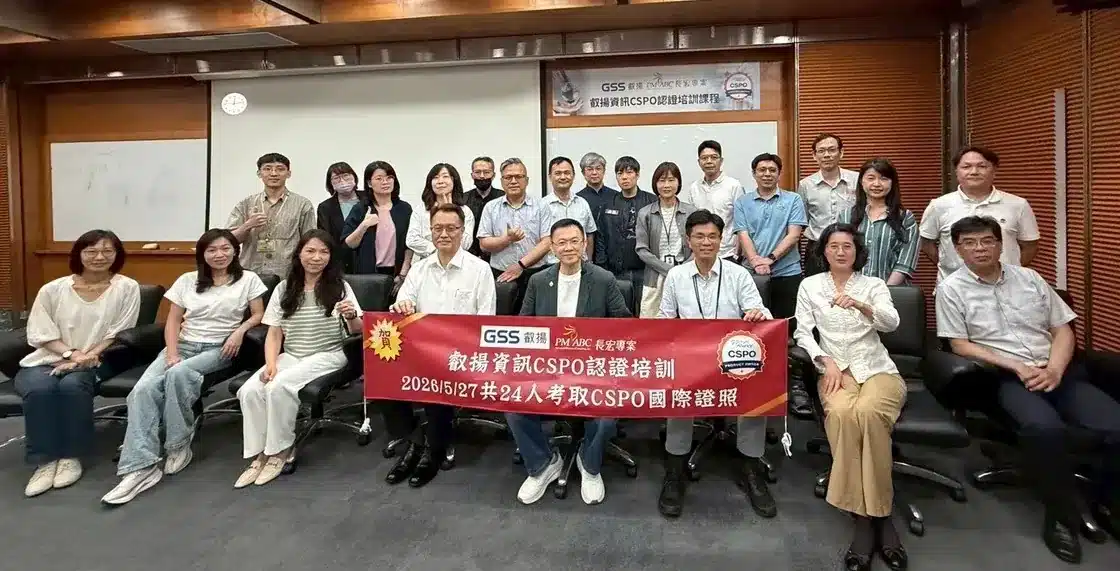
In February 2025, she made an unusual decision. She believed this approach shouldn’t stop with her — the entire company should learn it. So Galaxy launched two CSM enterprise cohorts in sequence — the first for senior executives, from BG GM Chris all the way down to every director; the second for product managers and middle managers. Fifty senior executives in total, all CSM-certified.
One year after CSM rolled out, a new question surfaced: how do we make the PO role properly empowered?
Team collaboration had improved. Cross-departmental communication had become smoother. But the hard questions were still there: which products are worth investing in? Which requirements should we turn down? Which markets are worth pursuing? Which features only look important?
CSM can’t answer these questions.
Because CSM solves “how a team works together,” while these senior executives were facing “what the company should actually be working on.” When the first problem gets resolved, the second one surfaces — and it’s harder. That’s why Galaxy decided to reinvest in CSPO.
Why That February 2025 Decision Is Still Reverberating Today
I’ve coached many companies through agile adoption. Most treat Scrum as “a certificate to collect” or “a training event to complete.” A year later, the cohort disperses, and the practice fades.
Galaxy is different.
Flora’s decision in February 2025 started simply: “I think this is worth spreading.” But she didn’t stop at “spreading.” She built it into the institution — making CSM the shared language for every senior executive in the company, then making CSPO the shared language for the next stage.
Behind it is a rare perspective: agile isn’t a one-off training event. It’s a long-term investment in an organization’s decision-making capability.
Once you start looking at Scrum through the lens of “investing in organizational decision-making capability,” CSM naturally leads to CSPO, and CSPO leads to CAF. That isn’t the catalog order of the courses. It’s the order in which an organization’s capability levels up.
In the AI Era, Human Value Doesn’t Lie in Writing Code — It Lies in Carrying the Team’s Judgment
In class, I asked a question.
“AI already writes code. AI already tests code. Soon AI will review code too — and we’ll cross-verify with multiple AIs. So what value is left for humans?”
The room went quiet for a few seconds.
The answer isn’t complicated.
Human value lies not in writing code, but in judgment: judgment about which market is worth entering, which requirements deserve to be built, which products will succeed, which business models will be profitable. AI can give suggestions on all these. But AI won’t carry the responsibility for you.
And the PO is exactly that role inside the organization — the one who carries the team’s judgment.
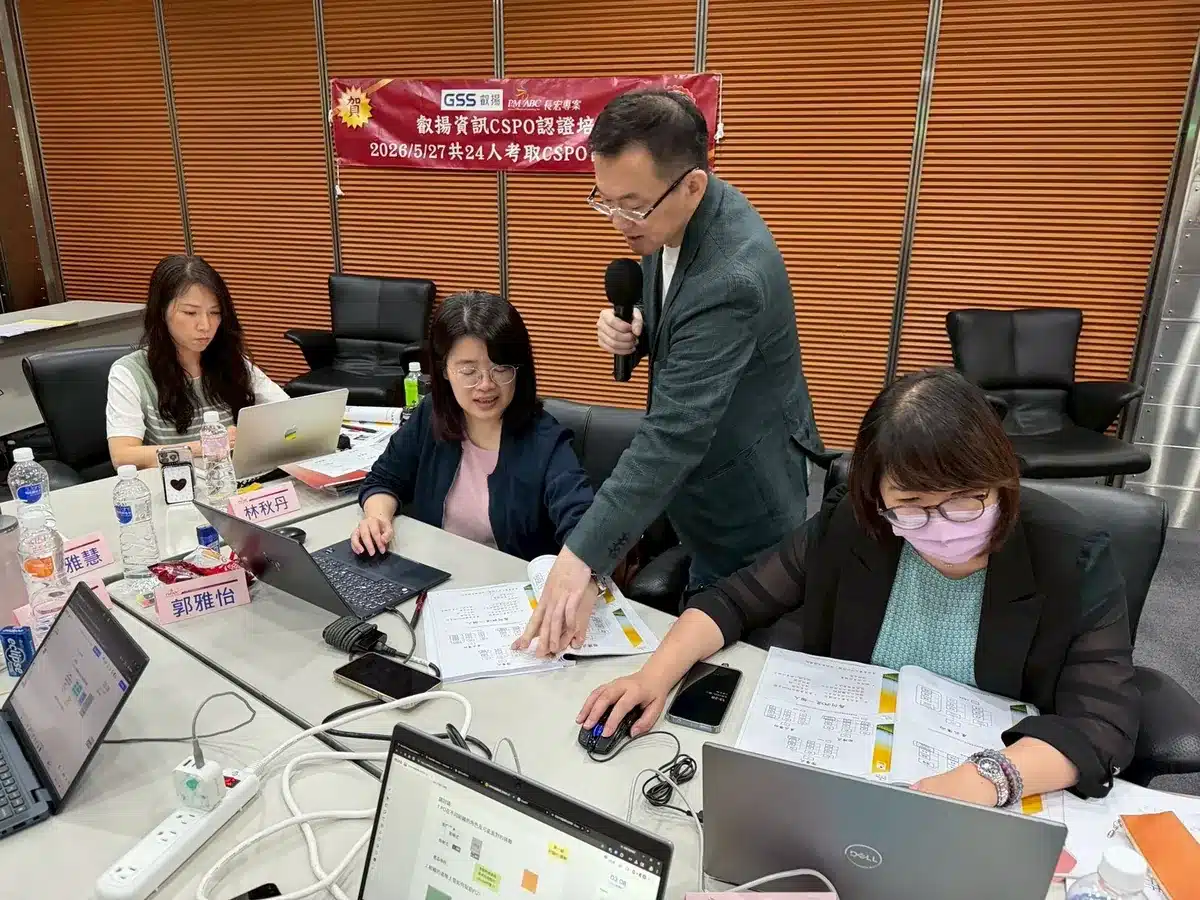
That’s why I believe CSPO is going to matter more and more in the AI era — not because PO tooling is good, but because the stronger AI gets, the rarer and more valuable becomes the human who can “make a business judgment on behalf of the team.”
A PO Isn’t a Requirements Receiver. A PO Is a Value Decision-Maker.
Many companies have a misconception about POs: that the PO is the one who collects requirements, writes user stories, runs meetings, and acts as a message relay.
But a truly good PO isn’t that.
In class I share one line: A PO isn’t a requirements receiver. A PO is a value decision-maker.
That line resonates with a lot of executives. Because they face the same problem every day — requirements never stop, every customer says theirs is most important, every salesperson says their case is most urgent, every manager wants their item moved up the queue.
Without a clear prioritization logic, the result is predictable: everyone is busy, but the company doesn’t necessarily become more successful.
In this course, we spent serious time building a prioritization framework — Galaxy’s POs developed five prioritization criteria, plus an explicit list of which exceptions must be escalated to the CEO for decision. When those criteria were finally written down, many directors realized something: the problem that had been frustrating them for years wasn’t a lack of resources — it was unclear prioritization.
Just writing those criteria solved 80% of the problem.
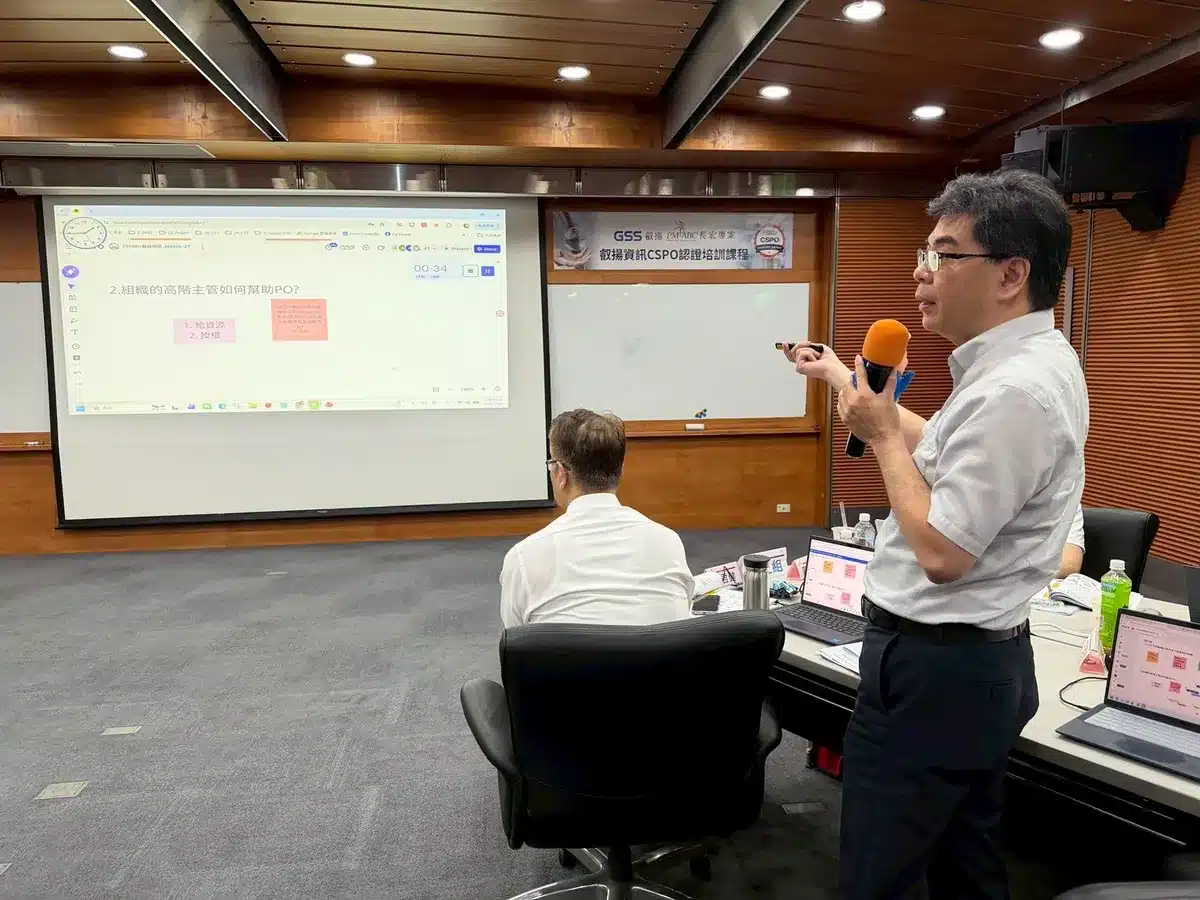
More importantly, the POs started to understand a power they’d never seriously claimed before — the right to say no. Not stuffing every requested feature into the product, but concentrating on the few that matter most and making them excellent. For a company that’s run SaaS for over a decade, this is a far-from-trivial mindset shift.
What Really Opened Senior Executives’ Minds Wasn’t Product — It Was Business Model
If you asked me what I gained most from this course, my answer would be: business model.
Galaxy’s products are already mature. CRM, document workflow systems, knowledge management systems — they all have real competitiveness in the market. But when I asked the class to lay out their business model canvas and reexamine it, something interesting started to happen.
I noticed something: everyone drew the “upper half” of the product design extremely thoroughly — customer segments, value propositions, channels, customer relationships. But the “lower half” — the business model itself, cost structure, revenue streams, financial leverage — was barely touched.
What does that mean? It means people were still living inside the original framing: same cost logic, same revenue model, making the same products.
I guided everyone to break out of that. I had them imagine: if you were designing Galaxy’s product from scratch today, how would you design the business model?
And then the mind-opening moments started.
One student shared: “I never knew McDonald’s real genius wasn’t burgers — it was real estate.” Another PO followed: “I always thought YouTube was just selling ads. Then I looked at its business model — YouTube’s revenue has surpassed Netflix’s, but its true core isn’t advertising. It’s revenue sharing with creators, incentivizing them to keep producing, building an entire ecosystem.”
The whole room went silent for a moment.
A great product doesn’t necessarily mean a profitable company. Product success isn’t the same as business model success.
For a company that’s stood on technical excellence for over a decade, that’s a heavy reframe.
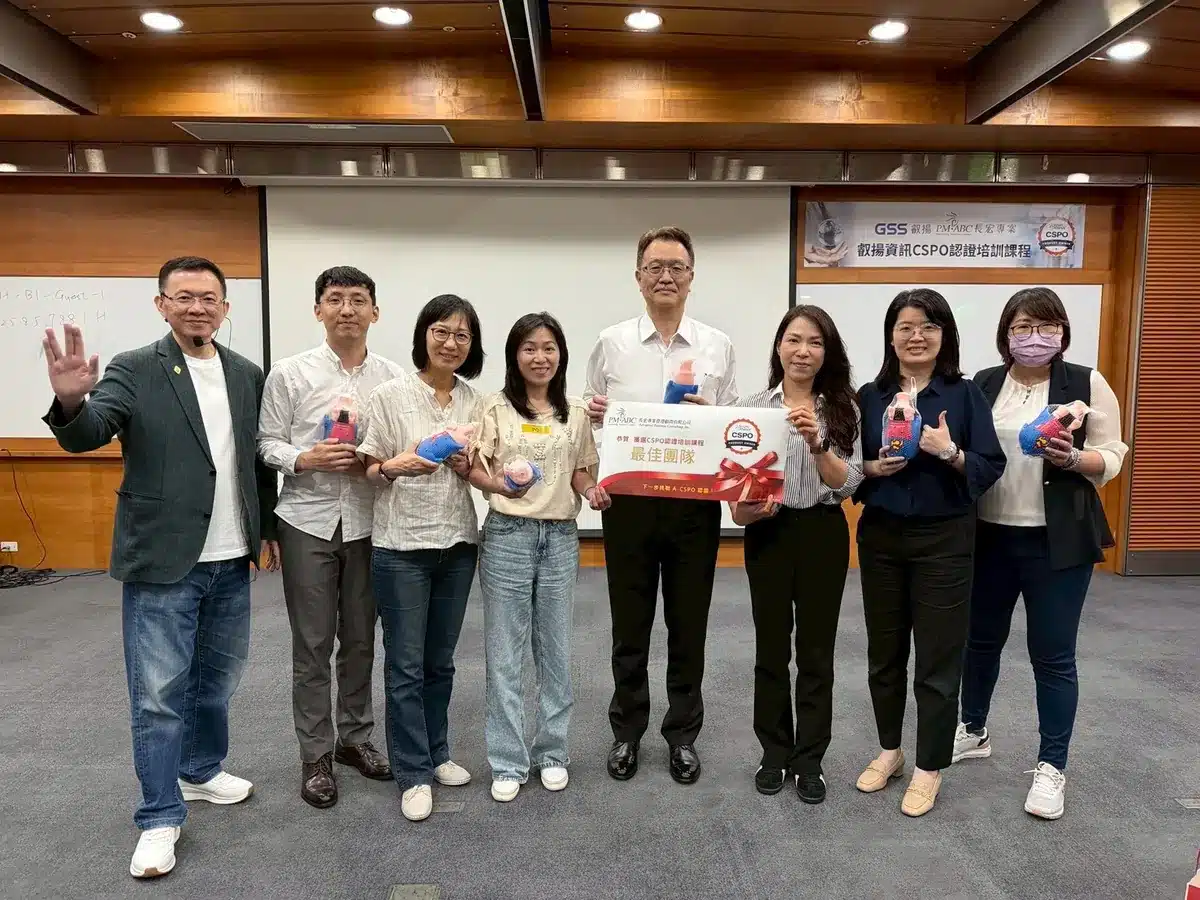
What’s Truly Profitable Is Always the Minority — A PO’s First Discipline
In class I asked Galaxy’s executives: “How many products does your company have?” Nobody answered immediately.
I asked again: “Which one is the biggest by revenue share?” The answer slowly surfaced — it was indeed a meaningful slice of revenue, but not large enough to carry the whole company.
After this CSPO training, the direction I gave Galaxy is clear: let the PO system take root, give the directors real business perspective, and re-calibrate every product’s priority, resource allocation, and value ordering. Once that thinking is internalized, every downstream product decision becomes naturally more precise — because they’ll figure out for themselves which features deserve to keep going, which deserve more investment, and which can be set aside for now.
That’s more substantial than any “growth strategy.”
From Technical Excellence to Product Leadership
In the proposal I gave Galaxy, I wrote one line:
“Galaxy stood on technical excellence for the last decade. For the next decade, it will write its next chapter on product leadership.”
That line is also my observation about many Taiwanese companies.
For the past twenty years, Taiwan has produced many excellent engineers. But for the next decade, what we need are product leaders. Because market competition is intensifying, AI tools are everywhere, and technical barriers are dropping fast. What will really separate winners going forward isn’t who has the best tech — it’s who understands the customer, the market, the business model, who can make the right decision faster.
That’s the real value of CSPO — it’s not for “people who want to learn product management.” It’s for people who want to upgrade their organization’s decision-making capability.
Why CSPO Should Be a Mandatory Course for Senior Executives
Many people think CSPO is a course for product managers. I don’t fully agree.
Since the start of this year alone, I’ve taken in 10+ CSPO enterprise cohorts for senior executives. I’ve found that the ones who benefit most are general managers, vice presidents, directors, and BG executives.
Because they start learning to look at things — product vision, business model, product investment, resource allocation, value prioritization — through one complete methodology.
These are exactly the decisions executives already make every day. They just never had a complete methodology — it was experience, instinct, and shouting matches in meeting rooms. CSPO provides an architecture, so these decisions can be made systematically, rather than determined by whoever has the loudest voice in the room.
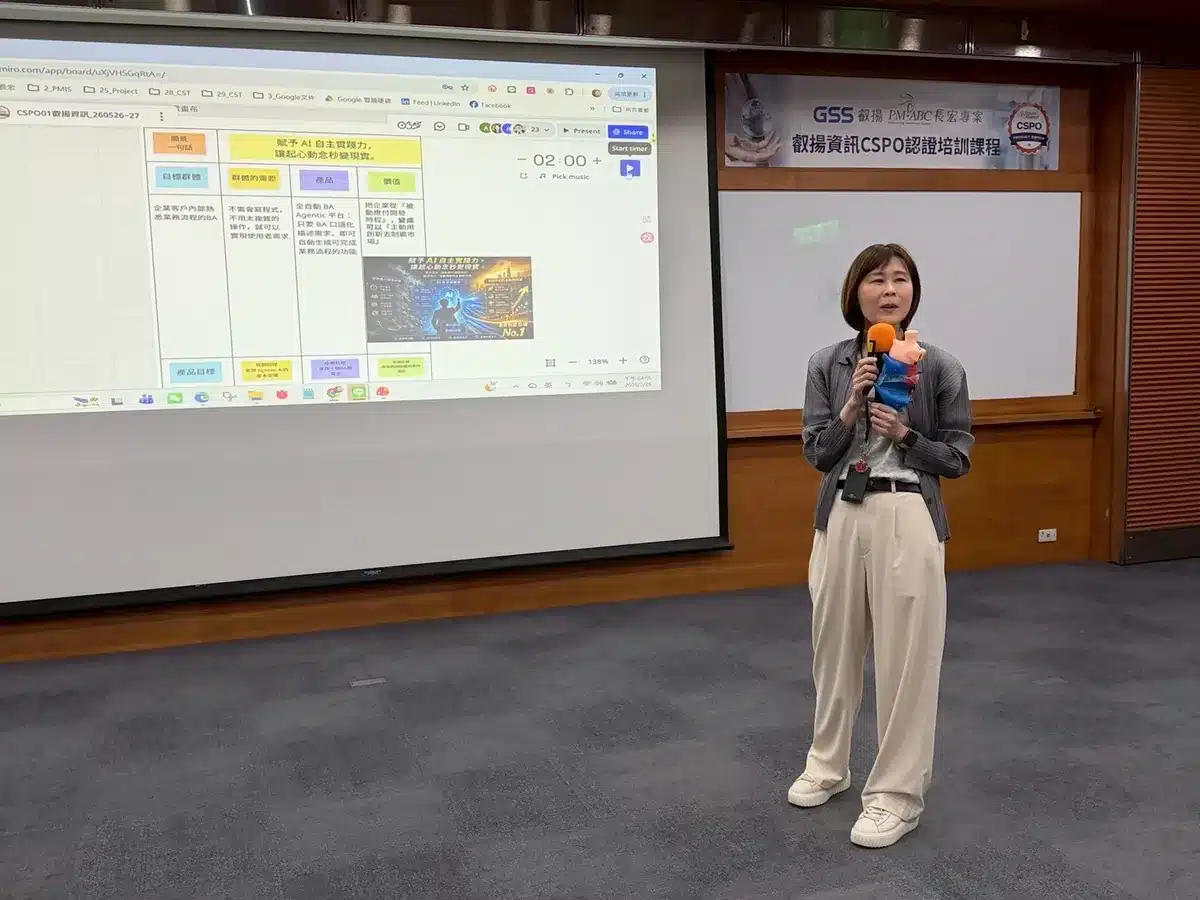
In class, I watched a director step up to present “how a PO should be empowered inside Galaxy,” and I watched BG GM Chris personally step up to evaluate each group’s business model. This isn’t “executives attending class as a formality.” It’s executives genuinely treating this as a decision-making tool of their own.
CSPO Doesn’t End When Class Ends — It’s the Starting Point of a 4–8 Week Coaching Engagement
Many companies finish CSPO and stop there: “course done, certificate earned.”
But real capability isn’t internalized the moment class ends.
For Galaxy’s CSPO senior executive cohort, I designed the course as the starting point of a coaching engagement, not the finish line.
Pre-course preparation: Before the course even started, I worked with Galaxy to lock in a real coaching case — Galaxy’s accounting & finance system. I also worked with the product owner on the mindset side: this isn’t a two-day course that ends when class ends. This is a 4–8 week sustained engagement that has to produce real work.
End-to-end visibility: I set up a Padlet board for the coaching case — product vision, roadmap, release strategy, outcome validation — each stage’s outputs, blockers, and decision rationale are all visible to the whole team. Whenever any stage stalls, I can intervene with diagnostics in real time.
4–8 week product cycle: During the engagement, the team completes one full CSPO cycle —
- Product Vision — re-align “who is this product for, and what does it solve?”
- Product Roadmap — break a 1–3 year direction into executable stages
- Release Strategy — what value does each release deliver, and how do we validate it?
- Outcome Validation — how do we measure post-launch, and how does that feedback shape the next release?
After completing one full cycle, the team has built the full “from idea to value” capability — and that capability can be replicated to the next product, the next team, the next fiscal year.
This matters more than the certification itself. A certificate proves an individual’s capability. A replicable product-operation model becomes the company’s long-term organizational asset.
For Ambitious Individual Contributors: Learn to Judge What’s Worth Doing First
If you’re an engineer, a PM, a PMO, or even just an individual contributor who hopes to become a manager someday — let me give you one piece of advice.
Don’t just learn how to do work well. Learn to judge what work is worth doing.
Because the greatest value of a manager isn’t execution. It’s decision-making.
Once you start looking at things through the lens of product vision, market need, business model, and value prioritization, your whole perspective changes — you won’t just see “how do I get this ticket done.” You’ll start asking “why does this ticket need to be done,” “what happens if it isn’t done,” and “what’s the biggest downstream impact of doing it.”
This thinking capability is the most valuable thing CSPO can give you. It teaches not just product management tools, but a mindset of someone who runs the business.
When you walk into your career carrying this mindset, you’ll be noticed sooner, trusted sooner, and entrusted with greater responsibility sooner. That’s worth far more than knowing one more tool.
Closing: When 50 Senior Executives Step Back into the Classroom, What Is This Company Telling the Market?
From Galaxy’s 50 senior executives investing themselves in CSPO this time, what I see isn’t just a course.
I see a company with the resolve to keep evolving — willing to send the BG general manager personally into the classroom, willing to make every director carve out time, willing to lay already-profitable products on the table and re-examine the business model.
That kind of resolve is, more often than not, the real reason a company can lead in the decade to come.
Many CEOs are waiting for “a better moment” to upgrade their organization’s decision-making capability. But in this era, waiting itself is one of the most expensive decisions an organization makes.
CSM solves collaboration. CSPO solves value. The next step is CAF, which solves the decision-making dialogue. The three certifications together form a complete leadership upgrade path for a modern senior executive — and Galaxy has already reached the second.
Want to Open a CSPO Enterprise Cohort for Your Own Team?
If you’re a senior executive who wants to build your company’s resilience against intense change, who has already felt the friction of “collaboration solved, but value not yet solved”; or you’re thinking about whether to send your entire senior leadership team into a CSPO classroom —
Why is this investment worth it? Because the return is never just ROI.
First, it’s an upgrade in core organizational capability. When your BG general manager, directors, and POs all share the same language of product decision-making, the company moves from “carried by a few heroes” to “a whole system that can consistently do the right things.” This capability doesn’t leave when any single person does — it settles into an organizational asset that the company keeps for the next decade. Product strategy stops being lost in translation through middle layers, and cross-functional alignment stops depending on whichever meeting people last shouted in.
Second, it’s an upgrade in governance quality and shareholder trust. When senior executives learn to explain every major decision through product vision, business model, and value prioritization, the quality of discourse at earnings calls, board meetings, and quarterly reports goes up a level. For a publicly listed company, “every resource allocation decision can be explained and traced” is the indicator of governance quality, and the foundation of long-term shareholder trust. When executives stop answering board questions with “I think” and start answering with methodology — that’s a different altitude.
Third, it’s the accumulation of brand reputation and talent magnetism. When customers, partners, and job candidates see your leadership team talking not only about technology but also about Product Thinking, Business Model, and Value Prioritization — that signal goes out and brings back better customers, better partnerships, and better talent. For SaaS and software businesses, this is a nearly invisible but persistent competitive advantage, because the best talent always wants to join organizations that “do the right things.”
And all of this rests on one prerequisite: having a group of people who understand this thinking and dare to make these judgments. A CSPO enterprise cohort is one of the most effective ways to systematically cultivate that group.
You’re welcome to request a free customized CSPO Enterprise Cohort Proposal. I’ll design a proposal specifically for your company — based on your industry, scale, and current agile maturity — including recommended cohort composition, course design, expected outcomes, and follow-up coaching mechanisms.
Contact: reply directly to Roger (pmsuccess@gmail.com) with the subject line “Request for CSPO Enterprise Cohort Proposal.”
Appendix: Reflections from Galaxy’s First CSPO Cohort
Chris / BG General Manager, Galaxy Software Services
I want to start by sincerely thanking Roger for this CSPO class. These two days were genuinely an eye-opening, somewhat shocking education for me. Honestly, the older I get, the more I feel that learning needs to start early — and yet, even at my age, the things that need to be learned still need to be learned. When Roger called my name in class, I was constantly in this state of nervous excitement. On the exam I realized I still have many areas to strengthen, but finishing the course and earning the certification was a real encouragement.
For more than twenty years at the company, I’ve mainly been responsible for Outsourcing services and general projects Biz, and have rarely directly led a product team. Three-plus years ago, when I took over the BG, I started leading two product teams — KM and HR — and that’s when I really felt how much more I still needed to learn about product thinking, business value, and PO know-how. The beginning was genuinely hard, and I’m grateful to my team members for all the support.
Through last year’s CSM and this year’s CSPO, with Roger’s guidance, I feel I’m gradually opening up in product management and agile thinking. CSPO doesn’t just clarify the PO role for me — it makes me rethink how to lead a team, how to shape product value, and how to create more contribution for the company. The fact that I’m still willing to learn and still able to earn a certification at my age also reminds me: as long as you’re willing to start, it’s never too late to learn. For anyone wanting to step into agile and product thinking, this course is truly worth experiencing in person.
Ms. Lin O. Tan / Director and Spokesperson, Galaxy Software Services
This CSPO class made me really happy — getting to take Roger’s course again was something to genuinely treasure. I originally expected two consecutive days of class to leave everyone tired, but actually the whole learning process was full of energy and interaction. I was fully engaged and excited the entire time.
Roger’s teaching style is vivid, and the tools and exercises that come with the course are very practical, turning what could have been abstract CSPO concepts into something easy to understand and easy to connect with real work and life. Although I don’t directly own a product or serve as a product manager right now, this course helped me see that Product Owner thinking applies far beyond products — it can also help us communicate more effectively with colleagues, clarify market positioning, and think about what we ourselves want to achieve.
I think every person can be their own PO. Whether it’s work, a team, or a direction in life, we can use this approach to see value more clearly, set priorities, and step by step move closer to the person we want to become. For anyone who wants to understand agile or improve their thinking and collaboration ability, CSPO is well worth investing in.
Mr. Wu O. Te / Manager, Galaxy Software Services
This CSPO class was a deeply inspiring learning experience for me. I currently have a product where I’m serving as PO, but coming from a technical background, I’ve always felt I had a lot to strengthen on the business perspective, business model, and how to think about products from market and customer value.
Over these two days, through the cases Roger shared, the goal-breakdown methods, and the exercises in redefining requirements from the customer’s perspective, I came to see clearly that the PO role isn’t just about organizing requirements and handing them to engineering — it’s about being able to judge which requirements are truly valuable, and to think through the business logic and revenue structure behind the product.
What left the deepest impression on me was the McDonald’s case. Its biggest source of revenue is actually tied to land — that was genuinely shocking, and it gave me a real “mind blown” moment. It turns out product and business model thinking can break out of the framework you’re used to and reveal much larger possibilities.
This CSPO course made me start looking at the PO role from a different angle, and I believe it will help me produce better thinking in future product planning and decision-making. For people coming from a technical background and shifting toward product thinking, this is a course truly worth taking.
Mr. Lai O. Jen / Director, Galaxy Software Services
I’m glad to have had the chance to take this CSPO class. For me, this wasn’t just an experience of earning a certificate — it was a journey of reorganizing product thinking. I hadn’t taken any certification exams for a long time, and I didn’t expect that at this stage of my career, I could still see clearer, more directional possibilities in product management through agile and Product Owner concepts.
In the course, I came to understand more deeply that the PO isn’t just the person who organizes requirements or pushes the project forward — they have to stand between the user, business value, and team collaboration, continually thinking about what genuinely valuable product is. This perspective should be very helpful in my future work and it makes me reflect on whether, in past product development, I could have focused more on value, priority, and team consensus.
CSPO made me feel that agile isn’t simply a method or a process — it’s a mindset that makes products better over time. I hope to bring what I’ve learned back into work and keep our products improving, letting the team build better outcomes around shared goals. For anyone considering whether to learn agile or understand product management, this is a course well worth investing in.
Mr. Wang O. Pin / Director, Galaxy Software Services
Over these two days of CSPO, I really learned a lot — and was hit with a lot. The pace of the course was fast and the information was rich, from agile thinking to product roles to how to look at value, requirements, and team collaboration. Many new feelings and reflections came up.
In class, when Roger asked me what I’d learned, the truth is I was asked two or three times and I couldn’t immediately answer. Not because I had nothing — but because the course brought so much, and it was so substantial, like being handed a thick book that I need to go back, slowly flip, slowly think, and slowly digest. For me, some learning isn’t answerable on the spot — it shows up later, in actual work situations, where its real value gradually surfaces.
What I find special about CSPO is that it doesn’t just teach a process — through Roger’s guidance and the class activities, it makes you rethink the relationship between product, customer, value, and decision. The pace was fast, but the experience was very fun, and it kept everyone engaged.
I want to thank Roger for these two days. A few days from now, after I let these contents settle, I believe more gains will surface. For anyone who wants to touch agile or open up product thinking, CSPO is a course worth experiencing in person.
Mr. Yao O. Chi / Deputy Director, Galaxy Software Services
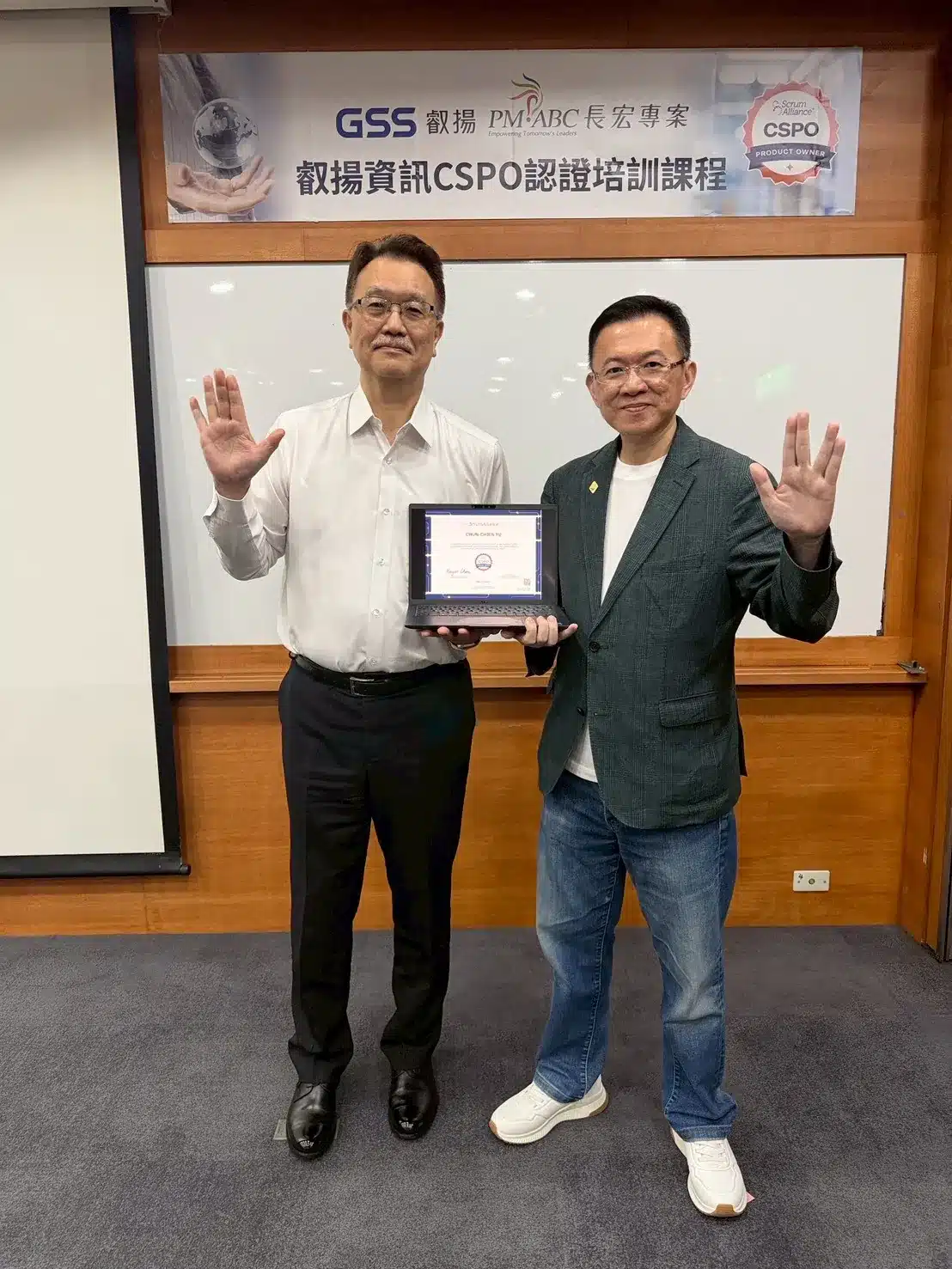
This CSPO class gave me a deep realization. When I took a photo with Roger after class, he mentioned: “Have you noticed this course is actually very similar in concept to marketing?” I strongly agreed. Because a Product Owner isn’t just responsible for feature planning — what matters more is understanding the market, understanding users, and thinking about what kind of product value is truly needed by the customer.
I’d previously taken CSM and had a basic understanding of the Scrum methodology, but this CSPO let me understand the way our company’s Scrum Team members operate, and resolved some areas where I’d been fuzzy or unclear. Roger’s teaching style is relaxed and rhythmic without being tiring, and the workshop approach lets everyone actually experience the principles behind the concepts, instead of staying at the level of theory.
I think CSPO’s gains apply not just to work, but extend to personal life and goal-setting. For Galaxy’s POs in particular, this course should open up many new ideas and perspectives. When thinking about what feature to develop next, perhaps we can break out of the existing framework and re-think with an approach closer to market and value. Many thanks to Roger for leading us, and to HR for arranging such a wonderful course.
Ms. Yuan O. Chien / PO, Galaxy Software Services
What left the deepest impression on me from this CSPO class was the homework Roger assigned. My group watched a Business Weekly piece on YouTube. It was just a class exercise, but afterwards it left me with a deep sense of impact, and it reopened my imagination about business models.
In the video, I saw several points I hadn’t known before. First, YouTube’s revenue has surpassed Netflix’s — which surprised me, because I personally watch Netflix more often and pay less attention to YouTube’s growth. Second, I’d thought YouTube was primarily watched on phones, but the proportion watched on TVs at home has now exceeded mobile. That made me realize user behavior is constantly changing.
What really opened my thinking was this: I used to think of YouTube as a tech or service company, but going deeper, I realized its real strength is building a platform — where creators, viewers, and advertisers form a continuously rolling business model. Creators bring content and traffic, advertisers invest budget, the platform shares revenue back with creators, and creators in turn keep improving content quality with that revenue feedback loop.
This CSPO taught me that a PO can’t just look at a product through intuition — they have to understand the operating logic behind the product from the user, the value stream, and the business model. For anyone wanting to break out of their existing thinking framework, CSPO is genuinely worth attending.
Ms. Chiang O. Hui / Director, Galaxy Software Services
Thank you to the company for the arrangement that gave me the opportunity to attend this CSPO course. Roger’s teaching, combining theory and practice professionally, gave me a lot. Over these two intense days of class, I had different realizations. I came to feel that you need all relevant stakeholders to jointly own the product vision and goal — only then can things move forward smoothly. As someone working in a business unit, I came to understand the product management and prioritization mechanism the PO is responsible for. These are all extremely useful and worth applying to daily work. Going forward, whether it’s communicating customer requirements externally, or syncing with the team internally on customer urgencies, we can use this logic to drive more systematic, rational communication, letting the team reach consensus efficiently and collaborate happily — and avoiding blind ad-hoc insertions, creating a real win-win.
Finally, my thanks to everyone who studied alongside me ~
Ms. Kang O. Fen / Director, Industry Business Division, Galaxy Software Services
This is a course truly suited for product owners. By learning these frameworks, the product owner can understand how to maximize product value through the Scrum mechanism.
Given that my own role is a manager in the sales organization, after taking this course I can translate it into my work — defining sales targets with PO thinking, executing through Scrum mechanisms.
The PO is responsible for maximizing “product value.” The role of a sales director — sales targets are my product. I’m equivalent to the highest-accountability person for that “sales product,” responsible for the final outcome.
Annual or quarterly sales targets are treated as a product backlog. Through prioritization and structured breakdown, they’re translated into tactical tasks and action plans that team members can “see and concretely execute.”
Learning the Scrum framework, I split sales execution into short iterations. Through continuous progress review and dynamic adjustment, the team can respond to market changes, gradually land each task, and steadily meet sales targets.