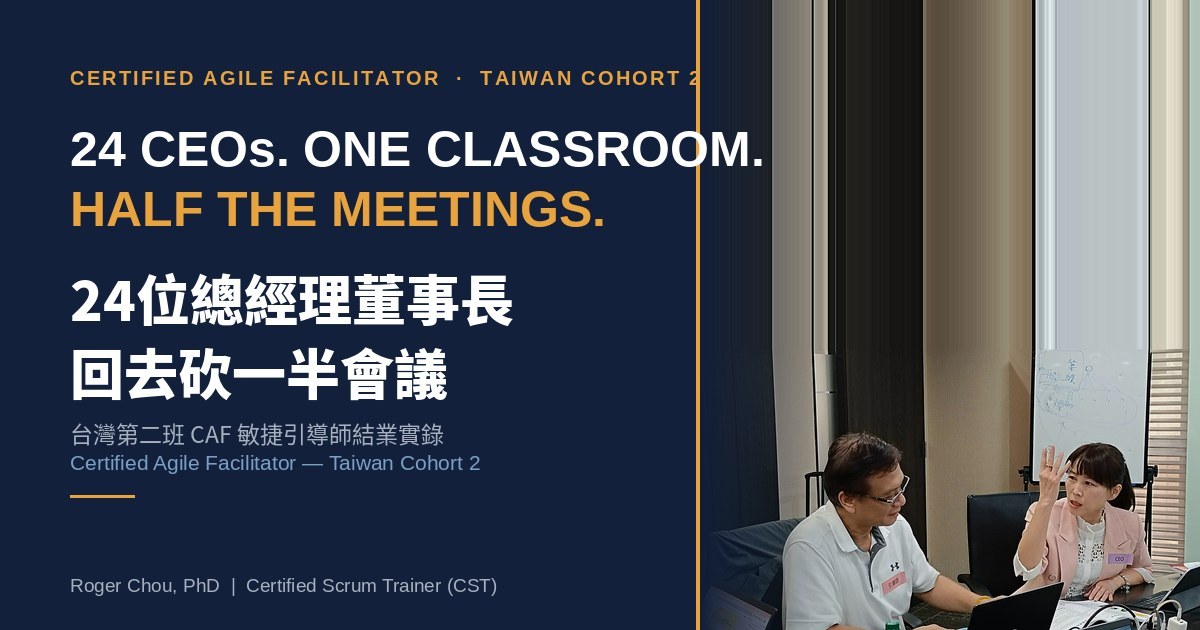

On graduation night of Taiwan’s second Certified Agile Facilitator (CAF) cohort, 24 students took the stage one after another to share what the two days had meant to them — 21 of them were CEOs, chairpersons, or executive vice presidents. One had a high-speed rail train to catch mid-share and finished anyway. This article isn’t about the facilitation techniques they learned. It’s about something harder: whether a chairperson is willing to stand in front of peers and publicly set herself a target — go home and cut meetings by half; whether a CEO is willing to admit that when meetings never end, the problem was never the people underneath him, it was that he never made the direction clear in the first place. Learning the diamond model and upward-facilitation phrasing — that’s two days of work. Whether you can actually hand the floor back to your team in the very next weekly meeting is the real exam this certificate gives you.

If your company asks “any objections?” in a meeting and nine times out of ten nobody says a word, do you call that consensus, or silence? That’s the real question this CAF cohort was built to ask.
What They Learned Wasn’t Facilitation — It Was the Courage to Admit, in Front of 24 Peers, That Their Meetings Were Already Broken
Graduation-night sharing is usually the easy part — photos, gift bags, a few pleasantries, done. Not this class. Nobody gave a pleasantry.
One student put it bluntly: the thing that hit him hardest in CAF was the “elephant in the vacuum.” He has plenty of senior staff under him, and every time he asks “any thoughts?” in a meeting, the answer is always no — but once execution starts, every objection surfaces. He eventually realized the problem was never that his people wouldn’t cooperate. It was that information had never actually been transparent. Everyone was guessing, and guessing eventually breeds resentment — and once that resentment detonates, there’s no pulling it back.
Honestly, hearing that stopped me for a second too. A manager who’s led teams for years, willing to admit in front of 24 peers that he’d misread his own people for that long — that’s not modesty. That’s choosing to lay your own blind spot out where everyone can see it. And that, more than anything, is what these two days were really teaching.

It’s hard to pretend this cohort was just a skills class. On Scrum Alliance’s official CAF trainer directory, Roger Chou has now collected 47 student reviews — every single one five stars, a perfect 5.0 TrustScore. That number, 47, is exactly the first cohort’s 23 plus this cohort’s 24. Of this cohort’s 24, 21 were CEOs, chairpersons, or executive vice presidents. When a company is willing to send the very top of its decision chain into a classroom — writing sticky notes alongside entry-level staff, getting called up at random to teach the diamond model — that alone is a top-down demonstration.

“Go Home and Cut Meetings in Half” Was a Chairwoman’s Own Standard for Passing the Test
Wei O. Fen, chairwoman of Xinya Digital, is one of the few people in this class who has already led her senior team all the way from Scrum and CSPO through to CAF inside her own company. Her share didn’t stop at “I learned a lot.” She gave a number specific enough to sting: starting next month’s monthly meeting, she’s requiring herself to cut meetings by 50%.
Before she gave that number, she said something every CEO should sit with: as authority gets delegated down over time, each unit keeps adding its own meetings, and the total quietly becomes enormous. Meetings waste time not because the people running them execute poorly — most of the time, the real problem is that senior leadership never defined the direction, the time box, or the scope of discussion before calling the meeting.
It’s not that the people underneath are inefficient. It’s that the person at the top never figured out what the meeting was supposed to solve before pulling everyone into the room. That line doesn’t sting frontline managers. It stings every senior executive who’s in the habit of calling the meeting first and thinking later.
She added something even more practical: cutting the number of meetings is only step one. What matters more is making sure the spirit of CAF actually gets implemented — not just fewer meetings for their own sake. She wants to turn what she learned into an SOP for how her company runs meetings, so people have clear steps to follow even before the habit sets in. Cutting meetings is the easy part. Making sure the ones you cut don’t quietly grow back in another form — that’s the real work.

Companies Stuck in “Discussed but Never Decided” Aren’t Short on Willpower — They’re Short on a Process That Makes Conflict Visible
Tsai O. Lang, GM of Laiyi Digital Technology, named a pain point every software company recognizes: they run daily standups, they run two-week sprints — and their weekly and monthly meetings still get stuck in “discussed but never decided.” Decisions get made, never actually implemented, and the same issue gets dragged back onto the table at the next meeting.
His old approach: when a new product plan hit disagreement — PM and engineering split, sales and engineering fighting over a bug — he’d go talk to each department separately, burning a lot of time just to untangle the problem. What CAF gave him was the realization that facilitation is a systematic, process-driven discipline that helps a team build a better way to decide. The real problem was never “did we ask for input.” Ask “any objections?” directly, and the answer is usually no — the real opinions only surface after the fact.
The cost isn’t the extra thirty minutes of discussion. It’s the next three months, where what you thought was settled was really just silence on the surface — and the same issue comes right back around at the next meeting, from square one.

“Conflict Isn’t Necessarily a Bad Thing” — A Different Answer from a GSS Group GM
Not everyone in this class showed up with a meeting-culture crisis. Hu O. Jou, group GM at GSS Information Technology, runs a company of over 800 people, and by her own account, meetings there already run reasonably well. She’d bought books on facilitation years earlier, always feeling she wasn’t quite a good enough facilitator herself. She’d worked with coaching techniques before too, but doing real one-on-one coaching with her own team ran into a wall — trust itself was something that had to be earned first. So she’d only ever used coaching-style questions inside meetings, at a fairly shallow level.
What CAF gave her wasn’t a tool for putting out fires. It was a more formal, more methodical way to facilitate. Like a lot of managers, she used to instinctively fear conflict inside a team, treating it as a sign things were spinning out of control. Now she’s starting to think conflict itself isn’t necessarily bad — what matters is whether there’s a good facilitator in the room, helping people see different viewpoints and eventually shape a solution everyone can live with.
That’s worth sitting with for any executive who thinks their company is “already pretty open.” A meeting that never spins out of control doesn’t mean it’s already good enough. It just means nobody has pointed out the ceiling yet.
Someone Acted Out the “Elephant in the Vacuum” in Class and Had Everyone Laughing — the People Watching Were Bosses Nobody Usually Dares to Laugh At
There was a moment during group role-play that explained what CAF actually does better than any of the serious feedback.
One general manager, who normally keeps up the composed, buttoned-up posture the job requires, dropped that posture for once during the role-play and personally acted out the “elephant in the vacuum” — playing, with total commitment, the exact scene of a manager asking “any objections?” to dead silence. He had the whole room laughing, and his groupmates kept bringing it up afterward, saying he’d nailed it a little too well.

It was funny, and it was uncomfortable. A general manager had to wait until a CAF classroom, two days in, for his first real chance to act out the exact scene he privately hates most — and he was performing it for a room full of peers at his own level. What that tells you is that the silence after “any objections?” isn’t one company’s disease. It’s a pain almost every executive sitting in that room already recognized.
No Conflict Doesn’t Mean There’s Consensus — A Lot of Companies Mistake “Quiet” for “No Problem”
One line from Chen O. Hsun, senior VP at Xinya Digital, cut deeper than anything else in this cohort: managers get used to controlling the pace, pushing for a quick decision, treating “we reached a conclusion” as the same thing as an effective meeting. But a meeting can look perfectly harmonious — everyone says fine, no problem — and afterward, a pile of different opinions surfaces. It’s only during execution that you find out everyone understood it differently.
No conflict doesn’t necessarily mean there’s consensus. Sometimes it just means the important issue hasn’t been said out loud yet.
Take the word “meeting” out of that sentence and it still holds. Plenty of companies think they’re already open — employees don’t argue, everyone says yes — and management keeps moving forward, reassured. It’s only when execution falls apart that anyone realizes people were never on the same page to begin with. The cost was never the extra thirty minutes in the meeting. It’s three months later, when the whole team discovers there was never any real consensus — after they’ve already spent three months walking in their own separate directions, each convinced they understood the plan.

The four things that stuck with him most: full participation, mutual understanding, an inclusive plan, shared ownership — the diamond model moves from divergence, into the groan zone, and only then to convergence, and disagreement showing up in the middle isn’t necessarily bad. A facilitator’s job isn’t to rush and suppress the conflict. It’s to help the team say out loud what they’re actually worried about, what they need, what the risks and differences really are — and then find a direction forward together. He plans to bring this into management meetings, cross-department meetings, even discussions about rolling out new systems.
“Should the Elephant Disappear, or Turn Into a Rabbit?” A GSS Executive Assistant’s Answer Was Neither
There’s a classic question in the class: after finishing CAF, what do you want the “elephant” in your own head to become?

Lin O. Tang, executive assistant to the CEO at GSS, said his first instinct was to want the elephant gone entirely — once the pressure disappears, the truth finally has room to surface. He heard that some people choose instead to turn the elephant into a rabbit; he thought about it and decided a manager doesn’t necessarily need to become a rabbit. If you’re a manager, you have that role for a reason — your own traits, your own convictions. The point isn’t to shrink yourself down or make yourself harmless. It’s to make sure that strength doesn’t become an obstacle that blocks the team from thinking and growing on its own.
There’s no textbook answer here, but it forces a harder question: if you were that manager, how much of the elephant’s weight would you keep, and how much room would you actually give up? Everyone has blind spots — too much logic, too much emotion, neither is automatically a good thing. This isn’t a technique question. It’s a trade-off every person sitting at the head of the table eventually has to work out for themselves.
“The More Senior the Room, the More an Ineffective Meeting Actually Costs” — A Reminder from an Innolux Director
Chang O. Ming, a director at Innolux, said something after CAF that few people are willing to say out loud: every company is stuck holding meeting after meeting after meeting, but an ineffective one doesn’t just burn time and energy — it’s a serious cost. The more senior the people in the room, the more shocking that cost actually is.

What he’s pointing at is exactly the part of “discussed but never decided, decided but never executed” that’s easiest to overlook: everyone assumes a meeting happened, but opinions may never have been fully discussed, and consensus never turned into a real commitment. The “consensus decision” we’re all most familiar with often delivers far less follow-through than expected. It echoes what Tsai O. Lang said earlier about “discussed but never decided,” just from a different angle — the problem isn’t that the process was poorly designed. It’s that nobody has ever calculated what an hour of the people sitting in that room is actually worth.
An Observation from a Managing Director at Ricoh Taiwan: The Anger a Manager Shows Isn’t Always Real Anger
Hsu O. Tun said something very grounded after finishing CAF: CAF has real commercial value on the enterprise side — unlike CSM or CSPO, which lean more technical, it’s a method any company, in any working context, can pick up and use directly.
But the line that followed was the real insight: how a senior executive actually expresses emotion in the room doesn’t always match the textbook scenario — the anger a manager shows isn’t always real anger. Sometimes it’s just a way to get the team to pay attention to something that matters. That kind of on-the-ground nuance can’t be taught from a book. Only someone who’s actually been redirected by a manager’s emotions in a real meeting room ever really learns it.

One Certificate, 21 People, 21 Different Answers
What CAF gives you was never a single script. It’s a decision-making logic — and dropped into each person’s own organization, it grows into a different shape every time.
One GM at Chunghwa Telecom’s operations division wrote that the biggest difference between CAF and CSM or CSPO is that regardless of whether you’re a Scrum Master or a Product Owner, the actual job always requires mobilizing a team, drawing out requirements, and helping people discuss — and CAF’s logic doesn’t stop at agile teams; it extends into sales and everyday work. Another student had gone from CSM in 2023 all the way through CSPO and ACSM, and now CAF — she said the two days gave her a genuinely elevated understanding of what facilitation is at its core: a facilitator isn’t the person who owns the answer. They’re the one who polishes the mirror that reflects the group’s collective wisdom.

I’ve spent years coaching companies through this, and I’ve watched too many of them treat CSM, CSPO, and CAF as three separate certificates to collect. But most of the people in this class have already been through CSM and CSPO, and when they came back for CAF, they said it themselves, plainly: this isn’t three separate levels. It’s three entry points into the same decision-making logic — you start wherever you’re currently stuck. And that’s something that can be designed.
Closing: The Moment You Get the Certificate Is Where It Actually Starts — Your Next Meeting Is the Real Test
Wei O. Fen gave herself a number: cut meetings in half. Tsai O. Lang wants to turn facilitation into his company’s built-in decision-making logic. Chen O. Hsun has decided to bring “Set, Display, Polish, Gather, Close” into management meetings, cross-department meetings, even system-rollout discussions. These are all moving graduation-night promises.
But honestly, everyone in this class already knows the harder part isn’t the certificate. It’s whether, back at the office, they’ll actually dare to cut next month’s meeting in half; whether the next time disagreement surfaces, they’ll let it sit in the open instead of doing what they’ve always done — calling the vote before anyone’s really said their piece.
Twenty-four CEOs and chairpersons spent two days sitting in the same classroom as entry-level students — writing sticky notes, getting called up at random to teach the diamond model, acting out the elephant in the vacuum in front of their peers. That alone is a kind of demonstration. The real test isn’t in the graduation photo. It’s in the next meeting each of them runs — with no instructor in the room to remind them, just themselves, and the choice of whether to actually hand the floor back.

Appendix: Reflections from the Second CAF Class (By Role)
Below are the full reflections from every student in this cohort, grouped by role, with names masked.

A. Senior Executive Perspectives
Wei O. Fen/Chairwoman, Xinya Digital Co., Ltd.
From Scrum and CSPO all the way to CAF, what struck me most this time is that I could already picture how to use it the moment I got back to the office. Take our monthly meeting — we’ve already committed to cutting it by 50%. Over time, as we delegated more authority down, each unit kept adding its own meetings, and the total became genuinely large, with plenty of room to trim. But cutting meetings is only half the job — what matters more is actually implementing the spirit of what CAF taught us, not just running fewer meetings for their own sake. This also made me see something new: meetings waste time not because the people running them execute poorly. Most of the time, the real problem is that senior leadership never defined the direction, the time box, or the scope of discussion before calling the meeting.
Hu O. Jou/Group GM, GSS Information Technology
We’re a company of over 800 people, and our meetings already run reasonably well overall — but I’ve always felt I wasn’t quite a good enough facilitator myself, and I wanted a more systematic understanding of facilitation. I’d worked with coaching techniques before, but doing deep one-on-one coaching with my own staff ran into a wall — trust itself is something you have to earn first — so I mostly used coaching-style questions inside meetings, at a fairly shallow level. CAF gave me a more formal, more methodical way to facilitate. We used to instinctively fear conflict on the team. Now I’m starting to think conflict itself isn’t necessarily bad — what matters is whether there’s a good facilitator in the room, helping people see different viewpoints and eventually shape a plan everyone can accept.
Hsu O. Tun/Managing Director, Ricoh Taiwan
I started with PMP ten years ago, got my CSM in 2021, and after finishing CAF now, I think it has real commercial value on the enterprise side. Compared to other courses, CAF is more focused on “facilitation” specifically, and it’s a method that any company, in any working context, can adopt directly. This course also made me realize that how senior executives actually communicate in the room doesn’t always match the textbook scenario — the anger a manager shows isn’t always real anger; sometimes it’s a way of using emotion to get the team to focus on something important. If that kind of on-the-ground nuance could be combined with the course methods and shared experience, I think it would make CAF even more relevant to real enterprise needs. I also strongly support having experienced senior executives exchange with each other — even facilitating meetings at other companies.
Tai O. Chin/GM, Chunghwa Telecom Hsinchu Business Office
I first want to thank Roger and Elly — we’ve been exchanging notes on project management since 2011. I’d originally planned to continue with CSPO and CSM, and it was Roger who suggested I try CAF instead. People tend to treat CSM and CSPO as more technical courses, but agile has always emphasized that it applies across every industry. CAF’s content is relatively lightweight, but it’s more focused specifically on “facilitation” — whether you’re a Scrum Master or a Product Owner, the job always requires mobilizing a team, drawing out requirements, helping with discussion, even running retrospectives, and CAF complements everything I’ve learned before. This logic doesn’t stop at agile teams — it extends into sales and everyday work. I really enjoyed learning alongside my Group 4 teammates these two days.
Tsai O. Lang/GM, Laiyi Digital Technology Co., Ltd.
My biggest takeaway after CAF is that it could become a genuine breakthrough point in how our company operates. I mainly run software development teams — we already do daily standups and two-week sprints. But our weekly and monthly meetings still often get stuck in “discussed but never decided,” or decisions get made and never implemented, and the same issue comes back up at the next meeting. CAF made me realize facilitation is a systematic, process-driven discipline that helps a team build a better way to decide. Very often, asking “any objections?” directly gets you a no — the real opinions only surface afterward. In the past, when departments disagreed, I’d talk to each one separately, burning a lot of time to untangle it. Now I’m thinking about how to use CAF to build a shared decision-making logic across the whole organization.
Lin O. Tang/Executive Assistant to the CEO, GSS Inc.
The bigger a company gets, the more communication it needs — but more communication only matters if it’s effective and actually drives execution. The diamond model in this course gave me a much more concrete understanding of how a team moves from different viewpoints to real consensus. When asked what I wanted my own “elephant” to become after the course, my first instinct was to want it gone entirely — once the pressure disappears, the truth finally has room to surface. Later I heard some people choose to turn the elephant into a rabbit instead, but I don’t think a manager necessarily needs to become a rabbit — if you’re a manager, you have that role for a reason, your own traits and convictions included. What matters isn’t shrinking yourself down; it’s making sure your own strength doesn’t become an obstacle that blocks the team’s own thinking and growth. Going from CSM to CSPO to CAF, I’ve increasingly felt that agile is really an “inner discipline” — in the end, what actually changes is the way you think.
Chen O. Hsun/Senior VP, Xinya Digital Co., Ltd.
My biggest gain from finishing CAF wasn’t a few more meeting tools — it was re-understanding what facilitation actually is. In the past, running meetings and cross-department coordination, I fell into the habit — like a lot of managers do — of controlling the pace and pushing for a quick decision, treating “we reached a conclusion” as the same thing as an effective meeting. After CAF, I started to understand that what really matters in a meeting isn’t just the conclusion — it’s whether the team actually said what needed to be said. A meeting can look perfectly harmonious, everyone says fine, no problem — and afterward a pile of different opinions surfaces, and it’s only during execution that you realize everyone understood it differently. No conflict doesn’t necessarily mean there’s consensus; sometimes it just means the important issue hasn’t been said out loud yet. Getting the certificate is only the beginning — what actually matters is bringing this method back to the real workplace, until it slowly becomes how the team runs meetings and makes decisions as a matter of course.
Chang O. Ming/Director, Innolux
Becoming a certified Agile Facilitator isn’t just earning a certificate — it’s taking on a bigger responsibility. This CAF class hit directly on a scene we all face every day at work: meetings. Every company is stuck holding meeting after meeting after meeting, but an ineffective meeting doesn’t just burn time and energy — it’s a serious cost, and the more senior the people in the room, the more shocking that cost actually is. In reality, we’re surrounded by ineffective meetings where things are “discussed but never decided, decided but never executed” — everyone assumes a meeting happened, but opinions may never have been fully aired, and consensus never turned into a real commitment. This course started from the diamond model — full participation, mutual understanding, an inclusive plan, shared ownership — and I believe it has real potential to change the meeting culture we’ve all taken for granted.
Lin O. Jung/VP, Winchains Technology
Two intensive days of CAF certification training, packed with hands-on practice, came to a close, and getting the certificate left me with a deep sense of gratitude for these past few years of agile journey. I started learning under Roger in 2023, formally entering agile through CSM, then working through CSPO and ACSM step by step, and now adding CAF as a new identity. These two intense days gave me a genuinely elevated understanding of what facilitation is at its core — in the past, project and team work tended to focus on process frameworks and delivery targets. CAF goes deeper: how to create a safe space for conversation, precisely read team dynamics, defuse potential conflict, and guide diverse viewpoints toward real co-creation and commitment. A facilitator isn’t the person who owns the answer. They’re the one who polishes the mirror that reflects the group’s collective wisdom.
B. Sales and Professional Staff Perspectives
Li O. Ching/Sales Deputy Manager, Xinya Digital
This time, finishing CAF felt very different from CSPO, which I’d taken before. I manage a department with a lot of senior staff, and in the past, asking for input in meetings, the answer was almost always “nothing” — but once execution actually started, plenty of opinions would surface. Through the anonymous voting mechanism in this course, I realized that instead of asking people to state their views directly, it’s easier to give them a lower-friction way to participate — start with two votes each, and you can already tell which issues are worth digging into further. It also made me rethink the gossip and misunderstanding that constantly pops up on teams — a lot of the time, the real problem is that information just isn’t transparent enough. When information that could be shared doesn’t get passed along, people start guessing on their own, and over time that breeds negative feelings, which can eventually escalate into real conflict.
Tu O. Wen/Senior Specialist, Jin-Sheng Energy Services Co., Ltd.
I first came across CAF while attending a PMI-related course, and I realized it addresses exactly the pain points we deal with at work. After our company’s reorganization earlier this year, I noticed discussions dragging on much longer — meetings that never end, no decisions made, everyone holding their own position, creating serious internal friction. I’m not a manager, but I hold myself to a high standard, and I tend to push people toward a goal fairly directly. The “elephant and the baby elephant” case study in this course made me realize I may have been overlooking my team’s own thinking in the past — pushing people to execute a predetermined direction without first building consensus through communication and facilitation. Going forward, in cross-department coordination meetings, I want to actually put these facilitation methods into practice — helping people set aside their individual positions first, and focus on the problem that actually needs solving.

Want to know whether your company’s meetings right now mean “nobody objected” or “we actually agree”? If your company is running into any of the problems above, I’d welcome the chance to talk. I can put together a CAF proposal tailored to your organization, and we can work through how to bring this method into your meeting room. Reach me at: pmsuccess@gmail.com