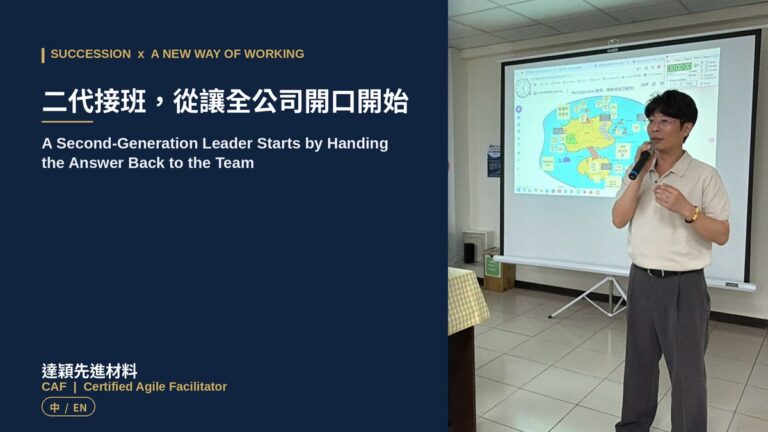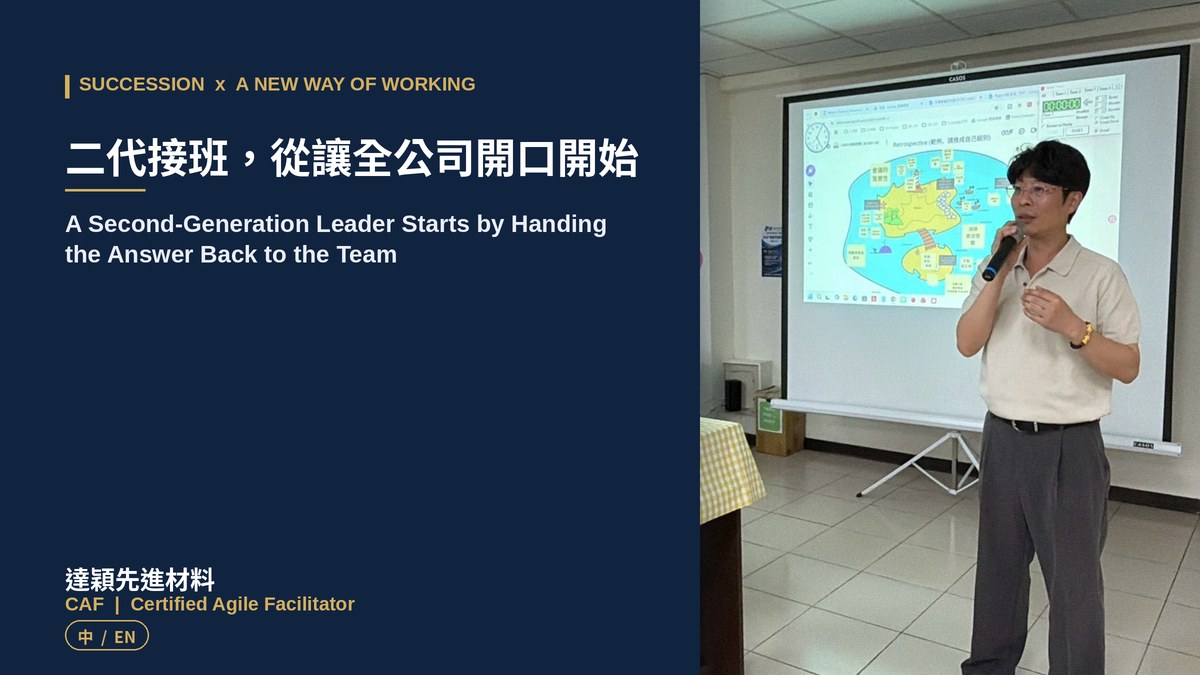

Der Ying Advanced Materials has been in business for thirty-five years. As succession approached, its second-generation General Manager, Shih-Fan Li, chose to bring CAF agile facilitation to the whole company. This is a record of his choice, and of what I saw in the classroom over two days.
What a Successor Must Inherit First Is the Company’s Ability to Speak Up
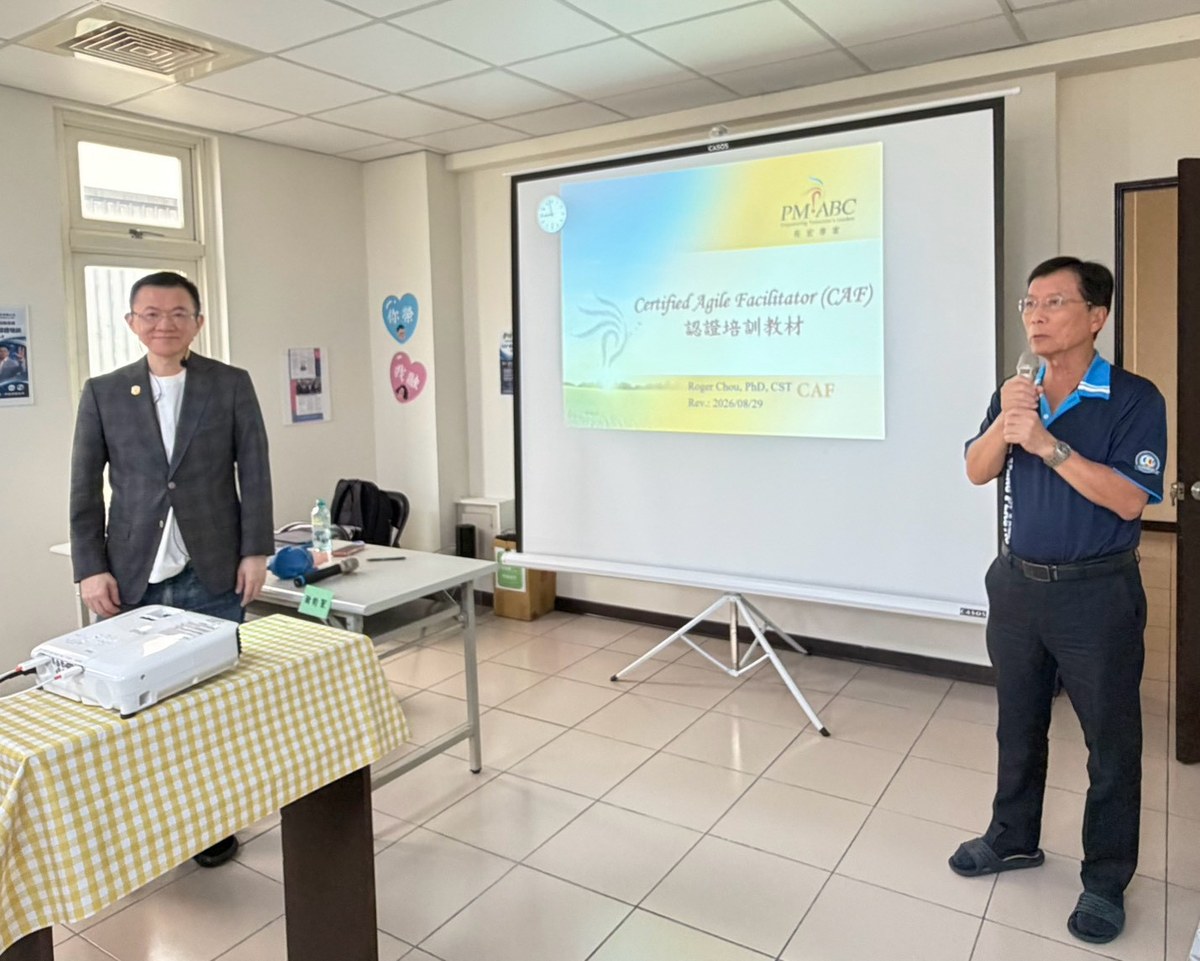
On the morning of October 1, Chairman Mike Li (李安重) of Der Ying Advanced Materials picked up the microphone and said, before anything else, the sentence the whole company had found hardest to say. He did not talk about vision, and he did not introduce CAF. He said that this course was proposed by the General Manager, and that its purpose was to change something Der Ying had long lived with: in meetings and in every kind of company activity, people were “not quite willing to voice their own opinions.”
A founder of thirty-five years stood in front of his own colleagues, with four old friends in the room, and said this out loud. In doing so he also handed the matter to his successor. In many companies, succession is a ceremony of changing titles. At Der Ying, the second generation chose to bring a question of his own: how does this company make decisions together?
I have seen versions of this scene in many companies. A dozen managers sit in a meeting room. The boss finishes presenting a plan and asks, “Any thoughts?” The room goes quiet. Three seconds, five seconds, ten seconds. Then the boss says, “Good, let’s go with that.” The meeting ends, and the real meeting begins in the break room. If the founder is still the last checkpoint in your company, and people read the boss’s face before they present, this article is about you.
A company can expand its plant, grow revenue, and hire fifty more people. But as long as every stuck problem still waits in line for the boss to answer it, the company has not really grown up.
This article is about one choice that General Manager Shih-Fan Li made at the moment of succession.
The Decision of a Second-Generation Successor
Der Ying was founded in 1991. Chairman Li began as a professional manager in the film industry, then went out on his own. Over thirty-five years the company moved from plastics processing to high-performance materials, and renamed itself Der Ying Advanced Materials.
A first-generation founder runs on speed, experience, and the nerve to carry every judgment alone. Hand him a report and in three minutes he knows what is wrong. That instinct cannot be copied to the next generation, much less to every manager. If succession is only a change of title, the company’s “center of answers” simply moves from one person to another. A successor who inherits only the founder’s judgment inherits a single point of failure: when this person travels, the projects wait; when this person is ill, the approvals pile up.
General Manager Li chose a different path. I met him in the second year of my CSPO program, and like the Chairman he is a senior executive who loves to learn. This time he did not take a course and bring it back. He brought the whole team into the classroom: the Chairman, vice presidents, managers, and colleagues, along with four old friends of the company, all sitting down for two days to learn one shared language of facilitation.
After the course, the Chairman said in front of everyone: “Since I encourage the General Manager, who is preparing to take over, to try many things, then as long as it does not harm the foundation of the company, I should be his backstop.” For a first-generation founder to stand behind a second-generation successor’s experiment is one of the rarest things in any succession.
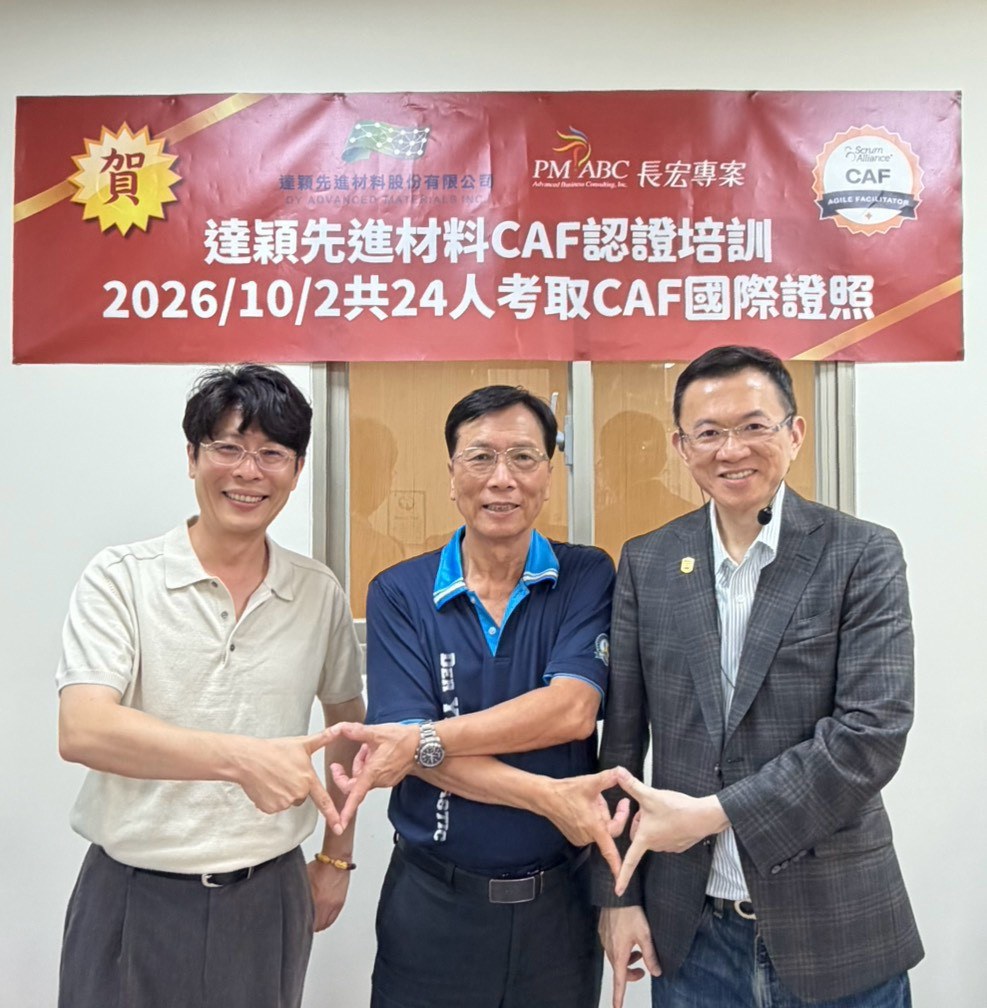
At the opening I promised nothing. I told the class that a corporate culture formed over thirty-five years cannot be changed in two days, but it can be shaped slowly, together, into a new Der Ying ready to welcome the next generation. I also explained the General Manager’s intention to everyone: “He does not want to become a facilitator. He wants everyone to become one.”
Facilitation Is Not a Tool Only for Agile Teams. It Is a Basic Capability of the Enterprise
Many people hear “CAF” and assume it teaches how to run meetings, or that it is for IT teams. I told the Der Ying team: “We are not here to learn how to hold meetings. You do not need to learn that. If it takes two days to learn how to hold meetings, then what have all those years of meetings been?”
CAF stands for Certified Agile Facilitator. The word “agile” in the name causes the misunderstanding, as if it were a technique reserved for agile work. What it addresses is something more basic that appears as a company grows larger, with more departments and more complex expertise: how to get people with different positions to think together effectively. Sales wants volume, quality assurance has a line it will not cross, and everyone is right in their own way. When nobody designs the conversation, you usually get one of two outcomes: an argument with no conclusion, or silence while everyone waits for the boss to decide.
The cases I worked through in these two days included a quality dispute before shipment, a cross-department meeting, and a managers’ meeting where people hesitated to take a position. None of them was a Scrum scene. Tools change, but it always comes back to the same picture: a group of people at one table, and whether they can think the matter through. CAF is about something else: how to design a conversation so that everyone has a chance to be heard.
Day One: No One Was Called On, and Everyone Spoke
I had arranged the seating in advance. The chairmen sat together at one table, and the other groups mixed managers with colleagues. I asked each group’s managers to raise their hands and then announced: “Today I take away your rank. None of you is a superior. You are all classmates.” The General Manager sat in the learners’ seats too. At the chairmen’s table, for the first time, they worked on an assignment by the same rules as their colleagues, with no one operating the computer for them and no one speaking for them.
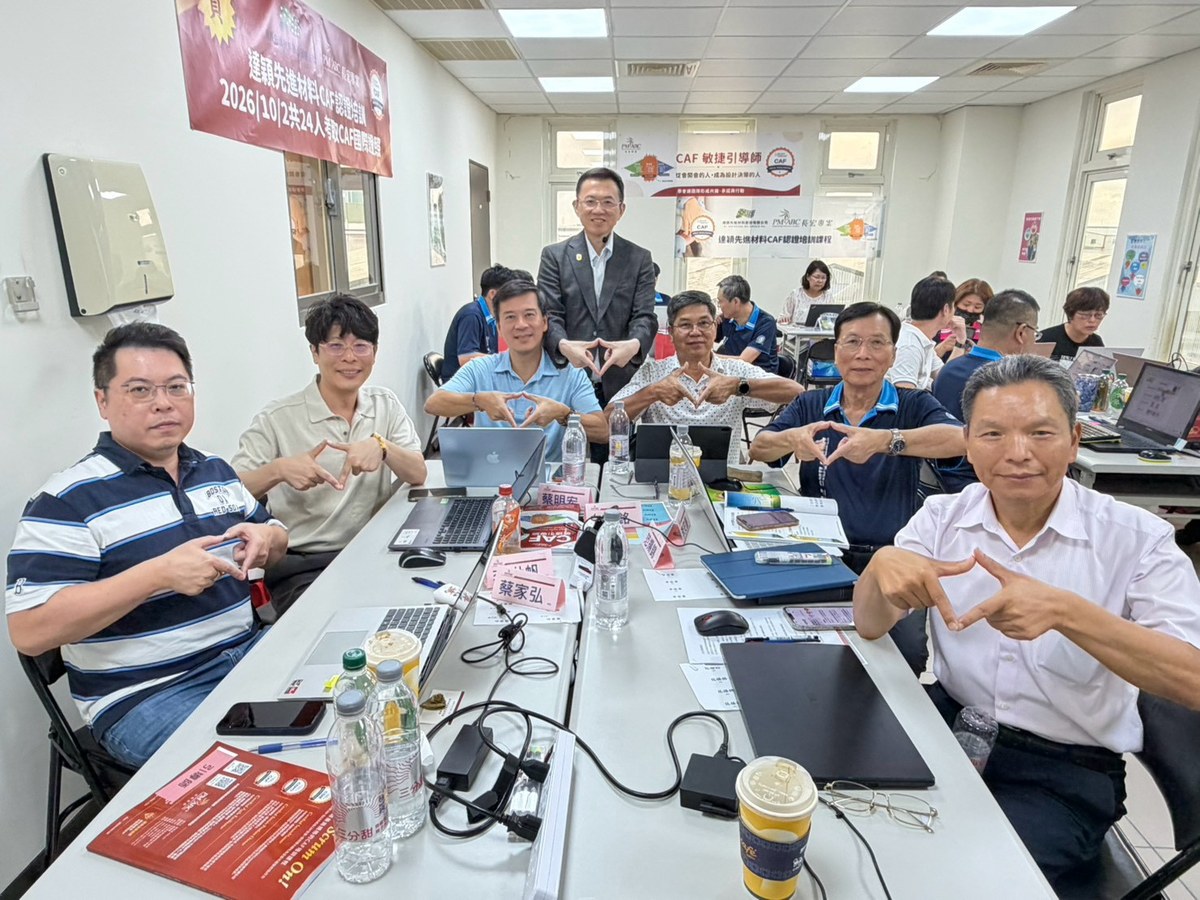
In the first workshop, each person wrote an answer on a card first, then discussed it in pairs, and finally each group sent a representative to report. There was only one rule: write first, then speak. Without that, the loudest voice always goes first and everyone else follows in his direction. When it ended I turned to the General Manager and said: “Mr. Li, you can feel it: our people are full of energy and speak very well.”
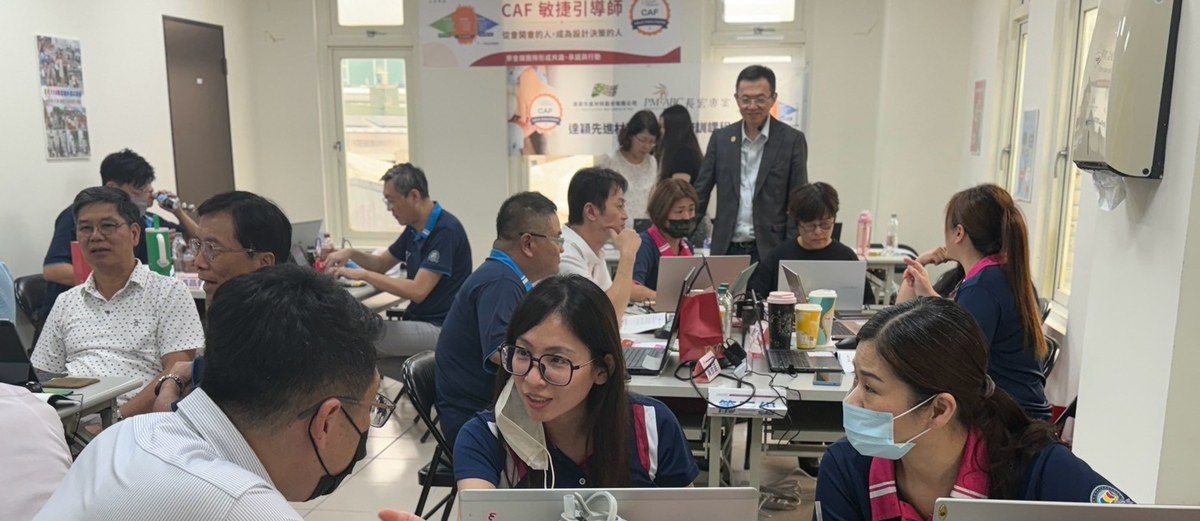
Halfway through the activity, I told the whole class that it was so lively today that I almost walked into the wrong room. The night before at dinner, Mr. Li had warned me in advance: “Tomorrow you’d better be prepared. We will be very quiet. Nobody talks.”
In the next game, I asked everyone to write anonymously on the screen: if we wanted this project to fail, what would we keep doing? Two ideas each, duplicates removed, then a vote. Anonymity lets people say the least safe things in the safest way, and these answers were organized by the whole team together, so nobody had to answer for any single line.
Before the end of the first day, my homework for everyone was: ask more questions, or simply raise your hand.
Morning of Day Two: The Elephant in the Room
On the second day, each participant took a turn teaching the Diamond Model: divergence, the groan zone, convergence. Four groups drew names at random, and one of the people drawn was Der Ying’s Vice President, Ho-Sheng Yang. His teaching scenario was “forming a cross-generational project task force”: silver-haired colleagues over seventy, middle-aged colleagues, and the younger generation, working on one project together. When we voted, sixteen people raised their hands to choose him as best instructor. I asked on the spot, did you really not vote for him because he is a vice president? The class said no.
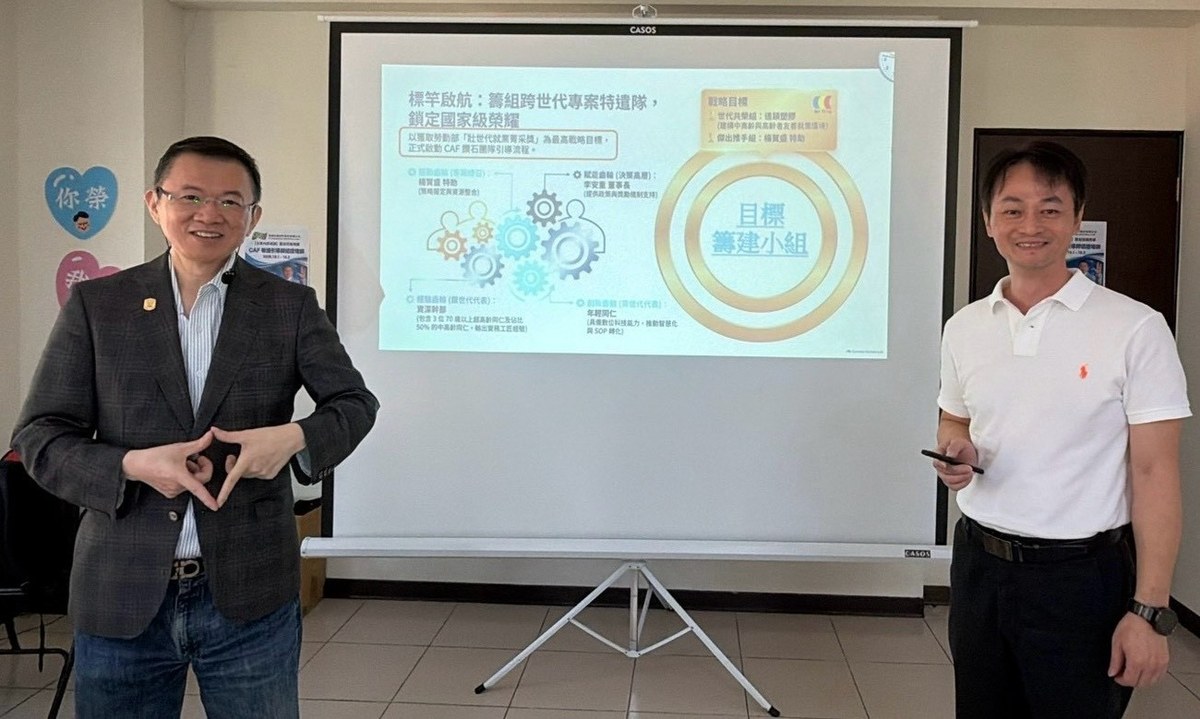
Then came what I consider the most important moment of the two days.
I put a picture on the slide with the title “The Elephant in the Room,” and said: “As CEO, your opinion is like an elephant walking into the room. The moment you speak, the space is gone.” I asked everyone to guess who the elephant in the picture was. Someone got it right: a chairman who had been invited took the microphone, finished the answer himself, and said the elephant was himself. He said that within limited space and limited time, the moment the boss steps in, it adds pressure to every other manager. There were several chairmen in the room that day, and I added: “We already have six elephants in this room.”
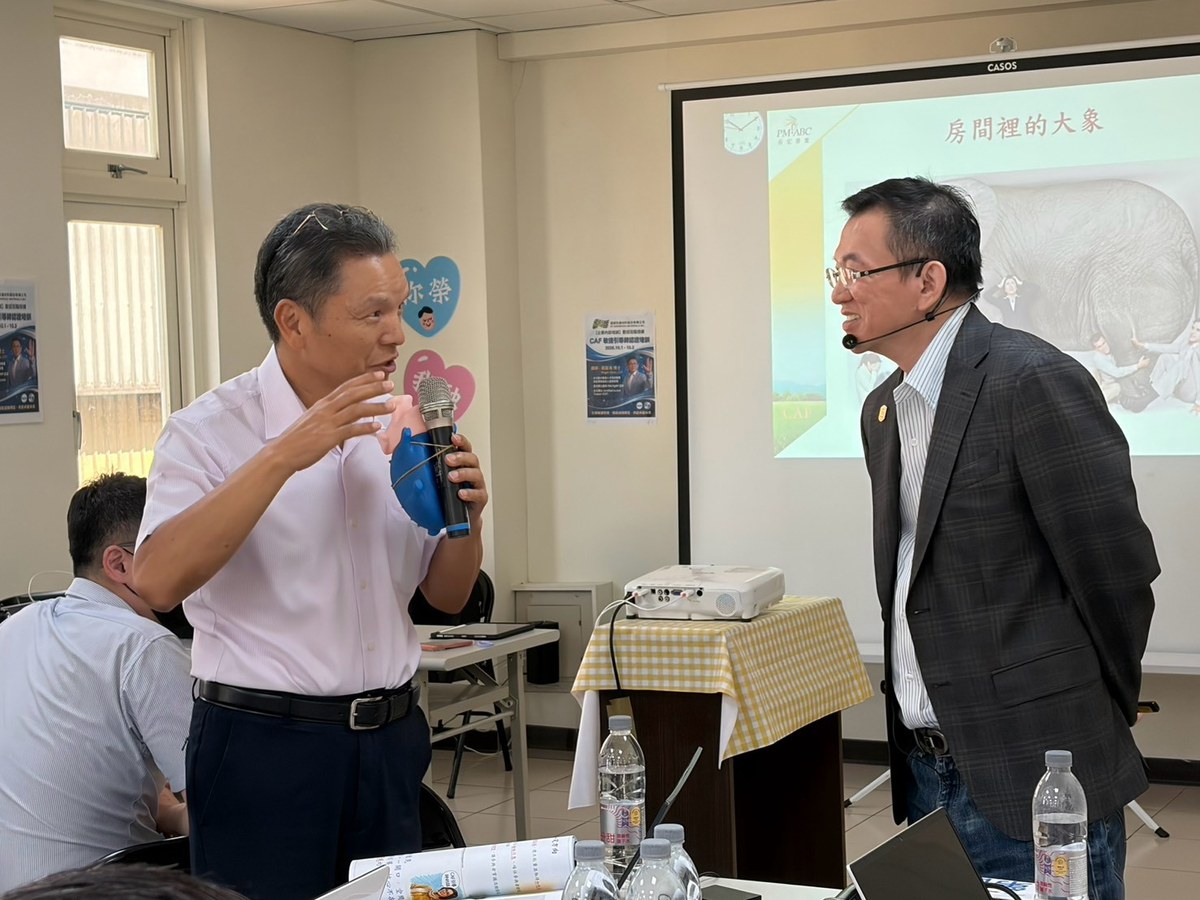
The moment the boss speaks, the discussion is over. What is left is only proving the boss right.
Next came the meeting-management skits. Each group performed a cross-department meeting with unequal power. The day before, an executive asked me: “We don’t have to act, do we?” I said no, just show how you usually hold meetings. Later I said on stage: “So they did not act. They showed how they normally run a meeting.”
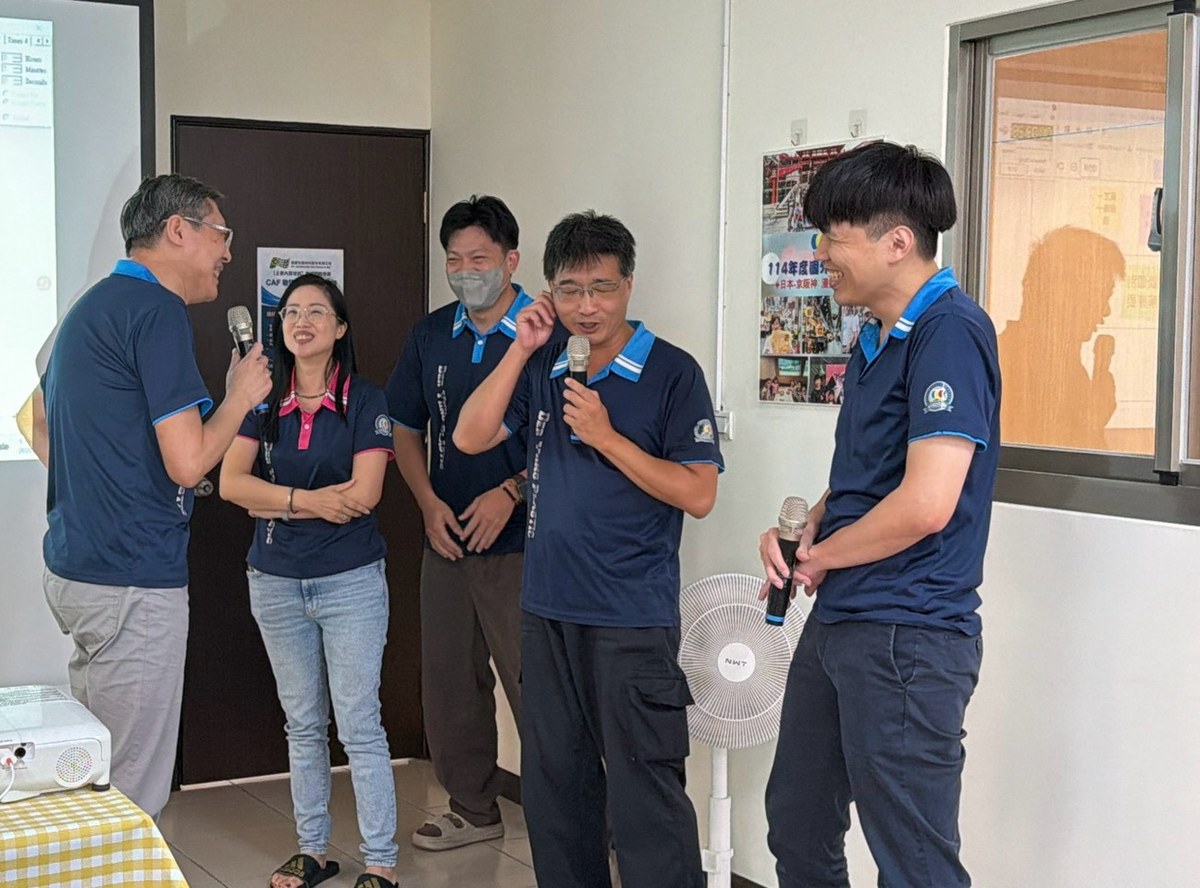
In one group’s scenario, a pre-shipment sampling showed that ten percent of a batch missed the heat-resistance limit. The facilitator did not rush to decide who was right; he first asked what was making each person uneasy. The group chose this plan: pull out the defective units, rework them in an estimated ten hours, and ship on time the next afternoon.
I also had a criticism. This group voted too smoothly. I said from the back of the room: “That was actually too fast. You were in the groan zone, the zone of arguing. Before you vote, you need to understand each other.” A facilitator’s job is to keep people from escaping discomfort too early.
Afternoon of Day Two: Listening, and Winning the Vote While Losing the People
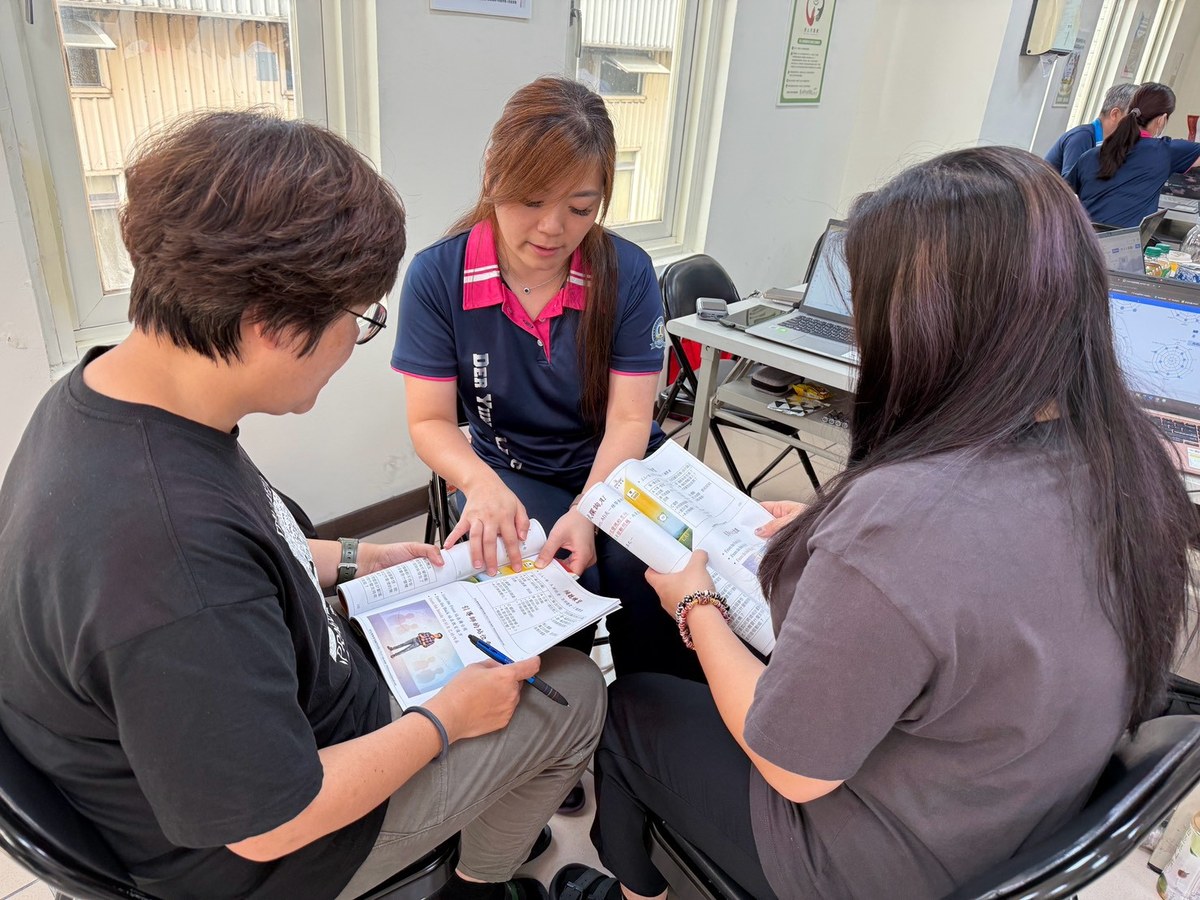
The afternoon was a listening exercise, in groups of three, knee to knee. In the first round you may give advice right away. In the second round you may only respond to emotion, pause three seconds, and give no advice. The observers reported that in round one, the speaker was repeatedly interrupted and gradually stopped wanting to talk; in round two, the speaker was willing to say more, and the real problem slowly surfaced. In class I gave an example: the speaker is talking and her eyes turn red. Whether the listener catches that emotion makes all the difference.
I wrapped it all up with a number every boss knows. A hundred people vote. Fifty-one choose A, forty-nine choose B. A wins, the boss decides, and everyone executes. Later it fizzles out, because behind those fifty-one votes stand forty-nine people who disagreed. You win the vote and lose the people. The other approach we call deep democracy: first listen to each other’s positions, then work to find where they overlap.
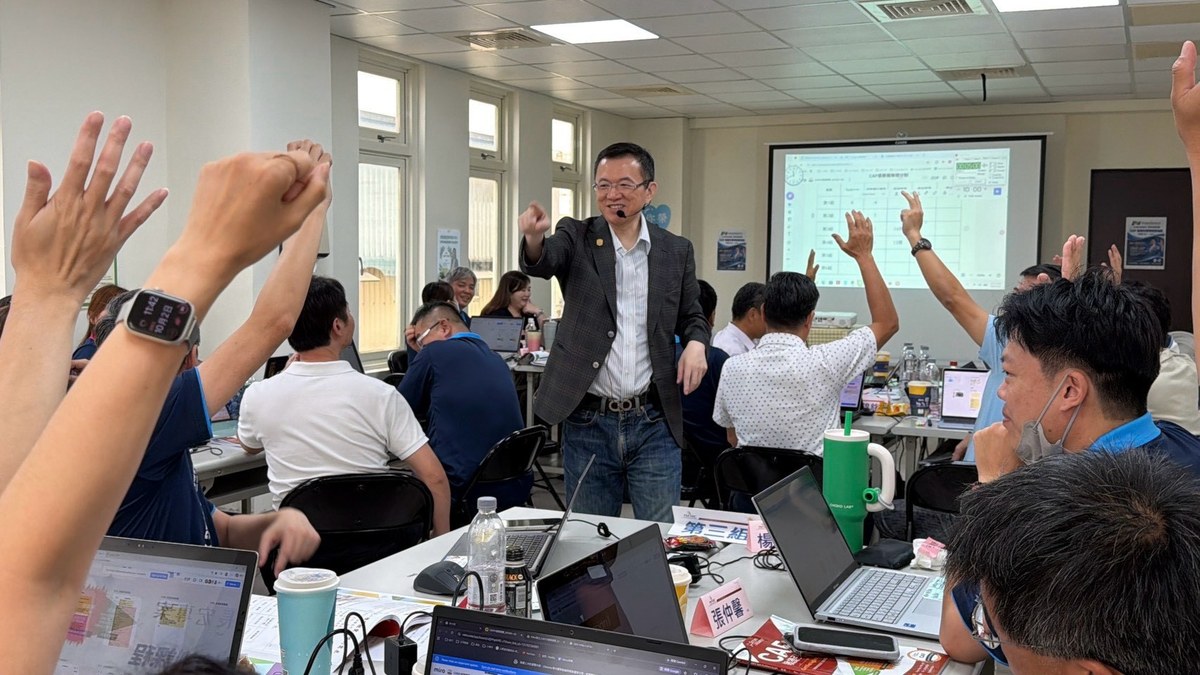
In the reflections after class, a few lines said it better than I could. One sales supervisor wrote: “A good leader, besides planning the process well, must learn to ‘shut up.'” Another sales supervisor said that since becoming a manager she cannot help stepping in to handle things for her team, and over these two days she decided to slow down and give the team more room to try.
The Last Hour: The General Manager Said “Good”
I know the usual shape of corporate training well: attend, graduate, get the certificate, go back to your post. A few months later most people have forgotten. So before the end of the second day I stopped and asked everyone: after today, is this just a certificate?
The next dozen minutes or so were the part I looked forward to most. Each group spent two minutes proposing “a real project you could invite me to coach,” written on a card. Three groups, three proposals. Then the twenty-three people in the room voted with sticky notes, with no limit on votes, and the top choice was the “Sandwich Bag Development Project.”
The colleague who proposed it explained why: the company was investing in a new platform and urgently needed new customers and new orders; the strategy was already set; the work would begin this month and run through at least December. I asked those who supported the project to raise their hands, one to five, and then turned to the General Manager: “General Manager, your decision.” He said: “Good.” I told the whole class on the spot that this “good” matters, because it means full support: when resources are needed, resources must be given.
A successor, in front of the whole company, took on a proposal that an employee had put forward, on the spot. That act carries more weight than any policy announcement, because from that moment the project was no longer a practice exercise. It had real customers, a real timeline, and the backing of management.
There was one more small design. Each participant received an “Agile Action Declaration Card” and wrote down one wish, small is fine. Then each found a Buddy from a different department, and every two weeks they would call or meet and ask each other: what did I do with facilitation, what worked, what did not? One HR colleague used a phrase in her reflection: the “boomerang effect.” She said that some courses give you a lot in the moment, then fade once you return to work, and that the ideas from this course would be “pulled back” in later work situations.
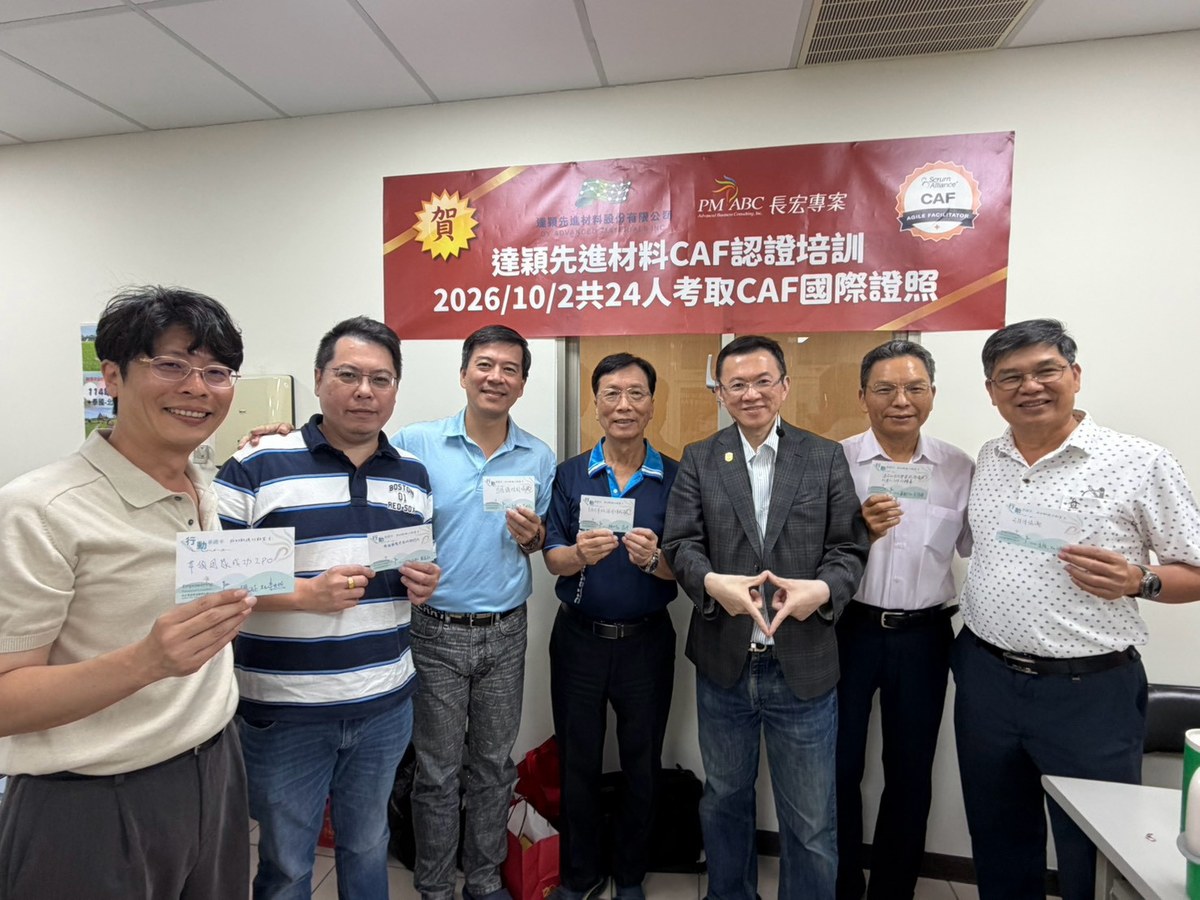
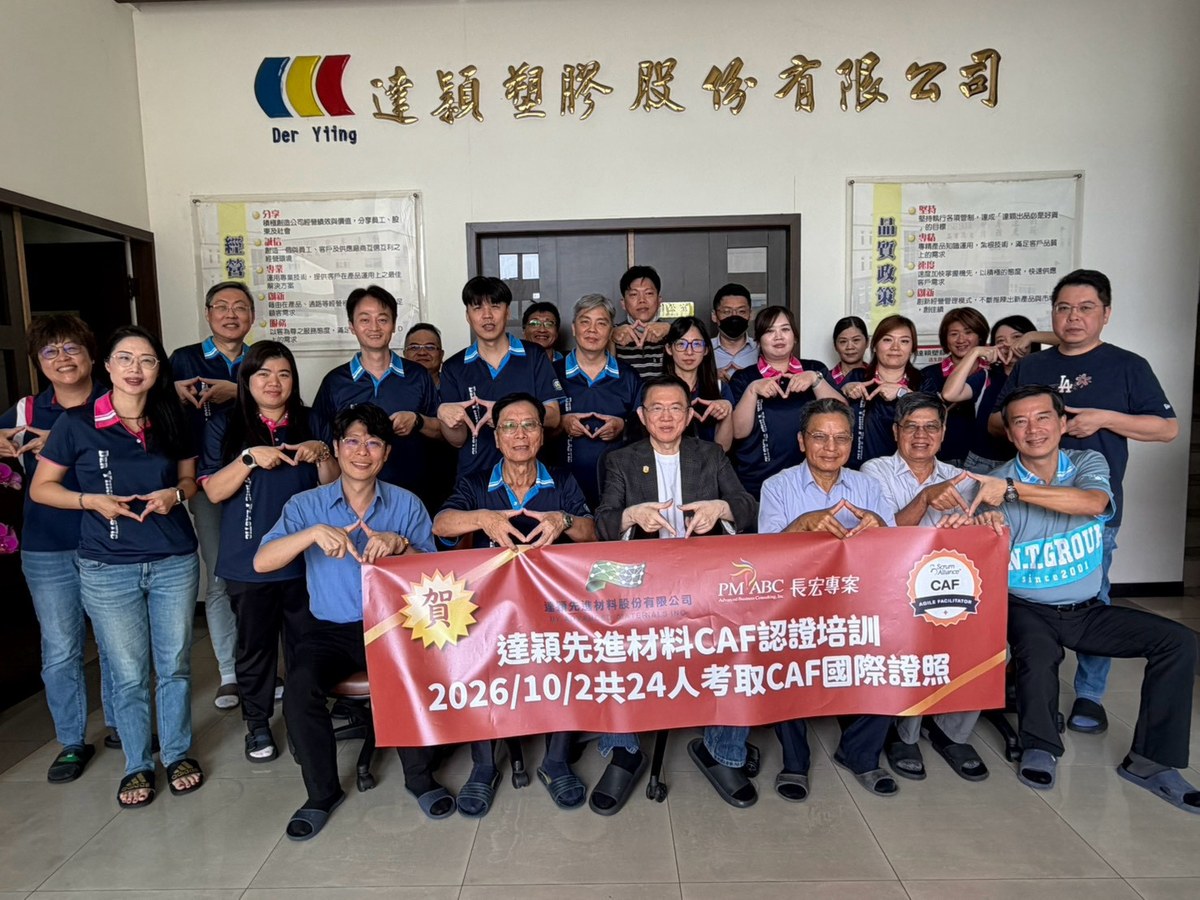
The certificates were awarded after all of this. On October 2, 23 participants received their CAF international certification.
Before the Public Listing Track, Decisions Must Be Repeatable
Der Ying Advanced Materials expects to move toward its next stage, the Taiwan emerging-company board and IPO, around the end of 2027. (These are different stages in procedure; here they only mark the timeline.)
In class I asked everyone to applaud this milestone, and reminded them that the next generation faces an age where answers get cheaper. Ideas are increasingly easy to get; AI can give you a hundred in a minute. But in a meeting room, who is willing to say, “I will carry this one”? AI cannot help with that for now.
When a company reaches the stage of going public, the market looks at revenue and profit. The homework inside is this: can the company’s decisions leave the founder’s head? Plants can be built with capital. The quality of decisions can only be trained, again and again.
Succession is hard not in handing over titles but in the sequence: when the founder starts to speak last, when the second generation dares to say “I will decide,” and when the veterans stop waiting for one person to give the answer. If one of these three is missing, the handover is just a change of position. In the classroom, General Manager Li has already taken the first step.
Closing: The Successor’s First Move
General Manager Shih-Fan Li said in front of everyone after the course: “I hope that starting next week, everyone will show some new energy at work. I will also try to adjust, using more ‘facilitation’ and listening more to your ideas and intentions. If I am a little rash and accidentally interrupt anyone’s remarks or suggestions, please just remind me directly.”
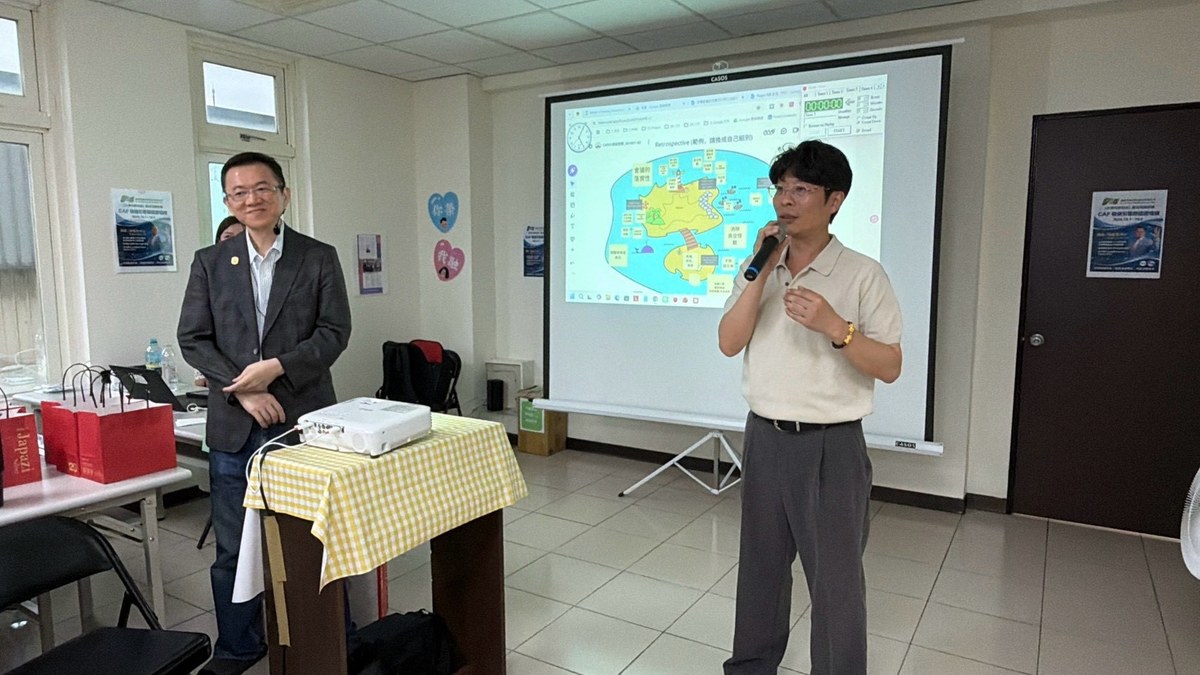
A successor who already has the answer asks everyone, in front of the whole class, to remind him when he interrupts someone. That act happens before any policy does. In the companies I have coached, the first change usually shows up not in the system but on the day the boss chooses to speak last. I have no statistics, only a pattern I keep seeing.
If you are a chairman, a general manager, or someone preparing for succession, take one meeting you were going to lead tomorrow and do one thing only: give your own answer last. Let everyone finish putting their information on the table, let the objections come out, and then notice whether you hear what you could not hear before.
Succession is not handing the answer to the next person. It is making sure the company no longer has only one person who has the answer.
No need to talk about courses yet. If you want to talk first, chairmen and second-generation leaders can write me three lines about “the hardest meeting to hold in your company.” HR leaders can tell me what the one sentence your managers are least willing to say is. My email is PMSuccess@gmail.com.
Appendix: Participant Reflections from Der Ying Advanced Materials’ CAF Course
Mike Li (李安重) / Chairman, Der Ying Advanced Materials
First, my thanks to Roger, the program team, and everyone who gave these two days their full effort.
When the General Manager proposed this training program, I will admit my heart “ached a little” when I saw the tuition. I have always believed learning is the most worthwhile long-term investment for a person and for a company, and I have never been stingy with training budgets, but this price was a new high. I still chose to support it fully. It is an investment in the company’s future, and since I encourage the General Manager, who is preparing to take over, to try many things, then as long as it does not harm the foundation of the company, I should be his backstop.
Fortunately everyone gained a great deal over these two days. I hope what we learned will carry the company forward and benefit all of us.
Finally, special thanks to the friends from the industry who came at our invitation. Honestly, I was quite nervous when I invited them. I have taken Roger’s courses myself and know their value, but I still worried I might fall short of everyone’s expectations. Only after hearing their praise, far beyond what I expected, could I finally breathe easy. The credit belongs entirely to Roger’s depth of knowledge and outstanding facilitation.
Thank you again to Roger, the team, and all my good friends!
Shih-Fan Li (李世帆) / General Manager, Der Ying Advanced Materials
Everyone worked hard these two days! I will keep this short so you can leave early and get home safely.
I hope that starting next week, everyone will show some new energy at work. I will also try to adjust, using more “facilitation” and listening more to your ideas and intentions.
And if I am a little rash and accidentally interrupt anyone’s remarks or suggestions, please just remind me directly! My boundaries are open. If you see me doing something poorly, you are welcome to give me suggestions at any time.
Thank you all again. Well done, everyone!
蔡O宏 (Tsai O. Hung) / Chairman, I.N.T. International Inc. (怡凌股份)
Many thanks for these two days of learning.
At first I felt the two days would be a real challenge, and I spent a good deal of time practicing for the exam. I took several mock exams, and only after I truly understood the material did I slowly sense the value of this system.
I think the biggest gain from this course is that it let us see different management systems and ways of thinking from the viewpoint of a business owner.
Our company has been around for a while. In the past we might have felt that a traditional industry cannot easily transform, and even wondered whether we could only maintain the status quo. Through this learning I reconsidered: whether it is a traditional industry or a small or mid-sized company, there is still a chance to transform and change. We should not think only about how far we have come, but keep moving to the next stage.
These two days also taught me that repeated practice and understanding matter a great deal. Mock exams are not only for high scores. By reading question after question and understanding the answers, the knowledge slowly comes together. That is one of my biggest gains this time.
During these two days I took part in the CAF course that the senior Chairman Li and General Manager Li warmly invited me to. Studying alongside Der Ying’s elite team, I felt that besides the two leaders, every single person is truly an elite, a strong hitter. In class, people were willing to share good things and even more willing to voice what they hope for the company. What I admire most is the natural cohesion and unity of the Der Ying team, the warmth of a harmonious family. I envy everyone for growing up in such a big family, such a good company, with such a fine environment.
Der Ying’s Vice President also mentioned that both my company and Der Ying were fortunate to be shortlisted for the Taoyuan Golden Enterprise Award. To Chairman Li, whom I have known for many years, it is something everyone sees as well-deserved and long awaited. I am very happy that my company was shortlisted alongside, and proud to share in the honor. Being shortlisted is already a win. This is I.N.T.’s first time, and I would not dare to think about whether we win in the end. I am simply grateful.
Learning together with the Der Ying team for two days also felt wonderfully refreshing. Thank you, Der Ying team, for keeping us company!
范O錦 (Fan O. Chin) / Chairman, Ever Camel Plastic Industrial Corp. (駱恆股份)
Thank you all for these two days.
The course left a deep impression on me. In the past our management style leaned toward a “one-man show”: in meetings, one person usually talks while everyone else listens.
After this course, I hope I can go back and become a better listener.
In my work and management from now on, I want to hear everyone’s ideas first, and then carry out the decision. I will also bring the ideas I learned back to the company and put them into practice step by step.
For me, this course is not only my own learning but also a process of passing something on. I hope to keep these ideas going, so that more people can learn and practice them together.
蔡O弘 (Tsai O. Hong) / Chairman, I-DA Straw Co., Ltd. (毅達吸管)
Time flew; two days were over in a moment. Thank you very much to Chairman Li for inviting us to this course, and to the instructor for leading it. Overall I gained a great deal over these two days.
Even during class, I had already started thinking about how to apply this method in practice back at the company, including future meetings, team management, and finding and developing talent.
After I return, I hope to truly put this system to use, so that the learning does not stay in the classroom but lands in real work.
白O銘 (Pai O. Ming) / Chairman, Li Fong Machinery Co., Ltd. (利峰機械)
First, thank you to Chairman Li for giving us this opportunity to learn, and thank you to the instructor for teaching us these two days.
We have had little contact with courses like this in the past, but having taken part, I feel I learned many new ideas and methods.
Although we are somewhat older, I believe this learning will still help the future management of our company a great deal, especially in how we see things, handle things, and interact with the team. It has the potential to change them.
When I go back, I hope to start by testing it with the smallest team, putting what I learned over these two days into practice, and then gradually expanding to other teams. I hope that through real trials this learning can truly take root.
楊O盛 (Yang O. Sheng) / Vice President, Der Ying Advanced Materials
These two days made me deeply aware that listening is very important.
At work we are used to expressing our own ideas. We talk a lot, yet easily overlook truly listening to the other person.
Through this learning I understood that listening is not just hearing someone speak. It matters more to understand what the other person is thinking, so that different opinions can be heard and the team’s consensus can form.
When a decision comes out of everyone’s discussion and consensus, team members are also more willing to commit and execute. So in driving projects and work from now on, I hope to put more weight on listening and on building consensus.
謝O妤 (Hsieh O. Yu) / Procurement Specialist, Der Ying Advanced Materials
Taking this course was a very different learning experience for me.
My daily work involves many tasks and a lot of detail, so before the course began I sometimes felt a bit of resistance because of how busy I was, and even felt that setting aside extra time for a course was a burden. But once I actually took part, I found the learning quite rewarding.
Besides exposing me to communication and leadership skills I had rarely encountered, the more important thing was that, by learning with different colleagues in each group, I got to know the people around me again.
At work we may only see each other’s roles and performance, but through the interactions in class I found that every colleague has different strengths and skills, and that there is a lot to learn from them. For example, when I took the course alongside O-yi from my group, I found she has the habit of reading and joining book clubs, has her own ideas in writing and sharing, and can offer observations and feedback from different angles. These are qualities one does not always get to see at work, and they gave me more understanding and appreciation of my colleague.
So I feel the biggest gain from this course is not only new knowledge and skills, but seeing, through shared learning and exchange, the different qualities and strengths of every colleague around me.
I am also grateful to the company for providing this opportunity, so that outside our busy work we could learn from and get to know one another through the course, and improve understanding and cooperation within the team.
紀O宜 (Chi O. Yi) / Sales Specialist, Der Ying Advanced Materials
Thank you to my supervisor for giving me this chance to learn.
In my past work experience there was little training this complete, so this course was a rare learning experience for me.
I enjoy exchanging with people and sharing my ideas, so when I join book clubs or talk with others I am used to voicing my own opinions.
But this course showed me that often what really matters is not only whether I can express my own ideas, but whether I can help everyone say what is on their mind. Some people have a lot of ideas but do not know how to express them, or worry about saying them badly, and in the end choose to say nothing.
So how to use facilitation to give everyone a chance to speak is my big takeaway. At work, I hope to use this approach in leading my team, so that we learn together and the team gets better.
Also, because I love literature and joining book clubs, I hope to share what I learned and bring it into more exchange and learning.
劉O淇 (Liu O. Chi) / HR Specialist, Der Ying Advanced Materials
From the first contact about this course through its planning and execution, I was involved all the way, so seeing how everyone took part over these two days left a deep impression.
From the very beginning of planning, I could sense the instructor’s care in designing the course. From how groups were formed and how seats were arranged to the design of the whole venue, every detail had been thought through, not just the course content prepared. Once the instructor began leading, it felt as if we all walked into a “canvas” the instructor had designed, and slowly took part, interacted, and discovered along the way.
What struck me most this time was that people were more willing than before to express their real feelings and thoughts. I had worried a little that when it came to work problems or differing opinions, people would hold back, but in fact everyone was willing to share. That made me feel how important the “psychological safety” built by the course is. When people know they share an attitude of learning together, they can lower their guard and speak their minds.
What I liked most and found most inspiring was the “Diamond Model”. I think each of us is like a diamond not yet polished, and the different opinions, personalities, and viewpoints in a team are like the process of polishing against one another. The polishing is not always comfortable, but precisely because we collide and learn from each other, we slowly mature, and the team gains more possibilities.
I also liked another feature of the instructor’s course, which I call the “boomerang effect”. After some courses you feel you gained a lot at the moment, but slowly forget once you return to work. This course was different: its concepts and methods get “hooked back” in later work situations, reminding us that this method can be used in our own work too.
陳O暐 (Chen O. Wei) / Procurement, Der Ying Advanced Materials
What struck me most in this course was rediscovering how important “listening” is in work communication.
I never thought I did not listen at all. Rather, when communicating, my own thoughts or work concerns easily kept me from putting my attention on what the other person was actually saying. The “paraphrasing” technique the instructor mentioned hit home and made me realize this is a blind spot in my work.
Sometimes when a colleague explains something to me, because we understand it differently, I ask them to repeat it, or even state my own opinion before I truly understand theirs. Over time, this way of communicating makes the other person feel misunderstood and may create negative feelings that hurt our cooperation.
So through this course I learned that in communication I can first use “paraphrasing” to confirm whether I truly understand the other person’s question and thinking, to avoid continued misunderstanding from differing perceptions.
I believe that when we first understand the other person and then respond and discuss, we not only reduce gaps in communication, we also move work forward more smoothly. This is my biggest takeaway at work, and a reminder to focus more on listening and understanding.
周O妤 (Chou O. Yu) / Marketing Planning Supervisor, Der Ying Advanced Materials
Thank you to the Chairman for giving me the chance to take this course.
I am not good at speaking in public and get nervous easily; I feel nervous whenever I go on stage.
So for me, besides learning about leadership and leading teams, this course also made me start thinking that I should practice saying the things I dare not say. In meetings, with colleagues, or anywhere in the company, if I have an idea or a proposal, I hope to be braver in raising it.
I am also grateful to my group mates this time. Discussing and learning together in class, I saw everyone’s strengths. Especially in teamwork, I could feel that each person is good at something different, and exchanging with them gave me a chance to learn from others. This is an important takeaway of the course for me.
陳O婷 (Chen O. Ting) / Sales Supervisor, Der Ying Advanced Materials
First, thank you to my supervisor for this opportunity, and thank you to the company for such a rich course and learning environment.
One of the biggest gains from these two days was rediscovering how important “listening” is.
Since becoming a supervisor, I sometimes really can’t help stepping in to handle many things for my people, or telling them directly what to do. After these two days, I feel I should slow myself down, listen more, and give team members more chances to try. Rather than giving the answer right away, I should guide them in a coaching way.
I also feel “trial and error” is a very important learning process. A supervisor needs tolerance and room for mistakes, so team members can learn and grow through attempts and errors.
張O昇 (Chang O. Sheng) / Quality Assurance, Der Ying Advanced Materials
In the past we had already come across some agile activities and courses, and even practiced them for a while.
After this course, I found it differed from my earlier understanding, and it let me step out of my old way of thinking and see another direction.
I think my biggest gain is a fresh understanding of how agile can be applied. In the past I was familiar with PO, SM, and Kanban, and this course added different tools and applications such as the Diamond Model. By using different models, we can think about a problem from different structures and angles, and so guide out better solutions.
So I take “guiding out the best solution” as my most important takeaway from this course.
林O偉 (Lin O. Wei) / Sales Supervisor, Der Ying Advanced Materials
My biggest gain from these two days was learning that a good leader, besides planning the process well, must learn to “shut up.”
In the past I was used to giving advice and rushed to supply answers. Through this course I found that leading is not telling people what to do, but using facilitation and questions so they think for themselves and find their own answers.
So I believe the point of leading is not to hand out advice directly, but to let the other person discover the problem and find a direction, and from there develop action that truly belongs to them.