From Strategy Failure to Seeing the Real Problem
Over the years, while working alongside companies going through transformation, one thing I have heard senior executives say again and again is: “It’s not that we lack strategy—we just can’t get it moving.”
Behind that sentence is a deep sense of frustration. For a CEO, founder, or general manager, the most powerless moment is often not failing to understand the market. It is seeing the direction clearly, knowing what needs to be done, and still watching the strategy slowly die in the conference room.
On the surface, many companies appear to be dealing with an execution problem. But at a deeper level, what is often breaking down is the organization’s capacity to learn. The issue is not a lack of direction. It is a lack of ability to help a group of smart people develop sound judgment together in an environment defined by pressure, speed, and uncertainty.
That is where the real paradox shows up: each person looks highly capable on their own, but when brought together, they do not produce greater collective intelligence.

Why The Fifth Discipline Still Matters
At the beginning of The Fifth Discipline:The Art and Practice of The Learning Organization, Peter Senge poses a striking question: why is it that in many teams, every individual member has an IQ above 120, yet the team’s collective IQ is only 63? He also argues that the most successful organizations of the future will be learning organizations, and that the only sustainable advantage is the ability to learn faster than the competition.
What made this book a classic is that it clearly articulated the foundational capabilities behind organizational evolution: personal mastery, mental models, shared vision, team learning, and systems thinking. Among them, systems thinking is the discipline that integrates the other four.
The challenge is that more than thirty years after these ideas were introduced, relatively few companies have truly put them into practice. The issue is not that people are unaware of the theory. It is that most organizations have overlooked a critical gap that is rarely made explicit: if an organization cannot engage in high-quality dialogue, the five disciplines never really come to life.
Why Most Meetings Aren’t Really About Thinking Together
In many organizations, meetings look like spaces for thinking, but in reality, they are not. Someone is giving a report. Someone else is defending their position. Someone is trying to guess what the boss wants to hear. And someone says nothing the entire time, only to offer the most insightful comments later in the hallway.
So meetings keep multiplying, while truth becomes harder and harder to find. Surface-level alignment looks stronger, but beneath it, the internal divide only grows wider.

Peter Senge makes an important distinction when he talks about team learning: ordinary discussion is not the same as genuine dialogue. The real turning point is not getting people to say more. It is creating the conditions for underlying assumptions to surface.
A lot of companies do not fail because they lack answers. They fail because the assumptions that actually determine the quality of those answers are never put on the table.
At that point, what is needed is not authority, tight control, or polished speaking skills. What is needed is a more advanced leadership capability: facilitation.
Facilitation Is Not a Workshop Technique. It Is the Interface for Organizational Evolution

A lot of people assume facilitation is about sticky notes, energizing the room, and keeping the session running smoothly. Honestly, if that were all it was, CEOs would have no reason to learn it. They could just bring in an outside consultant to run a few workshops.
But real, high-level facilitation is something entirely different. At its core, facilitation is about designing collective thinking. It creates the conditions for people to speak honestly, for hidden mental models to surface, and for conflict to become more than simple opposition—to become a way of seeing the system more clearly. It helps organizations move from top-down compliance to shared judgment, and it gives strategies that would otherwise die in the meeting room a chance to come back to life.
Peter Senge’s classic 1990 book The Fifth Discipline: The Art & Practice of the Learning Organization introduced five core disciplines required to build a learning organization. Among them, the most fundamental is Systems Thinking.
This framework explains how organizations develop the capacity for continuous learning and evolution through shared vision, mental models, team learning, and personal mastery.
The Fifth Discipline: The Art & Practice of the Learning Organization, published by Peter Senge in 1990, is a classic work that introduced five disciplines describing the core capabilities required to build a learning organization. Among them, the most critical is Systems Thinking.
If The Fifth Discipline outlines the capability framework for building a learning organization, then in real organizations, the element that actually brings these capabilities to life is a rarely discussed capability—facilitation. It is not merely a “nice-to-have” skill, but a foundational capability for how organizations operate. And it is not simply a soft skill; it is a hard asset that directly influences the quality of decision-making and the emergence of collective intelligence.
A Large Company with More Than 500 Employees Showed Me the Real Power of Facilitation
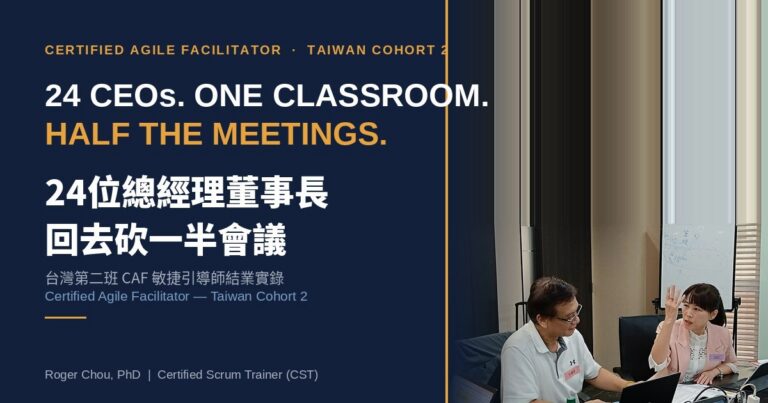
Many people know me as Taiwan’s first Certified Scrum Trainer. Over the years, I have spent a great deal of time helping senior executives learn Scrum, CSM, CSPO, and enterprise agility, and I have worked with more than 300 CEOs, founders, and senior leaders as they stepped into the world of product thinking and agile leadership.
One of the cases that has stayed with me most in recent years involved a large Taiwanese company with more than 500 employees. It had a long history and a mature organizational structure. In most people’s eyes, it was the definition of a stable, traditional large enterprise. And that is exactly why its willingness to begin a transformation made the case so meaningful.
What stood out was that this was not a situation where a few mid-level managers experimented on the side. The company launched learning at an organizational level. All of its senior executives went through CSPO training, and what left the deepest impression on me was that the general manager personally committed to the process. At the time, he said something I still remember clearly: “It’s not that we lack strategy. What we lack is the ability to think about the future together.”
From there, through a series of facilitated workshops, the senior team moved beyond simply attending training sessions and began tackling more fundamental questions together: What is really changing for our customers? What value are we truly trying to create? Why are our product decisions always one step behind? When cross-functional collaboration gets stuck, is it really just a process issue—or something more?
Once those questions were opened up, many truths that would never have surfaced in a formal meeting began to emerge. And more importantly, the results started to follow. Product discussions that used to require multiple layers of approval and endless back-and-forth began to focus much faster on value and priorities within a single shared conversation. Cross-functional conversations that once felt like separate departments talking past one another gradually shifted into a common language around customers, value, and direction. Senior leaders who were used to giving answers first began learning to ask questions first, see the system first, and make space for different perspectives before forcing conclusions.
These changes may not show up immediately in the numbers on a financial report. But they do appear first in something even more important: the leading indicators. Decision-making gets faster. Discussion gets deeper. Collaboration becomes real.
A lot of transformations fail because companies focus only on the final outcome while ignoring the fact that, before results improve, the early signs of high-quality decision-making have to appear first. That is the deepest lesson I took away from this company: when senior leaders truly begin thinking together, the organization develops an entirely different sense of speed and direction.
Why Facilitation Will Become Even More Valuable in the Age of AI

Today, this matters even more than it did three or five years ago. AI is here, and it is moving fast. Leaders everywhere are talking about AI adoption, AI agents, and process automation. All of that matters. But in my view, the real question is not how much AI can do. It is this: when AI takes on more and more of the execution and analysis, what human advantage is actually left?
My answer is clear: what remains is collective judgment, value-based choices, cross-functional integration, and the ability to make high-quality decisions together in the face of complex systems.
That means the competition ahead will not be defined only by products, or even by efficiency. It will be a competition in organizational learning speed—or more precisely, in the quality of organizational decision-making. The companies that gain an edge will be the ones that can surface assumptions earlier, handle conflict more maturely, and help a group of smart people move beyond debate into real shared thinking.
CAF: Why I See It as a Next-Generation Leadership Capability
That is exactly why I have gradually integrated my years of experience in Scrum, enterprise transformation, team learning, and executive coaching into a more complete capability system: CAF, or Certified Agile Facilitator.
I want to be clear about one thing: CAF is not just a certification. It is a full developmental journey—from reframing how leaders think, to practicing facilitation, to applying it in real-world situations. It is not about teaching people how to run lively workshops. It is about training people to make collective intelligence possible in environments marked by high complexity, high uncertainty, and steep power gradients.
More concretely, it helps leaders rethink four things: how to make meetings more than just information exchange; how to turn conflict into a gateway to insight; how to hear the truth without relying on authority or pressure; and how to make strategy something the whole team truly understands, not something only the leader holds.
The leaders of the future will need to do more than set strategy. They will need to design the conversations that allow strategy to survive. That, to me, is the real value of CAF. It is not just the name of a course. It is a next-generation leadership capability.
One Final Question I Hope You Will Sit With
If you are thinking about transformation in your organization today, I would invite you not to ask only: Should we adopt AI? Should we become more agile? Should we redesign the organization?
A more important question is this: can our organization actually think together?
If the answer is still unclear, then the capability you most need to invest in may not be another management tool. It may be a capability that will only become more valuable over the next decade.
That capability is facilitation.
Not the kind that simply energizes the room.
Not the kind that just makes people feel more involved.
But the kind that makes real organizational learning possible, keeps strategy from dying in the meeting room, and helps a group of smart people develop something close to collective genius.
Because I believe the strongest form of leadership in the age of AI is not just better analysis. It is the ability to help people make sense of complexity—and make sound judgments—together.
And the companies that will be most competitive in the future will not simply be the ones that adopt more tools. They will be the ones that have more leaders who know how to unlock collective intelligence.