The Next Battlefield: Not IT, But “Power and Decision-Making”
This was not a routine courtesy call. When I met separately with Scrum Alliance’s CGO and CMO, the conversation bypassed the usual vanity metrics of class sizes or certification numbers.
They came with a core problem statement that is vexing headquarters:
Why has Scrum in the West been pigeonholed into IT and compliance, while in Taiwan, it is embraced by the C-Suite as a “Leadership Operating System”?
Superficially, this looks like a market difference. Fundamentally, it is a difference in the tier of judgment. In most markets, critical judgment in Scrum has been delegated down to process adherence and roles. In Taiwan, we deliberately elevated Scrum to where it belongs: the management and leadership layer. We focus on the existential questions: Is this value worth creating? What comes first? Who owns the decision?

The “Ferrari in Gridlock” Paradox
This discussion confirmed a vital reality: The “Value-Driven, Decision-Centric Model” I have validated in Taiwan has formally entered Scrum Alliance’s global strategic radar. We are no longer just being seen; we are being needed.
In many regions, organizations are mastering the ceremonies of Scrum while failing at the speed of business. The Daily Scrum happens, the Demo is polished, and the Retrospective generates action items. Yet, the underlying dysfunctions remain:
- Centralized decision-making bottlenecks.
- Layers of bureaucratic approval.
- Information silos.
- Diffusion of responsibility.
When these four toxins coexist, a “perfect” Scrum implementation is like a Ferrari stuck in gridlock: the engine is powerful, but the system prevents movement.
What I see in the field is rarely a process failure; it is a structural failure of power distribution. Taiwan was “tapped” by Scrum Alliance because we stopped fixing the framework and started fixing the organization. We asked: How do we redistribute decision rights? How do we ensure value judgment happens at the source?This is not just a track record; it is a verifiable model. Consider the recent global discourse around NVidia. The surface debate concerns compliance and markets, but the underlying driver of their success is that Jensen Huang refuses to delegate critical judgment to “process.” He retains high-velocity decision-making at the top. Taiwan’s Scrum implementation mirrors this philosophy: we don’t standardize Scrum; we install it where the judgments are made.

Repositioning the CSPO: From “Product Manager” to “Value Leader”
In driving the CSPO certification in Taiwan, I made a calculated deviation from the global norm. I rebranded CSPO from a “Software Product Manager Course” to “Training for Value-Driven Leaders.”
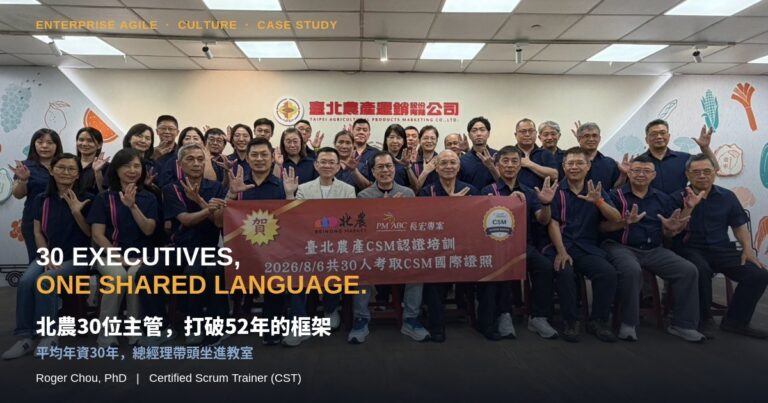
The market response was immediate and transformative. My classrooms are no longer filled solely with PMs. They are populated by CEOs, HR Directors, Brand Strategists, and R&D Heads. They aren’t there to learn backlog grooming; they are there to import the logic of the Product Owner—value maximization and ruthless prioritization—into their executive decision-making.
This shift triggered a network effect:
The Scrum Alliance certification ceased to be a badge of individual capability and became a corporate lingua franca—a shared language for discussing value and decision quality.
When a market converts a certification into an enterprise-level language, it graduates from a “local market” to a “global strategic blueprint.” This is why the C-Suite executives from headquarters flew in (virtually) to listen. They aren’t studying our numbers; they are studying our model for replication.

The Maturity Flywheel: Integrating CSM, CSPO, and CAF
I have never viewed the CSM (ScrumMaster), CSPO, and CAF (Agile Facilitation) as standalone products. They are distinct milestones on an organizational maturity roadmap.
- Level 1 | CSM: The Managerial Shift
- Transforms the manager from “Commander” to “Head Coach.”
- Goal: Moving from chaos to a self-regulating operating rhythm.
- Level 2 | CSPO: The Strategic Shift
- Transforms the leader from “Chasing Progress” to “Defining Value.”
- Goal: Shifting focus from output (volume) to outcome (business/user value).
- Level 3 | CAF: The Systemic Shift
- Transforms the organization from “Hero-Dependence” to “Collective Intelligence.”
- Goal: Enabling the system to dialogue, align, and self-correct without executive intervention.
This isn’t a curriculum; it is a flywheel. It is a replicable path for organizational scaling. When Scrum Alliance observed that Taiwan wasn’t selling “classes” but building an ecosystem that generates leaders, the question became inevitable: If this works in Taiwan, can it unlock APEC and the greater Mandarin-speaking world?

Four Strategic Pillars for the Asian Market
In my strategic dialogue with CGO Dean, I was direct:
If Scrum is to grow in Asia, we must change its “Default Installation Directory.”
I proposed four pillars for strategic upgrades:
- Establish “Organizational Presence” The Asian community doesn’t need another event; it needs commitment. The PMI (Project Management Institute) scaled through the Chapter system, which created a sense of permanence. Scrum Alliance doesn’t need to copy this, but it must define an “Asian Presence” that signals long-term partnership.
- Re-architect the Learning Pathway Micro-learning is the entry point; CSM/CSPO is the backbone; CAF is the deep dive. In the AI era, translation is cheap. What is scarce—and valuable—is the “High-Quality Finalizer,” the person who contextualizes content for local decision-makers.
- Strategically Exit the IT Silo AI is rewriting software delivery. The new value proposition for Scrum is in high-collaboration, high-stakes environments: Pharma, Construction, Manufacturing, Finance, and Government. This is where the collaboration deficit is highest, and where Scrum is most needed.

4. Upgrade, Don’t Antagonize, Project Management Project management isn’t disappearing; it is becoming more complex. We should not frame Scrum as the enemy of the PMP. Instead, Scrum is the “Upgrade Engine” that helps Project Managers evolve from schedule-trackers to steady delivery leaders.
The Synthesis: The future of Scrum lies in upgrading mindsets, roles, and industry scope. Asia is the tipping point for this transition.
Rewriting the Global Narrative: Taiwan as the Flagship Case Study
My conversation with CMO Tracee confirmed the trajectory. We weren’t discussing marketing tactics; we were aligning on a global narrative strategy.
We agreed that Taiwan’s evolution over the past two years serves as the proof-of-concept for Scrum’s next era—moving from a software delivery framework to a cross-industry capability for leadership and collaboration.
We discussed tangible collaborations:
- Utilizing Taiwan’s cross-industry case studies for APEC campaigns.
- Leveraging these “Flagship Cases” for global brand recognition.
- Tailoring white papers and landing pages to speak the language of business, not just code.

To put it bluntly: Taiwan isn’t seeking more exposure. Taiwan is positioned to become the “Reference Implementation” for Scrum Alliance’s global storytelling.
The Ask: A Partnership for the Future
My expectations for Scrum Alliance are clear. I am not asking for resources; I am proposing a partnership to co-design the future.
- I expect Scrum Alliance to view Asia as an innovation lab, not just a revenue stream.
- I expect a tangible local presence that tells our corporations: “We are here with you.”
- I expect a brave expansion beyond IT borders, recognizing that value lies in the human dynamics of decision-making.
- I expect us to embrace Project Managers and offer them a path to evolution.
If Agile is an operating system, now is the time to re-code its installation path.
Conclusion: The Call to the Stage
Being interviewed by the C-Suite of a global organization is an honor, but the implications outweigh the prestige.
Scrum Alliance is facing a “NVidia moment”: the choice is not which market to enter, but whether to keep relying on old models or to embrace a new architecture of judgment.
Taiwan has been tapped not because we are the loudest, but because we have proven a thesis: When you restore Scrum to the decision-making layer, it ceases to be a method and becomes an engine.

We have been called to the global stage. The task now is not to celebrate the news, but to widen this path into a highway that Asia can travel and the world can trust.
This is just the beginning.