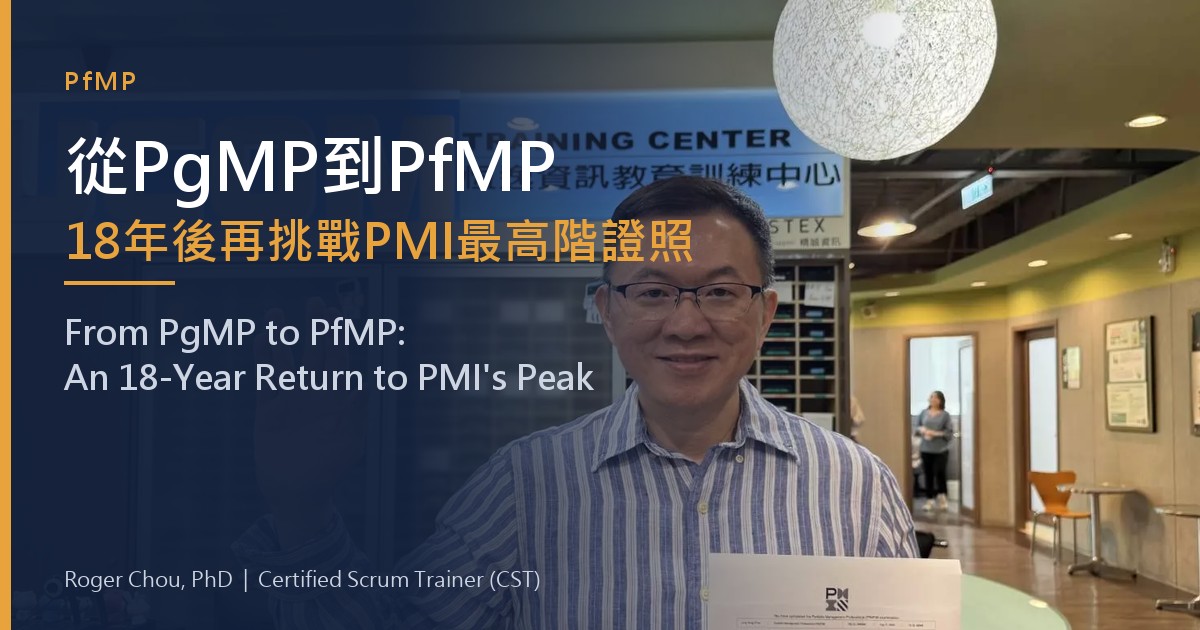

It has actually been quite some time since I last set out to pursue such a challenging certification. After becoming a CST (International Scrum Ambassador), many people dedicate significant effort to cultivating more CSMs and CSPOs—a path that indeed plays an important role in spreading agility. But for me, certifications have never been the destination, nor a means to economic gain. They have always served as bridges, carrying vision and mission. This time, by choosing to take on the PfMP (Portfolio Management Professional), the highest-level certification within the PMI system, I see it less as a credential to obtain and more as a journey of self-breakthrough and an extension of responsibility.
PMI’s second-highest certification is the PgMP (Program Management Professional), which I obtained on Christmas Day in 2008. I applied it to accomplish many meaningful initiatives, including uniting 300 PMPs to contribute to disaster relief efforts during the Typhoon Morakot flood.
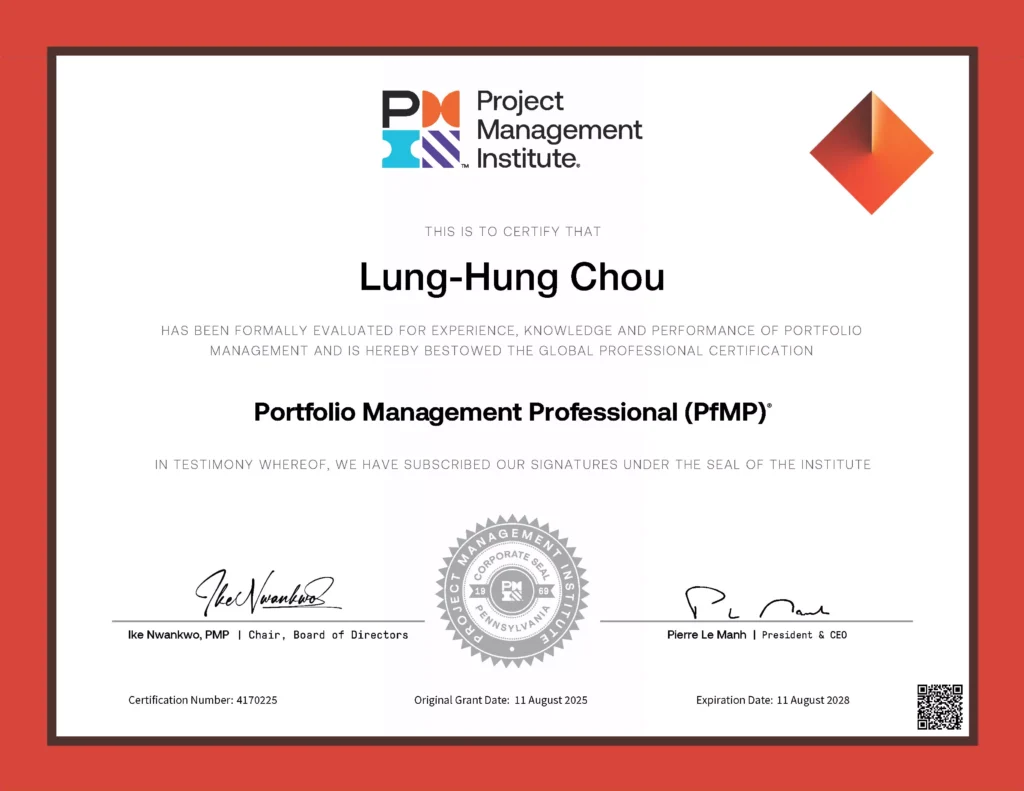
Eighteen years later, I once again challenged myself by pursuing the PfMP. To me, this is not just a certification in strategic portfolio management, but one that carries extraordinary symbolic significance.

The Positioning of PfMP: Strategic Portfolio Management
The focus of PfMP goes far beyond traditional project management. If PgMP represents Program Management, then PfMP stands for Strategic Portfolio Management.
At its core, portfolio strategy means that while an enterprise may have vision and direction, the way to bring them to life is through portfolio management. This includes major programs, projects, and even day-to-day operations. These initiatives may complement one another, but they don’t need to be directly connected—as long as they collectively support the enterprise’s strategy, they are part of the portfolio.
However, many companies tend to leap straight from strategic planning into project management, leaving a critical gap in between: the methodology to bridge vision and execution. This missing methodology is precisely the strategic management framework that PfMP provides.
There are only about 1,700 people worldwide, and just 9 in Taiwan
Since its launch in 2014, PfMP has been around for 11 years, yet there are only about 1,700 holders worldwide—and just 9 in Taiwan, including myself. Those who have completed the full journey from PMP, ACP, PBA, RMP, PgMP, all the way to PfMP are even rarer; I might even be the only one in Taiwan. But this isn’t about flaunting a “full collection” of certifications. What I want to emphasize is that these credentials are not merely stepping stones for career advancement—they represent a knowledge system forged through countless trials and refinements.
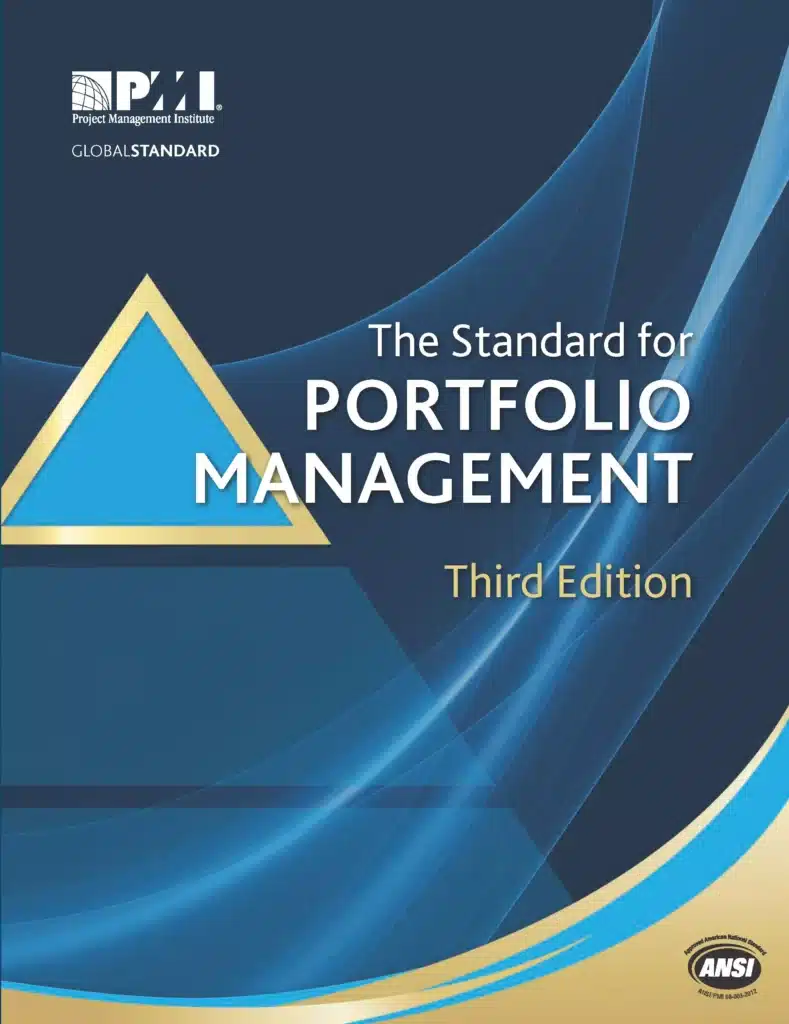
Take PMP as an example: behind it stands the classic PMBOK® Guide (Project Management Body of Knowledge). Similarly, behind PfMP is The Standard for Portfolio Management. These guides are not ivory-tower theories; they are distilled wisdom, validated through the experience of countless practitioners, and have become tools and levers we can truly apply today.
Providing Leverage for Agile Transformation
For me, the significance of PfMP lies in its role as a powerful lever for driving enterprise agile transformation. If my vision is to help one hundred companies successfully transform within the next decade, then the PfMP methodology provides the means to accelerate transformation, align it more closely with corporate strategy, and directly address organizational pain points.
Agility is a way to respond quickly, but without a clear direction, it’s easy to run in circles or backtrack. PfMP offers the strategic management compass that complements agile practices—ensuring companies don’t just move fast, but move in the right direction. Let me share a few industry applications:
- IT Companies: In the early stages of agile adoption, combining it with PfMP would have helped identify strategic implementation paths sooner and enabled quicker course correction.
- Pharmaceutical Firms: Even when Taiwan is not the R&D headquarters, PfMP can guide marketing strategies, making local market promotion more systematic.
- Network Maintenance & Customer Service Providers: With a focus on service delivery, PfMP helps anchor strategy and optimize resource allocation.
- Long-Established Restaurant Chains: Even after decades of operation, PfMP can help rediscover positioning and re-plan transformation pathways.
I often say: CSM is the Heaven-Reliant Sword, CSPO is the Dragon-Slaying Saber, and PfMP is the ultimate compass—a compass that can evolve with the trends of the times. Having all three equips me to guide enterprises through transformation with greater stability, ensuring I stand on unshakable ground.
PfMP’s five knowledge domains and three process groups
PfMP is composed of five knowledge domains:
- Strategic Management
- Governance Management
- Performance Management
- Communication Management
- Risk Management
At the same time, it is also divided into three process groups:
- Defining: Includes outputs such as the strategic plan, portfolio charter, and portfolio roadmap.
- Aligning: Expands the strategic management plan into performance, communication, and risk management plans.
- Authorizing & Controlling: Translates management plans into execution actions and ensures implementation.
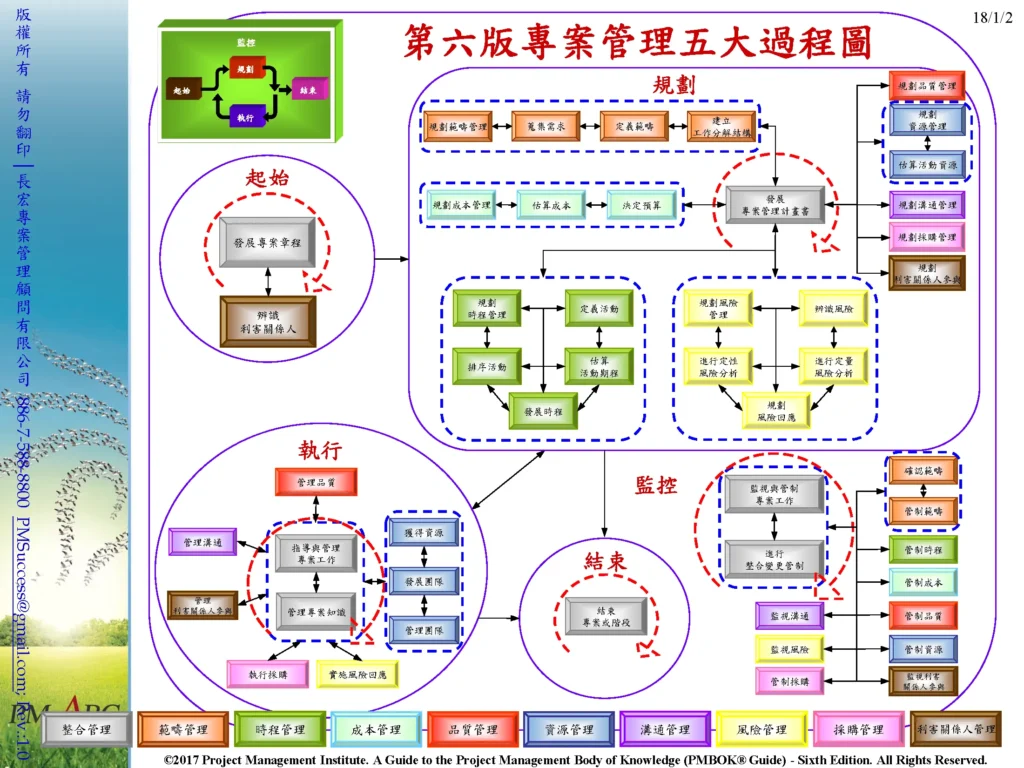
I translated PfMP’s five performance domains and 16 process diagrams into Traditional Chinese to make it easier for everyone to compare with PMP’s 49 subprocesses. Some may think that PfMP looks simpler, but in fact, it is “concise and essential” because it focuses on the “direction at the top,” rather than the execution details.


PfMP vs. PgMP Difficulty Comparison
Using a relative comparison:
- PfMP difficulty ≈ 1.5 times that of PMP
- PgMP difficulty ≈ 2 times that of PfMP
Therefore, PgMP is still regarded as the most difficult of PMI’s advanced certifications. However, the strategic management value of PfMP makes it more practically meaningful for senior executives and transformation leaders.
Exam Experience and Recommendations
At the testing center, I spent about three hours completing all the questions (with a total of four hours available). The overall process went very smoothly, and the results turned out just as I had hoped.
The only regret was not preparing my PfMP application in advance, which caused me to lose an extra month. Since PMI requires up to 60 days for application review, and my preparation period was around three months, I ended up spending the first month just submitting the application. As a result, I could have taken the exam in the second month, but it was delayed until the third.
Therefore, my advice for future candidates is:
- Complete your PfMP application first: This will save you valuable waiting time.
- Plan for a two-month study period: The PfMP body of knowledge is not overly large; with a systematic approach, two months is sufficient.
- If I could do it again: I would memorize all the ITTOs in advance. There are only about a hundred, but they are extremely helpful in shaping problem-solving logic. I was able to recall and write them down within about eight minutes.
Conclusion: The Emergence of More PfMPs in Taiwan
Although the PfMP exam is conducted entirely in English, it should not be intimidating because of the language. Its logic is not difficult, and any determined senior executive can fully understand and apply it.
If I can achieve it, why can’t you? I sincerely hope to see more Taiwanese professionals join the ranks of PfMP holders in the future, so that together we can build a stronger strategic management influence in the Chinese-speaking world.