

Scrum Alliance’s First Construction Case Study Stars a Taiwanese Builder
When people talk about agile, they picture Silicon Valley: tech companies, engineers, development teams. So when the first complete construction-industry transformation case appeared in the resource library of Scrum Alliance — the world’s most authoritative agile organization — everyone naturally assumed the star would be some Western engineering giant.
It isn’t.
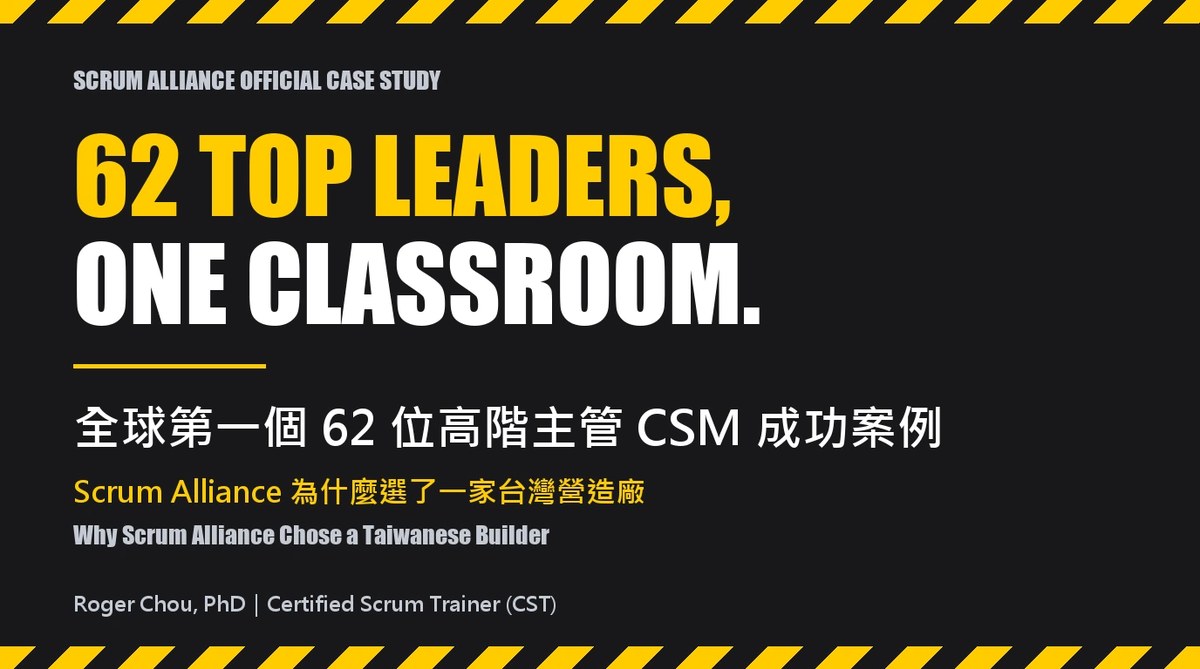
The star is a company that builds buildings in Taiwan: Formosa Builders. The case was authored by Scrum Alliance itself and published on its official site for a global audience: 62 middle and senior managers earned their Certified ScrumMaster credential together — SA officially calls them “62 top leaders.” In that same case library, the companies that stood on this stage before were Salesforce and the United States Patent and Trademark Office. This time, it’s a 30-year-old Taiwanese construction firm.
Agile was never the private property of IT. The real threshold is whether a CEO is willing to put the entire top decision-making layer in a classroom.
What’s Rare Isn’t the Number 62 — It’s Who Those 62 People Are
The number draws your eye, but it’s not the most important part of this story.
What’s genuinely rare is that these 62 people are the operating and management core of Formosa Builders — from the innermost decision-making circle to senior and middle managers across every department, trained in two cohorts, every one of them completing the program.
In the history of agile adoption worldwide, certification and training almost always start at the engineering level and slowly seep upward into management. Formosa walked the opposite direction. Scrum Alliance framed this case as executive-led — driven from the top, not percolating up from below.
And the real cost of that decision was never the training fee. What’s truly expensive is the opportunity cost of 62 managers pressing pause on their business at the same time. When a company’s management core is willing to pay that price, it doesn’t mean “they want to learn a new method.” It means they’ve decided to face something seriously.

Construction Is the Hardest Place to Bring Agile — Which Is Exactly Why This Matters
If agile were easy to adopt in construction, this case wouldn’t deserve the world’s attention.
The truth is the opposite. Construction is rigidly hierarchical, schedule pressure is brutal, and decisions concentrate at the top — it’s one of the hardest industries in which to get senior executives to learn one shared language together.
Schedule slips, subcontractor coordination, changing requirements, resources squeezed across multiple job sites — these were never process problems. They’re decision-language problems: when every unit reads the same event through its own position and its own KPIs, the company’s overall direction quietly drifts.
I’ve coached executives across many industries, and honestly, the decision inertia in construction is the hardest I’ve seen. Precisely because it’s the hardest, Formosa pulling it off means something.
Tony Kuo’s Call: Don’t Send People to Class — Lead Them Into the Classroom
When most owners want a transformation, their first move is to send a few mid-level managers to a course. That’s the fantasy of changing the company without moving the top.
Tony Kuo, executive director of Formosa Builders, chose the opposite path. He didn’t outsource agile to a department. He put 62 middle and senior managers — including the innermost decision-making circle — into the classroom together.
On opening day, the room wasn’t filled with young engineers. It was filled with the people who shuttle daily between job sites, contracts, and the boardroom. Add up everyone in that room and you’re looking at the entire lifeline of a 30-year construction firm. In Taiwan’s construction industry, I had never seen that picture before.
Walking alongside them, what I saw wasn’t a group of managers ordered to attend a course. It was a group of decision-makers choosing to see the same thing clearly, together. The protagonists of this story are Formosa and Tony. My role was to design that learning — and to run alongside them.

So What Actually Changed About How They Decide?
When a CEO reads a success story, the real question underneath is always the same: after the training, did anything about their decision-making actually change?
One premise first: senior executives don’t take CSM training to turn vice presidents into Scrum Masters. They take it to use Scrum’s language to re-see value, priority, cadence, and collaboration. It’s not entry-level training. It’s executive governance.
The first thing that changed was how priorities get judged — from “whoever’s loudest” to “whatever’s most valuable.” Resources used to flow to the department that argued best; now they flow back to product value and customer outcomes. Then cross-department meetings changed: instead of everyone talking past each other, they rank priorities in one shared language, and meetings stop being turf wars. But what convinced me this had truly landed was speed: when the executive team shares one language, the cost of alignment collapses — and decision cycles shorten on their own.
That’s not an adjective. The Scrum Alliance case carries real numbers: cross-team transparency up roughly 30 percent; a stalled ERP rollout rescued in 60 days with an agile approach; ERP, BIM, Primavera P6, and ESG reporting integrated into a single digital backbone. Agile didn’t stay in the IT department as an island. It became the operating system of the whole company.
Language, priority, speed — plus changes you can write down in numbers. That’s no longer a Scrum training. That’s an upgrade to executive decision governance.
From 850 to 1,050 Employees: The Report Card Is Written in the Business
There’s another set of numbers in the Scrum Alliance case that I find far more persuasive for CEOs.
During this transformation, this 30-year-old construction company grew from 850 employees to 1,050 — and won the largest international project in its history.
After all these years of coaching, what I fear most isn’t companies failing to learn agile. It’s companies finishing the training with nothing left but a wall covered in sticky notes. Formosa’s report card isn’t posted on a wall. It’s written in the business: the organization grew by two hundred people, and the orders walked out of Taiwan.
Proof of transformation was never the course certificate. It’s whether the market is willing to trust you with bigger work.

Could This Be Replicated at My Company?
When a CEO reads someone else’s case, the real question isn’t “did they do well?” It’s “what does this have to do with me?”
Here’s the answer: Formosa’s value isn’t that it’s in construction. It’s that it proved one thing — agile doesn’t start with a department. It starts with the decision language of the leadership team.
If your company is also bleeding energy in cross-department coordination, wrestling over priorities, watching customer requirements shift while projects keep slipping — or the most common one: everyone nods in the executive meeting and there is, in fact, no consensus — then this approach can be replicated.
Put differently: Formosa isn’t a construction-industry special case. It’s a mirror.
Being Written Up as a Global Case Study Is Not the Same as Winning an Award
Plenty of excellent Taiwanese companies have earned national certifications and awards, and those deserve respect. But this is a different kind of event: Formosa didn’t say it did a good job. Scrum Alliance — an international organization — chose to write it up as a case study and introduce it to the world.
A national certification proves you worked hard. Being written into a global case study is the world vouching for you.
Asia used to be cast as the student of agile methods. This time, a Taiwanese company handed the world an answer worth studying.
Closing: The Ticket to the World Stage Starts With One Decision
If you’re a CEO, what this article really wants to ask you isn’t whether your company should learn Scrum. It’s this: does your executive team already share one language for facing change, ranking resources, shortening decision cycles — and keeping strategy from dying in the meeting room?
Formosa Builders proved that agile doesn’t have to start in IT. It can start with one CEO decision: let the top decision-makers learn to see problems in the same language first.
And that is something you can design.
Scrum Alliance has published Formosa’s full transformation blueprint as an official case study, free to download: An Agile Transformation in the Construction Industry. Honestly, reading someone else’s case always leaves a gap — if what you’re thinking as you finish is “maybe my executive team needs one shared decision language too,” come talk to me. I walked this road with Formosa, and my in-house CSM program was designed for exactly this: two days, and I personally train your decision layer until the language holds. Schedule and registration: https://www.pm-abc.com.tw/Member/Registration_SCRUM
Asia used to be the student. This time, a Taiwanese company gave the world an answer worth studying.