When Agile Leaders Come Together: CEOs and Master Coaches Returning to Beginner’s Mindset in CSPO
If you ask me, after all the CSPO cohorts I’ve taught, which one left the deepest mark—I wouldn’t hesitate for a second.
CSPO07. No contest.
I’ve led many classes, but the composition of CSPO07 was something I had never seen before. It felt almost improbable.
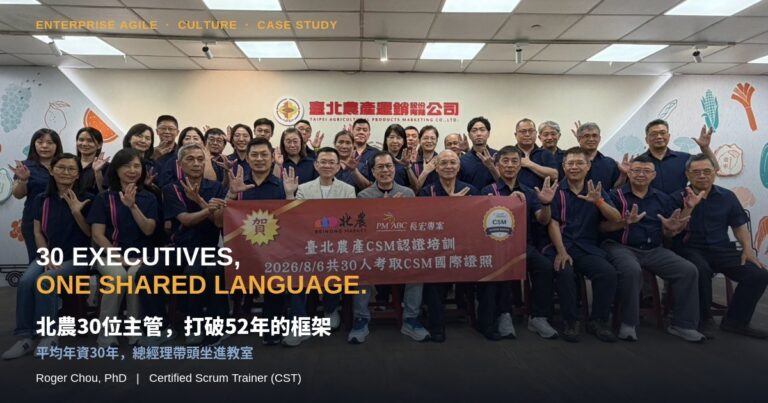
- There was a group of top-tier leaders: three recipients of the 2025 Global Top Agile CEO Award—Hu Jin-Yun, Lin Hsiao-Wei, and Wu Yu-Pin.
- Alongside them was a remarkable group of coaches: Yang Shih-Fan, who had just completed her term as Chair of ICF Taiwan, and Ms. Wang Jin-Ju, widely respected as the “mother of coaching” in Taiwan, at 75 years old.
- And then there was a cross-disciplinary group of volunteers: award-winning CEOs and professional lawyers—Chen Wei-Ting, Huang Yang-Bo, and Kuo Hsin-Yen—who chose to serve not as speakers, but as contributors.
These were people who, under normal circumstances, would be standing on stage, in the spotlight. Instead, they chose to sit side by side in the same room and reset themselves to zero—to learn again.
That level of humility changed everything.
From the very first day, you could feel it: the energy in the room was different, warmer, sharper, and profoundly alive.


Learning for Life: The Agile Spirit That Proves Vision Has No Age
The moment that truly struck an emotional chord across the room came from Coach Wang Jin-Ju.
Seventy-five years old. White hair. Walking with a cane.
To be honest, I was worried at first. CSPO is an intensive, hands-on course that requires sustained focus and a fair amount of computer work. Historically, we’ve rarely had participants over the age of 65.
But Coach Wang dismantled every concern through action.
She moved at her own pace—slower, perhaps—but with extraordinary resilience. In discussions, she consistently offered insights of remarkable depth. And then came the moment that left the entire room holding its breath: near the end of the class, she quietly wrote down her commitment—
“I will help 100 people learn coaching within one year.”
As I looked into her focused, unwavering eyes, one truth became unmistakably clear: vision has never been about age.
In her, “lifelong learning” wasn’t a slogan. It was a graceful, resolute way of living.
From Coach to Leader: Letting Go of Titles to Learn the Core of Product Thinking
What made this cohort truly rare was the depth of the empty-cup mindset the participants brought into the room.
Shih-Fan Yang, former Chair of ICF Taiwan, put it simply:
“If a coach doesn’t have an executive-level perspective, it’s hard to truly empathize. Learning CSPO allows me to stand at the same altitude as my clients—and walk with them.”
Wei-Ting Chen, serving as a volunteer and COO, deliberately reminded himself of one rule throughout the class:
“Open my ears. Hold back my mouth.”
When masters are willing to become students, and when strong leaders choose to listen, that’s where real leadership shows up.
They demonstrated something powerful: when it comes to passing on influence, the most effective posture is to become a learner once again.
You Are the Product Owner of Your Life: Why Everyone Needs a Blueprint
People often ask me, “Why do so many senior executives take CSPO?”
My answer is simple: in my eyes, this is a leadership course—and just as much, a life course.
In Scrum, a product doesn’t have to be something physical. It can be abstract.
- A CEO is accountable for the success or failure of the company.
- A plant manager is accountable for the outcomes of production.
- A head of HR is accountable for whether systems work or fail.
- A product manager is accountable for the success of a product.
- And you are accountable for your own life.
The difference between an ordinary life and an extraordinary one often comes down to a single thing: do you have a clear blueprint?
That’s what CSPO teaches at its core—how to define a vision, and how to break even the biggest aspirations into executable user stories. When I designed this course, I poured my own life experience into it. And that spirit, more than any framework, is what has resonated so deeply with so many people.
Scrum Product Vision in Practice: Turning Vision into Something Real
A lot of people say they have a vision.
The difference between a vision and a daydream often comes down to one thing: methodology.
In the course, we practice starting from the Golden Circle—Why—and then working our way toward a clear product vision. From there, we connect it to product roadmaps, release strategies, and impact mapping. Step by step, vision is no longer something abstract—it becomes something you can work with.
When a vision can be broken down, tested, and iterated, it stops feeling out of reach.
This time, what I saw participants write down were no longer empty words, but concrete commitments such as:
- Helping 100 people learn coaching within one year.
- Building a forward-looking technology group.
- Becoming a top-tier CPO who leads teams toward sustainable, long-term success.
That’s the moment when vision stops being inspirational talk—and starts becoming reality.
Agile in Action: Real Transformation Across Cybersecurity, AI, and Startups
The most convincing proof is never what I say—it’s what participants go on to create after the course.
- A cybersecurity breakthrough: Fang-Yi Hsu applied Agile by breaking work down to an exceptional level of granularity, leading his team to achieve one of Taiwan’s first SOC 2 security certifications.
- Performance unleashed: Wu Yu-Pin’s company used Agile to drive an AI transformation, tripling delivery output while rebuilding shared understanding across the team.
- Startup acceleration: Lin Jin-Wei’s company was only eight months old, yet after adopting Agile, overall efficiency improved dramatically.
These stories all point to the same truth: Agile is not a buzzword.
It’s a practical, battle-tested way to tackle complexity—and create real, lasting value.
A CSPO Mission Statement: Changing Taiwan’s Agile Ecosystem
When I designed the CSPO program, I made a personal commitment to myself—a mission, really: to train 100 CEOs as CSPOs within one year. As of January 11, 2026, that number has reached 151.
This was never about profit. It was about changing the way decisions are made in Taiwan.
I still remember a moment that deeply moved me. A chairman in his seventies—an “invisible champion” in his industry—said with emotion, “We built the number-one company in Taiwan, but I never really knew why it worked. Now I’ve finally found a methodology I can pass on to my son.”
That feeling—that realization—is why I keep going.
And it’s important to say this: I haven’t been walking this path alone.
In this cohort of 21 participants, 15 have already completed and actively practiced both CSM and CSPO. They didn’t just attend classes; they chose to bring Agile into real decision-making rooms and into the core of their organizations. The list includes:
- Lai O-Zong
- Hu O-Yun
- Lin O-Sheng
- Tsai O-Yu
- Huang O-Bo
- Wang O-Zhu
- Chang O-Xin
- Wu O-Jie
- Lin O-Long
- Wu O-Pin
- Yang O-Fan
- Lin O-Wei
- Chen O-Ting
- Hsu O-Yi
- Lin O-Wei

This, to me, is how an ecosystem begins to change—not through slogans, but through leaders who are willing to learn, practice, and lead differently.
Behind these names are not titles, but people—leaders who are willing to take responsibility for upgrading Taiwan’s decision-making culture.
When CSM and CSPO are no longer just certifications, but become the two eyes of the same leader, the organization inevitably begins to see the world differently.

Conclusion: My Life, My Call
This cohort set a record I had never seen before. By the end of Day Two, participants stepped onto the stage—on their own initiative—to share reflections. The urgency to act was palpable. That kind of energy can’t be contained.
There’s a line from the animated film Ne Zha that I’ve always loved:

“My life is mine to decide, not fate’s. Whether I become a demon or a god—that choice is mine.”
Translated into Product Owner language, it would sound like this:
“My life is a product. I am the Product Owner.
I decide the direction. I take responsibility for the outcome.
Whether I become ordinary or exceptional—that’s my call.”
Thank you, CSPO07. You allowed me to witness something rare: the awakening of life itself.
Your life is a product.
You are the Product Owner.
Have you decided what your next move will be?
With Gratitude
My deepest thanks to the three 2025 Global Top Agile CEOs, the two master coaches, and the three CEO Award volunteers who made this cohort extraordinary. You proved something powerful together:
Agile isn’t just a way to change organizations.
It’s a force that can change lives.
Join the CSPO Journey
In a world that’s changing faster than ever, the ability to create value through Agile thinking is no longer optional—it’s essential for every Product Owner.
CSPO is more than a certification. It’s a journey that reshapes how you think about products, value, and leadership. If you want to learn how to tell a compelling product story with clarity, guide teams toward shared understanding, and turn ideas into real outcomes through a more systematic approach, you’re warmly invited to join us.
Step into the CSPO experience—and begin your own path of product practice and impact.
https://www.pm-abc.com.tw/Member/Registration_SCRUM
Executive Reflections After the CSPO Program
For the full set of reflections, visit Changhong’s “Hall of Fame.”
- Contemporary Coach — Yang O-Fan / 9th Chair, ICF Taiwan / CSPO
Looking back on this learning journey, I completed CSM about two years ago. Coming back into a CSPO classroom this time brought up a lot of emotions—in the best way. What stood out most wasn’t just the content, but the people: teammates in my group, participants from different generations, and seasoned leaders with deep experience. Every conversation added a new layer of insight.
From a coach’s perspective, I genuinely hope more people commit to both CSM and CSPO. Because when we’re asked to support clients or walk with teams through change, the only way to truly empathize is to have walked the learning path ourselves. That embodied understanding—feeling what they feel, recognizing the struggle, and being able to think at the same altitude—doesn’t come from tools alone. It comes from practice and integration.And that’s what enables higher-quality support. We’re not only helping solve problems; we can see the real pain points, and also help people surface the strengths that are already there—so change can actually happen.
Both CSPO and the CSM experience before it reminded me of the depth of these programs. They don’t just teach an Agile framework or role definitions. They cultivate a way of seeing people, teams, and value. For Agile coaches, that capability is essential—and I’m encouraged to see more and more people in this learning community moving in that direction.
This experience reaffirmed something for me: Agile isn’t just a methodology. It’s an ability to accompany others as they grow. And that ability is built through continuous learning, reflection, and meaningful dialogue.
My heartfelt thanks to Roger for the guidance, and to every learning partner and staff member for the support and encouragement. I also hope CSM and CSPO continue to be understood and practiced more widely in Taiwan—so this human-centered, value-driven spirit can truly take root and expand. - “The Mother of Coaching” in Taiwan — Wang O-Zhu / Director of Life Coaching, Caritas Consulting / CSPO
I’m truly grateful to every partner who learned alongside me, and to the team’s support that helped me reach the finish line. I especially want to thank Roger for giving me this rare learning opportunity, and also Li-Xiu for her thoughtful assistance and arrangements, which allowed me to fully focus on the course.
The one sentence I most want to share is: age is never the issue.
Completing the course and earning the CSPO certificate was not easy for me—but precisely because it wasn’t easy, the journey became even more meaningful.
What moved me most was my renewed understanding of the Product Owner role: taking responsibility for my own life—I am the owner of my life. This isn’t only about products; it’s a stance toward life.
On the first day, I felt unusually energized and deeply engaged. That experience gave me a powerful sense of motivation. For the past 25 years, I’ve stayed committed to coaching and developing talent, hoping Taiwan will have more outstanding coaches. In recent years, I’ve also felt the importance of mindful coaching—when mindfulness and coaching professionalism come together, the impact on human change becomes deeper and longer-lasting.
I want to help more people build a stronger connection with themselves, learn to regulate emotions, and influence the people around them—so the environment gradually becomes better. That’s why I gathered my courage and wrote down this commitment: within one year, I hope to help 100 people learn coaching, so they can influence even more people, and help society keep moving in a better direction.
I’m deeply thankful for this CSPO learning journey and for everyone who supported and accompanied me. Thank you. - 2025 Top Agile CEO Award Recipient — Hu O-Yun / Vice President, Hewlett Packard Enterprise Taiwan / CSPO
What I want to share is my experience of “having the courage to participate.”
At first, I didn’t have much confidence in myself. I’m also not the kind of person who’s naturally eager to jump in. When the instructor encouraged me to submit and participate in the selection process, my first reaction was resistance. My mind immediately filled with reasons: I’m too busy, I travel constantly, I don’t have enough time—I simply can’t do it.
The two senior peers who were learning with me also worked overseas for long periods, which made the opportunity feel even more out of reach. The first time, I chose to let it go.
Later, when I was reminded again, I still replied with the same excuse: “Work has been really busy lately.” But one sentence from the instructor made it impossible to hide: “Last cohort—many people finished at the very last minute.”
So I decided to do it. In a very short time window, I pushed myself to整理 everything and get it done. Throughout the process, the senior peers were incredibly generous in helping and guiding me, step by step.
And that’s when I realized: the biggest gain wasn’t the result itself. It was being forced to look back and organize my own learning and experience. It was a process of honest self-review—not to complete an assignment, but to see the path of growth clearly.
After submitting, I told myself not to over-expect. Just do my best. And because of that, what happened afterward became an unexpected surprise.
When this cohort began connecting and building an ongoing community, I felt the real value for the first time. You get to meet people you normally wouldn’t have access to—senior leaders and experts you might never cross paths with otherwise. And the learning no longer stays in the classroom; it extends into long-term relationships of support, exchange, and mutual growth.
From seniors across different cohorts, I saw more possibilities—and my imagination for the future expanded.Looking back, I sincerely recommend this: don’t miss the chance to participate because of insecurity or fear of inconvenience. When you take that first step, what you gain often goes far beyond what you expected.
My heartfelt thanks to the senior peers who supported me, and to Roger. This wasn’t just an extension of a course—it was the beginning of an ongoing growth journey. - 2025 Top Agile CEO Award Recipient — Lin O-Wei / CEO, Mofu Strategy Co., Ltd. / CSPO
Roger is a truly unique mentor, and I gained a great deal from this course.
My work is in media and advocacy, which is quite different from many other industries. I need to learn how to collaborate with my team in a simple, effective way to achieve our social impact goals. CSPO offered the tools and mindset to help me turn ideals into actions that can actually land.
One of the most meaningful parts was the vision card exercise. My organization has long focused on public impact work, and public impact eventually has to translate into policy and real-world action. Through this process, I wrote down my annual goals and team goals clearly—and also gained clarity on how to align my personal vision with organizational mission.This process mattered especially to me as an Indigenous woman. I want to combine creativity with social advocacy, lead my team toward our political goals, and at the same time develop our collaboration capabilities and Agile mindset through practice.
The course helped me see that no matter how unique an industry is, the core Agile principles—rapid learning, continuous iteration, clear goals, and explicit roles—can be applied effectively in real work.
This learning didn’t only strengthen my methodology. It also helped me think about social impact and policy action with more structure and strategy. With an Agile mindset, I can connect team goals with personal vision and push impact initiatives forward step by step—so every action has a clearer purpose and value.
In short, CSPO isn’t just product management training. It’s a way of thinking: how to collaborate in complexity, stay focused on what matters most, and turn vision into reality. Going forward, I hope to keep applying these ideas to my team and advocacy work—to expand impact and drive meaningful change. - 2025 Top Agile CEO Award Recipient — Wu O-Pin / General Manager, AirGene Co., Ltd. / CSPO
Before this, I had taken CSM and practiced Agile inside my company. For a mid-to-large, more traditional organization like ours, the impact was significant. To make Agile truly stick, we also adopted a professional software system. Today, it’s almost to the point where we feel we wouldn’t know how to operate without it.
I believe this is because Agile provides a very clear framework—it helps teams move forward step by step. Still, even after nearly two years of execution, I always felt something was “slightly off,” as if some problems hadn’t been truly resolved.
In this CSPO course, through discussions with the group, I saw a key pattern more clearly: after we introduced AI and delivery-based software, our delivery volume did triple. But the real challenge wasn’t output—it was how to build genuine alignment and keep moving forward in a stable, calm way.
And in that process, I started rethinking—and unexpectedly realized that many of the bottlenecks we face day to day were already highlighted in the course. This isn’t only our company’s issue. It’s a shared challenge many organizations encounter in product and system operations.
Through tools, templates, and structured artifacts, the system can help us identify problems and even point us toward solution directions. As the course came together, I became increasingly clear: when I return, I want to rebuild our product development flow. Starting from Agile principles, we’ll first focus on MVP, align the team on goals and focus, and then continue iterating and optimizing with every cycle.
I believe this is how we build a sustainable success model for the company. For me, this learning was a critical bridge: after CSM truly landed, we hit real-world bottlenecks—and this complete CSPO course arrived at exactly the right time, helping us level up our mindset and approach again.
I’m very grateful, and also genuinely glad that I chose to take CSPO at this moment. - Director — Tsai O-Yu / Head, Institute of Nuclear Engineering and Science, National Tsing Hua University / CSPO
After participating in these two days, I’m even more convinced of the importance of this learning.
The course helped me redefine what “value” means—including clarifying business objectives and learning how to prioritize value. These concepts were critical for me. In the card exchange activity, I wrote a sentence: “Value first—and action must follow.” That line captures my biggest takeaway.
In academia, what we produce isn’t a typical “product,” but research papers. Yet research is full of uncertainty, and both direction and depth often require repeated adjustment. If we can have a clear framework that helps us identify what truly matters and focus limited time and energy, it could significantly accelerate progress.
I also hope to apply this thinking in my lab. We have over ten members working on four theme-based projects simultaneously, and in daily operations, it’s often hard to keep students motivated. I’ve tried many times to explain the overall structure, but a framework alone isn’t enough. What’s missing is a clear way to set goals—and to confirm and prioritize those goals together with advisors.
Over the next year, I hope to put CSPO learning into practice in the lab, so research becomes more focused, and outcomes become clearer and more stable. Thank you all for the learning and companionship. - CEO Award Volunteer — Chen O-Ting / COO, Laplace Intelligent Technology / CSPO
These two days of CSPO helped me learn many important concepts again from Roger.
Since taking CSM last year, I’ve tried applying Agile to my personal decisions. No matter what choice I face, I remind myself: experiment quickly, get feedback quickly, adjust quickly. That mindset also matches a line I strongly believe: failure today or tomorrow is fine—because failure is part of the process.
From the very first activity, I realized something important: in front of more experienced seniors, I must first learn to be a good follower. Over these two days, I deliberately reminded myself to let go of old habits: listen more, observe more—open my ears, hold back my mouth. Through discussion, I absorbed different perspectives instead of rushing to express my own.
In conversations with classmates and seniors, I also learned the importance of “daring to say the goal out loud.” Clearly stating what you want to achieve is itself a form of commitment—the beginning of action.
This learning environment pushed me to re-examine my goals, and gave me more courage to set a clear direction for the future. To me, CSPO isn’t just a course—it’s a way of practicing life in the face of uncertainty. With this learning, I hope to keep moving forward and truly bring the Agile spirit into every future choice. - CEO Award Volunteer — Huang O-Bo / Founder, TuYuan Innovation / CSPO
My organization is a startup accelerator system, and when shareholders evaluate founders, they often ask three questions.
First: what’s your target for personal valuation? If you don’t dare to set a big goal, it often means you lack true imagination for the future.
Second: have you observed people who’ve already achieved what you aspire to—how do they think and act?
Third: have you actually studied their approach and put it into practice?
These questions connect directly to what we discussed in CSPO about “vision.” At the beginning, during value ranking, I placed “vision” at the very top without hesitation. Because I believe vision is the core driver of action; without it, you don’t have motivation, and you don’t know where you’re going.One of my biggest takeaways is that in Taiwan’s learning environment, it’s rare to talk about vision so directly and deeply. Compared with a culture that often prefers “small and beautiful,” CSPO encourages people to face what they truly want to achieve.
Some long-term visions I rarely shared publicly also became clearer because of this course. I hope to build a technology group connected to frontier innovation—one that makes a real and positive impact on the world.
In the final action planning, I didn’t write a new goal. I wrote a commitment: when I go back, I will review all course content, select the tools that fit my current stage from the many models and theories, and actually put them into practice. Only then can theory become real work—and the gap between knowledge and reality becomes smaller.
That’s also what I want to recommend to every learner: after understanding, choose action. Thank you for helping me reconnect vision with practice.
- CEO Award Volunteer — Attorney Kuo O-Yan / CSPO
These two days helped me rethink what it means to be “responsible.”
As a legal professional, I’m trained to clarify accountability, risk boundaries, and decision consequences. The PO role is fundamentally similar: taking ultimate responsibility for value and trade-offs. A PO’s responsibility is like legal judgment—you must choose the most reasonable priorities right now, shape the Product Backlog, and accept the consequences of that choice.
Scrum also showed me how short cycles of inspection and feedback help false assumptions surface early—before large resources are invested in the wrong direction. That’s highly aligned with legal practice: prevent disputes and reduce irreversible risk.
In that sense, PO and legal professionals are alike: both make important choices for others under limited conditions. - CISO — Hsu O-Yi / APMIC.ai / CSPO
Honestly, getting here started as a “beautiful misunderstanding.” At first, I just wanted to keep up with younger people, so I signed up for CSM and CSPO. Over time, after reading the course and Roger’s articles, a thought slowly formed: maybe I should keep growing instead of standing still.
These two days felt very different from my previous learning experiences—the learning partners and the depth of discussion were on another level. The peer exchange gave me more stimulation and insight, and helped me re-examine what I’m doing through perspectives from very different backgrounds.
I want to share a concrete outcome that makes me proud. Six months after taking Roger’s course, I returned to my company and took charge of information security. The challenge was real: competitors were huge, with far more resources. At one point, we even treated OpenAI as a benchmark comparison.
Direct competition wasn’t possible. So we chose an Agile approach: we broke down the work to extremely granular levels, laid out every process and control point transparently. Even with a fraction of the manpower, we kept moving through small steps, fast learning, and rapid correction.
On December 12 last year, we successfully earned SOC 2 certification—one of the few in Taiwan—and became the first cybersecurity company in Taiwan to achieve it. Over these six months, we kept trying things that few had done before, and Agile thinking was the key force supporting us.Because of this experience, I realized what we talk about in class isn’t theory—it’s a way of working that changes outcomes. This CSPO course helped me elevate my perspective: from executing tasks to thinking in product value, delivery cadence, and long-term direction.
Recently, I also began planning applications for U.S. graduate programs and successfully submitted to a U.S. cybersecurity conference—earning an opportunity to present on an international stage. Looking back, these changes weren’t accidental; they were the cumulative result of learning, breaking down, and practicing again and again.
This course reaffirmed one thing for me: regardless of background, age, or industry, if you’re willing to keep learning, trying, and adjusting, Agile can be a force for change. Thank you to Roger and every learning partner for the companionship and exchange. I look forward to turning this learning into more real-world results. - Chief Product Officer — Yuan O-Yu / Ernst & Young FinTech / CSPO
I’m very happy to have joined this CSPO course. As a Product Owner, the challenges are clear—especially when managing multiple products that are connected. You must balance user needs while tracking market shifts, which demands strong decision-making and a big-picture view.
My biggest takeaway was how Roger used a scientific approach—tools and methods—to help us think about product and value systematically. These tools are immediately applicable in daily work, and they also gave me more confidence in strategy planning, prioritization, and decision-making.
Beyond work, the course also approached things from a life perspective: each of us is the owner of our own life. That was deeply inspiring for me. Roger also emphasized that being a CSPO isn’t only about responsibility—it requires a bold vision: believing your product can truly impact users, not just chase competitors or market noise.
At the end of class, I wrote my vision seriously: I want to become a top-tier CPO, lead my team with steady, sustainable execution, and help each team member achieve their own dreams.To me, product value isn’t only business results—it’s also resonance and growth within the team. When people can see their progress and accomplishments along the way, that’s real success.
This learning didn’t just strengthen product management skills. It deepened my understanding of vision, impact, and team value. I believe applying these ideas and methods will improve product performance—and also help both team dreams and personal dreams move forward together. - Executive Vice President — Chang O-Xin / Ernst & Young FinTech / CSPO
My previous CSM experience was intense and challenging. Looking back, I gained the most from learning how to use those methods to make my company and teams operate more effectively. It wasn’t only about tools; it was a systematic way of thinking and execution that brought more direction to daily decisions and long-term strategy.
In this CSPO course, I gained even deeper inspiration. Roger reminded us that each of us has our own journey and mission in this world. Life may feel challenging, but if we’re here, we should go all in—bring our vision and dreams to life.The course taught me that as a Product Owner or leader, we must manage our life and business as an owner—know our goals clearly, and keep translating them into daily work and product decisions.
My biggest takeaway was the importance of vision—not only personal dreams, but also something that can extend into how a company and team operate. When everyone knows their direction and focuses their energy on what truly matters, impact can be maximized.
The course also prompted me to think about a larger mission: Taiwan may be small in global scale, but our software capabilities and creativity are competitive. If we can collaborate and share more, more teams and companies can create impact on the international stage.
This wasn’t just a personal learning experience—it was a reminder: continuous growth, courageous experimentation, and turning vision into action benefit both ourselves and everyone around us. I hope to apply these ideas in my products and company, and encourage more partners to explore and grow together—for individuals, teams, and even Taiwan’s software industry. - Senior Engineer — Chen O-Sheng / Chunghwa Telecom, Information Technology Division / CSPO
I’m truly grateful to be invited to join this CSPO course. I gained a great deal. Through the class, I developed a deeper understanding of how Agile culture can be applied across contexts, learned how to introduce Agile concepts correctly, and gained hands-on ways to implement them.
I’ve known Agile for less than a year, but during that time I’ve already tried applying Agile at work and observed the challenges different teams face in practice. This course offered a more systematic structure, which will help me bring the right concepts back and support departments in adopting Agile methods.
One of my visions is to help teams in the company become fluent in Agile—delivering projects efficiently and producing valuable outcomes quickly. The course also gave me an opportunity to share what I learned with senior leadership. When executives experience the CSPO learning environment firsthand, they can feel the positive energy Agile culture creates.That not only strengthens alignment, it also creates a healthier environment for project execution—helping more initiatives get on track and raising overall operational efficiency.
For me, the biggest value of CSPO is not only tools and methods, but a shift in thinking: Agile isn’t just process—it’s culture and collaboration. With that culture, companies can respond faster to market needs while balancing structure and performance.
In summary, this course deepened my understanding and provided practical ways to land Agile. Going forward, I hope to keep promoting these ideas across teams and projects—so Agile becomes part of daily operations and improves efficiency, outcomes, and competitiveness. - CEO — Lin O-Wei / YouSheng Information Co., Ltd. / CSPO
My company was officially founded last year, so it’s been only about eight months. Our business is highly customized. Under traditional and open-ended management approaches, we often struggled as client needs changed—and the process was frequently frustrating.
Being able to join this CSPO course was a major shift in mindset and management for me. The course didn’t just teach frameworks and tools—it helped me understand how to truly land Agile thinking in everyday operations.After the course, I immediately began applying what I learned and adjusting internal workflows. The result was a clear improvement in overall efficiency. That made me realize: Agile isn’t only theory—it’s a management method that creates tangible benefits.
This learning also reinforced the importance of rapid iteration in project management. In the future, I want all projects to run in an Agile way—not only to respond quickly to changes, but also to improve collaboration and delivery quality.
The workshops and peer exchange gave me strategies I can use directly, and that’s especially valuable for a startup like ours. Most importantly, this method didn’t only improve efficiency—it also strengthened team confidence in facing challenges.
With a systematic Agile process, we can focus more on creating value and gradually build products and projects that can shape Taiwan’s future. I believe with continued practice, our team can achieve high collaboration and create impactful results in a short time. - Deputy Manager — Lin O-Sheng / AcBel Polytech Inc. / CSPO
I’m very happy to have joined this CSPO course. Being able to exchange with senior leaders across fields and also younger participants helped me see different ways of thinking and working. It also reminded me that while Taiwan isn’t large, people here are hardworking and creative.This made me believe CSPO concepts and methods can be applied across industries—helping more people solve problems through Agile thinking. For me, Agile isn’t just process or tools; it’s a mindset.
My company is a hardware business with 40 years of history, facing industry crises and transformation. This course helped me revisit my perspective and decision-making, and also gave practical methods to respond to change.
After taking CSM last year, I immediately enrolled in CSPO. Even though the schedule was tight and I had to balance travel and work, the learning was absolutely worth it. One of the biggest inspirations is that no matter your age, you can still learn and change. Seeing Coach Wang still learning at 75 helped me deeply understand that anyone can own their growth and life direction.It gave me more confidence to take the first step and practice Agile thinking in work and life. The course didn’t only teach product management and collaboration—it also helped me rethink how to be the owner of my life: set goals clearly, keep iterating, and keep improving.
I was a bit shy during these two days, so I didn’t share as much as others. But I believe the ideas have already shaped me and will continue to land in my work and life. I hope to apply what I learned across media platforms and projects in the future, and I wish everyone here continued courage and experimentation—so Agile thinking opens more possibilities and brings real change. - Co-Founder — Pan O-Ming / TPD Thinking Academy / CSPO
First, I want to thank Roger. Over these two days, I deeply felt the completeness and practicality of how the course integrates management experience and tools. It combined online and offline operations, offered a solid framework, and gave me a new understanding of how to use Agile in real work. This was the first time I felt a course design could be this complete and systematic—helping me organize scattered methods from the past and truly land them.
Second, I want to thank Li-Xiu and the team. From logistics and meals to materials and video resources, every detail was thoughtfully handled. Even during the course, resources were provided quickly, making the learning flow smooth and seamless. It created an excellent learning experience.
Third, I want to thank my classmates. In this cohort, I learned from seniors and experts across fields—absorbing their experience and ways of thinking. Watching others turn their PO vision into real action also made me realize I have more possibilities.
I haven’t worked a traditional job for six years. I don’t run a company yet. But this course sparked me to rethink the direction of entrepreneurship, and I’ve started an action plan to pursue it this year.
Finally, I want to thank my family—especially my wife. In the past, she questioned many of my plans. But with her support, I could fully invest in this learning. This winter break, we plan to travel in Europe for a month as a way to give back for that support.
In summary, this CSPO course didn’t just strengthen my Agile mindset and management tools. It also clarified my future vision and action direction—from learning methods to real-world execution, from entrepreneurship to family support. Every part of it contributed to a complete and meaningful growth experience. - Engineer — Lin O-Long / Chunghwa Telecom / CSPO
Joining Roger’s CSPO course gave me a completely new experience of product management and Agile practice. Returning to Simon Sinek’s Golden Circle, I realized that in the past, I often jumped straight into feature design or competitor comparison—while overlooking “why we’re building this product” and “how we validate that this value truly exists for users.”
Through carefully designed workshops, this course guided us end-to-end: product vision, roadmap, persona building, user story breakdown, and prioritization—turning knowledge into tools we can actually use. Compared with online CSM/CSPO courses I took before, this in-person course allowed me to operate and practice every step firsthand—no longer just theory.
Especially in group interaction, face-to-face collaboration made me feel the importance of “working together” and “face-to-face conversation” in the Agile Manifesto. Through real practice, I understood Agile isn’t just process—it’s a way to create value through collaboration.
I’m also grateful for several teammates. Our CEO, Shi-Jie, used clear logic to turn messy ideas into an actionable direction. PO Yi-Xin proposed ideas that matched real user pain points, helping us identify core needs even in a fundraising stage. And Yang-Bo showed strong business sense in the closing stage, reminding me that products must ultimately return to market and user value.
Coach Wang’s “lifelong learning” attitude also inspired me to keep growing, and I hope that spirit can influence more leaders in the company.
These two days strengthened my understanding of tools and methods, and also clarified the responsibility of a PO—not only delivery, but turning team vision into reality and creating value. The practical experience, tool application, and cross-domain collaboration skills will directly help my future work in product development, team management, and entrepreneurship.
I previously took CSPO with another instructor, and the biggest difference I felt was this:
Other CSPO courses focused more on Scrum/PO theory and role awareness—like drawing a basic map of what PO should care about and be responsible for. In that sense, there was some theoretical overlap between CSM and CSPO.Roger’s CSPO is clearly practice-driven. Through a large number of workshops, he connects product vision, roadmap, releases, stakeholders, persona, user journeys, user stories, acceptance criteria, and prioritization into one coherent product-thinking flow. It allowed me to practice, step by step, “starting from Why—and turning ideas into requirements that are actionable and verifiable.”
In one sentence: other instructors teach “What is Scrum.” Roger teaches “How a PO uses Scrum.”
Lastly, special thanks to Roger, Li-Xiu, and the course team for the guidance and support over these two days. The learning from this course will become a solid foundation for my continued progress in career and entrepreneurship. Let’s scrum on! - Executive Director — Lai O-Zong / Mi Psychology Counseling Center / CSPO
Over these two days in the CEO Agile CSPO cohort, the biggest gain wasn’t simply “getting a certificate.” It was finding a clearer, more executable solution to real bottlenecks I’ve faced while leading counseling centers—designing enterprise EAP programs and coordinating cross-functional work.
From product value and prioritization to Scrum cadence design, the course helped me see that Agile isn’t about being fast—it’s about delivering in short cycles, validating direction quickly, breaking risk into smaller pieces, and speeding up learning.
What resonated most was the role of the PO. A PO isn’t a messenger collecting requests. A PO is a decision-maker who maximizes value: turning vague ideas into testable hypotheses, writing work into a backlog the team can understand, and using transparency so enterprises and stakeholders know why we do this first and that later.
In that sense, Agile is training an organization’s communication quality and decision quality—resulting in major efficiency improvement.
During the course, I also turned key points into my own visuals—learning while producing artifacts I can take back and teach directly to our therapists and instructors. The online exam at the end was stressful, but it functioned like a rapid retrospective—recalibrating concepts one more time.
One deeper thought for me: as I push Agile-style EAP counseling plus training projects this year, adding AI could improve not only efficiency but also the speed of alignment. Agile × AI is worth turning into a repeatable enterprise solution.
Thank you to Changhong, and thank you Roger.