Why Knowing Scrum Still Isn’t Enough to Get an Organization Moving: A CEO’s Blind Spot
When did I first realize that just understanding Scrum was no longer enough for a CEO?
The moment is very clear to me.
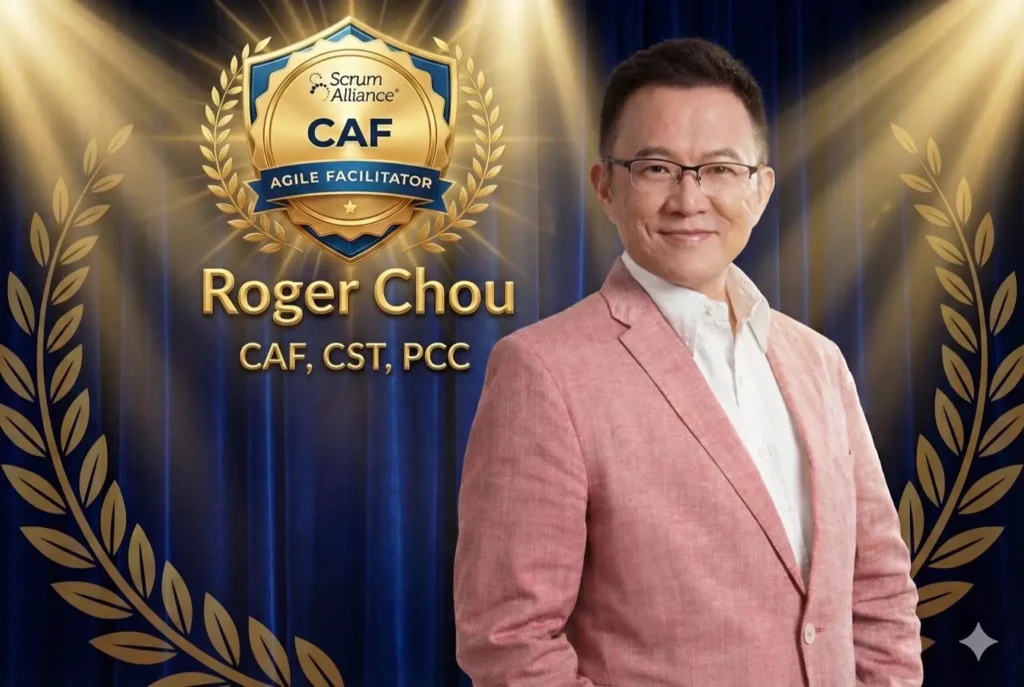
On May 5, 2023, I earned my CST.
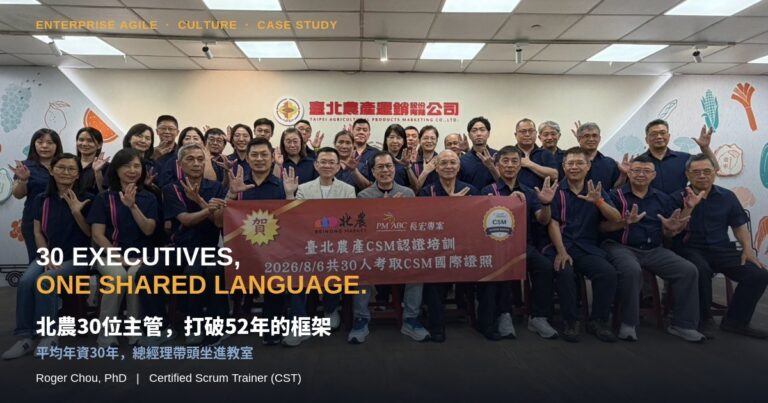
That same year, I launched my first personal mission: to train CEOs to become CSMs—within one year. We finished with 235 CEOs.
The following year, I launched a second mission: to train CEOs to become CSPOs, again within one year. This time, 150 CEOs completed the journey.
These weren’t a handful of individuals. They represented an entire generation of business leaders from different industries and company sizes.
But as I walked alongside these CEOs when they returned to their organizations and tried to put Scrum into practice, I was forced to confront an uncomfortable truth: only about 20% could truly turn Scrum into tangible organizational results.
And that number was strikingly consistent.
Industry didn’t matter. Company size didn’t matter. Once organizational complexity crossed a certain threshold, the success rate barely changed.
They weren’t lazy. They had done the work. They understood Scrum. They understood product backlogs. And yet—the organization still wouldn’t move.
Only later did I realize what was really holding them back. It wasn’t a lack of skill. It was something deeper: senior decision-making was still rooted in “I decide, you execute” rather than collective commitment.
When decisions are announced instead of co-created, even the most elegant strategy slowly bleeds out at the execution level.
That was the moment it finally clicked for me: Scrum provides structure—but structure alone does not create execution.
As I moved deeper into facilitation, I became increasingly clear about one thing: this path is not something anyone walks alone.
I am deeply grateful for the mentors who shaped my thinking, my discipline, and my sense of responsibility along the way.
From Srdjan, I learned what it means to design learning with integrity. Our conversations were never about polishing techniques. They were about structure, boundaries, and the weight of standing in front of senior leaders with clarity and humility. His feedback was precise, honest, and grounded in real-world facilitation practice. Perhaps most importantly, he offered trust — the kind that says, “I believe you understand what you are taking on.” That trust carries real responsibility.
From Anu and Kate, I learned what it truly means to put people before methods. Watching their facilitation in action made one thing unmistakably clear: powerful frameworks only work when they are held with care, restraint, and respect for human dynamics. Their thoughtfulness, clarity, and willingness to protect the intent behind their work deeply influenced how I now think about facilitation — not as a set of tools, but as a leadership stance.
Learning from these mentors reminded me that facilitation is not about personal style or performance. It is about stewardship. About carrying ideas forward without diluting their purpose. About knowing when to speak, when to pause, and when to let the group do the work.
When I stand in a classroom in Taiwan today, I am not simply teaching CAF. I am continuing a professional lineage that has been modeled with rigor, generosity, and care. That awareness shapes every design choice I make — and every responsibility I accept.
If we don’t address how people think things through together and take responsibility together, every new framework we introduce will deliver diminishing returns. This isn’t theory. It’s what I’ve seen firsthand over three consecutive years, across hundreds of real organizations.
What Really Holds Companies Back Isn’t Scrum—it’s a Decision-Making Style Without Facilitation
I came to understand this only later.
For C-level leaders, CSM is a framework.
CAF (Certified Agile Facilitator) is the engine that makes that framework actually run.
Most critical leadership meetings look surprisingly similar: the CEO is focused on efficiency, time is tight, and the moment conflict appears, there’s an urge to wrap things up quickly. A decision gets made. It looks efficient. The meeting ends on time.
But you and I both know what that really is: false alignment.
The real cost doesn’t show up in the meeting room. It shows up over the next three months—in delays, quiet resistance, finger-pointing, and eventually another meeting about the same issue.
There’s a line I learned in the CAF community that has since become a lens through which I view almost every decision:
People only support what they help create.
When concerns are surfaced early and accountability is made explicit while a decision is taking shape, that decision becomes a sustainable agreement—not an order that gets passively resisted afterward. This is why real execution power doesn’t come from stronger commands, but from better facilitation.
What Is CAF—and Why It May Be the Most Underrated Execution Engine for CEOs
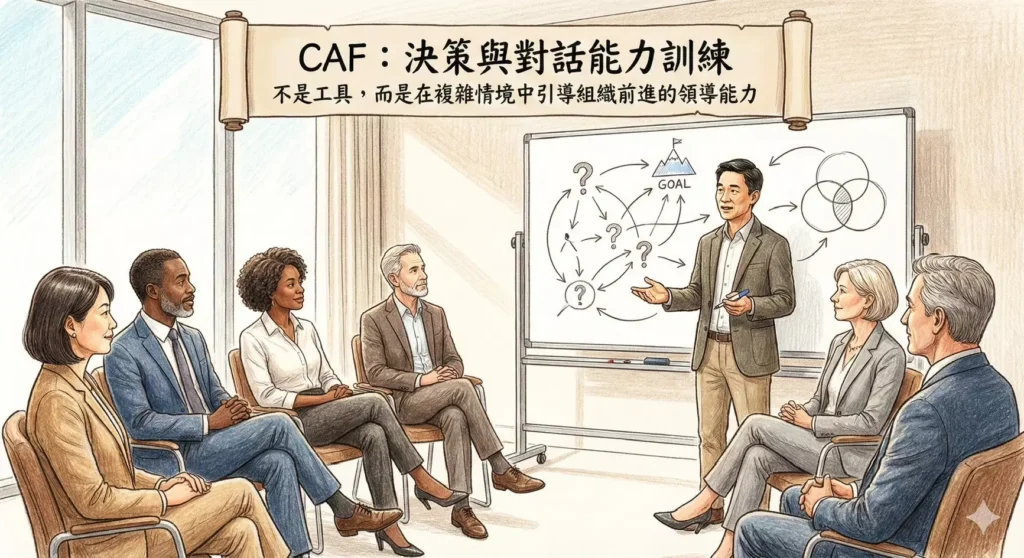
So what does CAF actually do?
I usually explain it in four words.
Many people assume CAF is just about running meetings better. That’s not even close.
At its core, CAF is built on four principles. I’ll translate them into English like this:
- Include – making sure every voice that needs to be heard actually shows up
- Understand – getting to what people truly think, not just their stated positions
- Integrate – moving beyond win–lose toward shared solutions
- Own – turning discussion into shared responsibility and collective commitment
That last one—ownership—is the most critical. This isn’t top-down assignment. It’s a subtle but powerful shift: because I participated in the decision, I’m committed to carrying it through.
Once these four conditions are in place, execution doesn’t need to be forced—it emerges on its own.
This becomes especially important when leaders are facing high uncertainty and problems with no clear right answer. Executives who understand facilitation know when not to rush to closure. They know how to hold the team in moments of confusion, tension, even discomfort—what I often call the Groan Zone.
Because the most competitive solutions are rarely the first ones that surface. They emerge only after conflict has been fully explored, not prematurely shut down.
What CAF truly changes isn’t process—it’s a leader’s stance.
From “I provide the answer”
to “we think it through together, commit together, and take responsibility together.”
When facilitation becomes this kind of leadership stance, it doesn’t live only in meetings anymore. It shows up in one-on-one conversations, conflict resolution, and throughout entire projects or transformation journeys.
That’s why I call leaders who practice CAF facilitative leaders.

With or Without CAF: How Facilitated Decisions Lead to Very Different Outcomes
A side-by-side look at two real leadership meetings
Let’s start with the version without CAF.
It’s the annual budget meeting. Tension between R&D and Sales has just surfaced, and the CEO is growing impatient. The final call comes quickly: “Alright—cut both sides by half.” The meeting ends on time. On paper, it looks highly efficient.
Three months later?
R&D is behind schedule. Sales says resources are insufficient. The decision everyone supposedly “agreed” to turns into finger-pointing at the execution stage. This isn’t an accident—it’s a structural outcome. The people who truly understood the market, the customers, and the risks were never genuinely heard in the first place.
Now let’s look at the version with CAF.
The company is at a make-or-break moment in its transformation. The CEO knows this time speed isn’t the answer. A skilled facilitator is brought in. Psychological safety is intentionally created so frontline teams feel safe telling the truth. Fears, constraints, and underlying concerns are all put on the table.
The meeting takes twice as long—sometimes more.
But what comes out of it is a decision the team genuinely believes in and is willing to own. Six months later, the transformation succeeds.
Not because the team was smarter, but because the decision was grounded in the full reality—not a filtered version of it.
And this kind of facilitation doesn’t stop when the meeting ends. It carries forward—
into one-on-one conversations that prioritize understanding people first;
into moments of rising conflict where relationships are stabilized before positions harden;
into stalled projects where leaders can recognize necessary chaos rather than blaming a lack of effort.
That’s the difference facilitation makes.
Why Are There Only 21 CAF Trainers Worldwide?
The Professional Bar Set by Scrum Alliance
Today, there are only 21 Certified Agile Facilitator (CAF) trainers in the world.
Only three are based in Asia—and just one in Taiwan.
This is no coincidence.
The CAF standard is intentionally rigorous, and it goes far beyond teaching facilitation techniques.
Roughly one-third of the program focuses on theory.
One-third is hands-on practice.
And the final third is about the facilitator’s mindset.
This last part is especially critical for CEOs.
A CEO doesn’t necessarily need to act as a facilitator personally.
But a CEO must understand facilitation—and make it a natural part of how the organization communicates and works together.
When a culture of full participation, mutual understanding, and shared ownership takes root, the impact is tangible.
Employee engagement rises. Retention improves.
And the organization becomes far more resilient in the face of change.
| Global List of CST Instructors Authorized to Teach CAF (Alphabetical Order A–Z) 1. Anu Smalley, CST 2. Björn Jensen, CST 3. Brenda Zhang, CST (中國) 4. David Caicedo, CST 5. Evelyn Tian, CST 6. Gaurav Rastogi, CST 7. Jimi Fosdick, CST 8. Joel Bancroft-Connors, CST 9. Judy Neher, CST 10. Kate Megaw, CST, CST 11. Lonnie Weaver-Johnson, CST 12. Ningning (Lance) Zhang, CST (中國) 13. Paul Goddard, CST 14. Ram Srinivasan, CST 15. Roger Chou, CST (台灣) 16. Sam Bowtell, CST 17. Srdjan Pavlovic, CST 18. Stuart Young, CST 19. Teddy Carroll, CSAT 20. V. Lee Henson, CST 21. Zuzana Sochova, CST |
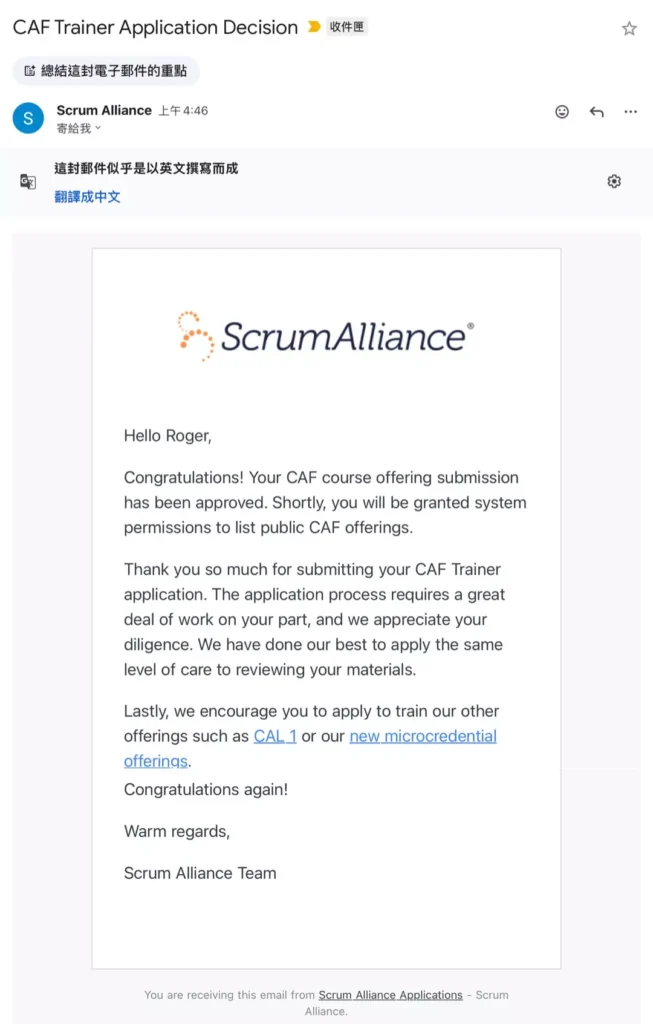
My CAF Mission: Why I Committed to Training 100 CEOs in One Year
This is the third mission I launched after becoming a CST.
Year one: CSM
Year two: CSPO
Year three: CAF
This year, I made a clear commitment to myself:
to train 100 CEOs to become CAFs—and to turn facilitation into execution capability that organizations can actually replicate.
Why the cap?
Because this is not a program where more people is better.
Each cohort is limited to around 15 senior leaders at the VP level or above. That’s intentional. The goal is peer quality, depth of conversation, and—most importantly—a psychologically safe space where real problems can be discussed honestly.
We’re not here to learn a technique.
We’re here to build an organizational capability—one that can withstand uncertainty and still carry results all the way through.
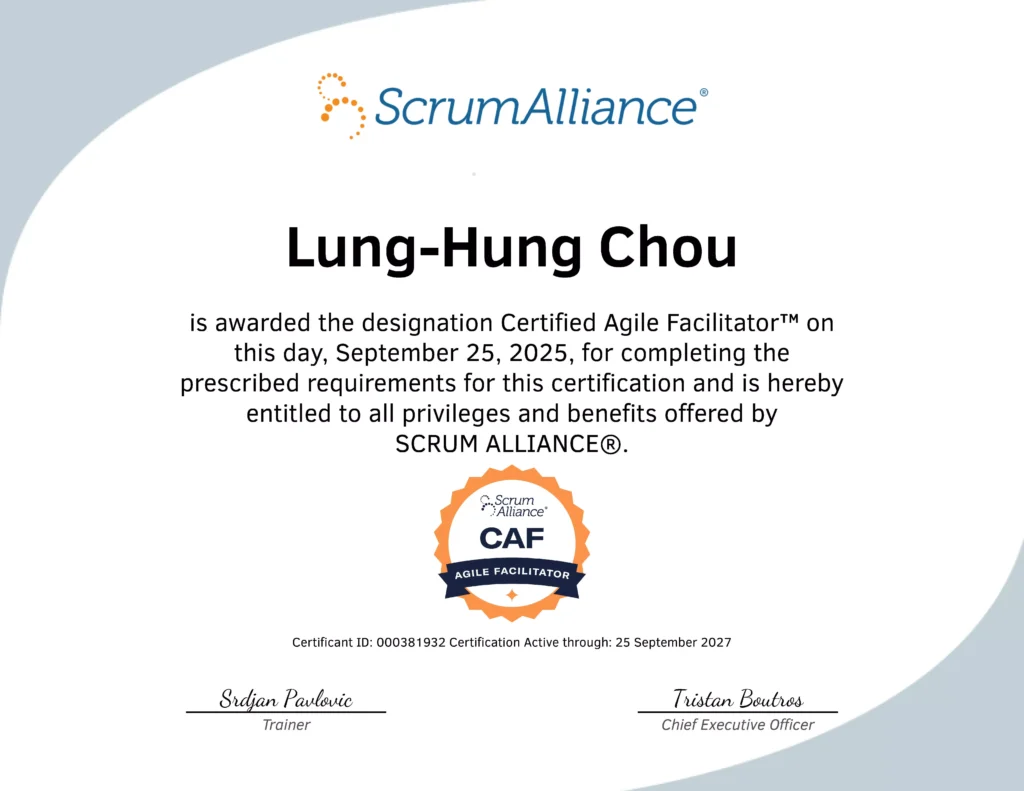
If 100 CEOs Truly Master Facilitation, What Would Taiwanese Companies Look Like?
Here’s the picture I see:
Executive meetings would no longer drain energy.
Conflict wouldn’t be suppressed—it would be transformed into innovation.
Decisions wouldn’t just be announced; they’d be jointly committed to and fully owned.
And every single meeting would compound the organization’s execution power and resilience.
This isn’t about me.
And it’s not just about your company.
It’s about helping Taiwanese enterprises step into a truly mature, sustainable, and accountable competitive state—one where people are willing to stand behind outcomes all the way to the end.
If you’ve already gone through CSM and CSPO,
if you’re now in a role where results ultimately land on your shoulders,
CAF may be the next—and most critical—chapter of your journey.
In an era defined by high uncertainty, where decisions must be made quickly and owned responsibly, what truly separates organizations is no longer whether they “understand Agile frameworks.” The real differentiator is whether leaders can harness collective intelligence, form genuine shared commitment, and turn strategy into reality.
CAF isn’t just another certification.
It’s a shift in leadership stance—from being the one with the answers to becoming the leader who helps the team think clearly together, commit together, and take responsibility together.

The first cohort of the CAF Program will take place on May 23 (Sat) and May 24 (Sun), Taipei.
If you’ve completed CSM or CSPO,
if you’re in a position where you are accountable for the outcomes of decisions,
and if you genuinely care about this question—
“Does every meeting move the company closer to real results?”
you’re invited to join the CAF executive (Vice President and above) development journey and step onto the path that transforms facilitation capability into scalable, repeatable execution power within the organization.
Please reserve your place : https://www.pm-abc.com.tw/Member/Registration_SCRUM
(Seats are limited. Admission is by application and review, with priority given to CSM / CSPO alumni.)