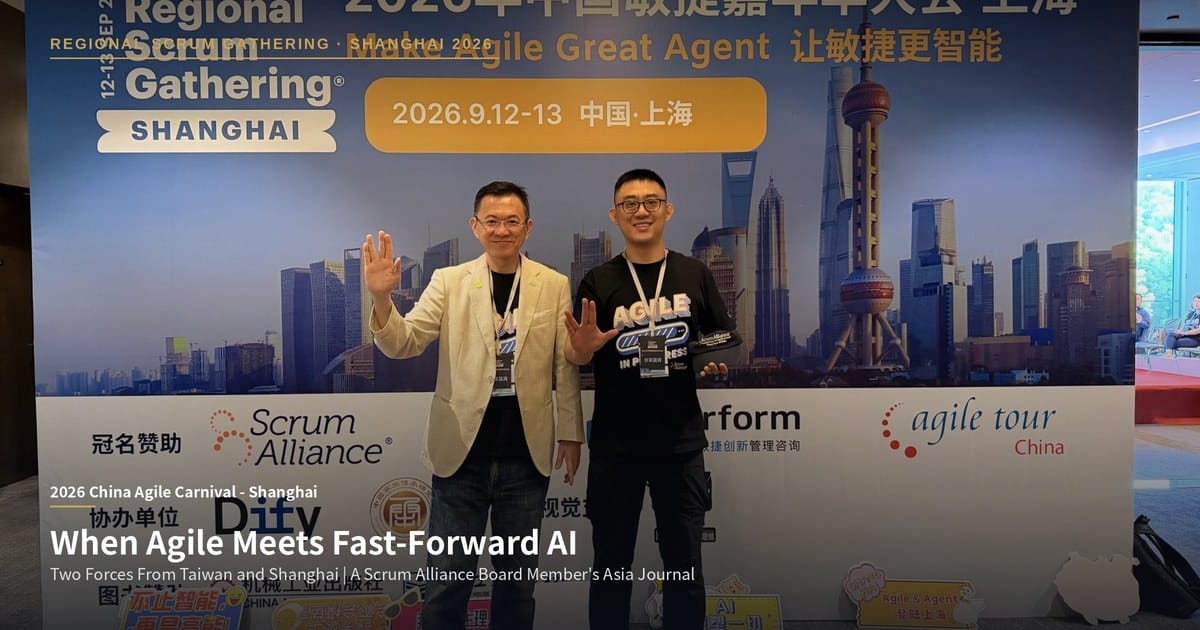

This is a travel journal from Taipei to Shanghai. I carried a real case study to Shanghai — a seventy-year-old Taiwanese education publisher that used agile to complete its AI transformation — only to find myself stunned by the sheer speed of AI practice inside China’s agile community. Taiwan is bringing agile to the CEO’s decision table; China is using agile to accelerate how humans and AI iterate together. Where these two forces meet, you’ll find Jacky’s still-unfinished “AI-Native Scrum Guide,” and you’ll find Brenda leading twenty organizers — nine of them graphic recorders — who did agile in front of everyone’s eyes, live.
The Ship Turns Back Toward Shanghai
After six days and five nights at sea, the ship turned back toward Shanghai.
The skyline sharpened in the distance, and my mind went to the company I was about to present in Shanghai at the Regional Scrum Gathering — a Taiwanese education publisher, three generations and more than seventy years old, with over a thousand employees. Corporate transformation is a lot like a voyage: the hard part was never knowing the destination. It’s whether a ship carrying a thousand people can turn together when the market suddenly changes course.
Honestly, I thought I was the one arriving with answers. It wasn’t until I landed in Shanghai that I realized I was wrong — I was the first one who got stumped.

What I Brought Was a Story About Redistributing Decision Rights
Facing a shrinking birth rate, generative AI, and rapidly changing ways of learning, this company wasn’t dealing with a short-term downturn — the entire industry structure was shifting under it. The moderator of that day’s breakout session opened with a number: the number of newborns in mainland China has now been cut in half, and then cut in half again, compared to 1987; Taiwan’s situation is just as severe. A shrinking birth rate isn’t news for one side of the strait — it’s a shared countdown clock for the publishing, education, and training industries on both sides.
The most intuitive answer is to cut costs and shrink headcount — and layoffs were, in fact, one of the options this company had originally considered. But layoffs can make a company smaller. They don’t automatically make it transform.
This company is Nan Yi Book Company, seventy years in reference-book publishing, now in the hands of its third-generation chairman — who himself couldn’t tell you exactly how many books the company has published. The shrinking birth rate cut student enrollment by twenty percent in five years, while labor costs rose the other way by twenty-two percent. Seventy years of accumulated intellectual property was once valued at over thirty billion NT dollars — which sounds like an asset, but was really pressure, because nobody knew how to turn it into revenue. Market share had slipped to third place.
Most companies assume the answer to AI transformation lives inside the model. Once I got inside Nan Yi, I found the real breaking point wasn’t the model at all — it was the space between curriculum research, sales, IT, information security, and management. Who decides which customers AI should serve? Who has the authority to prioritize the product roadmap? And when AI gets the answer wrong, who is accountable?
If those questions have no answers, even the most powerful model will only produce more proposals, more meetings, and more experiments that nobody is truly responsible for.
The hardest part of AI transformation was never generating answers. It was redistributing decision rights and accountability for outcomes.
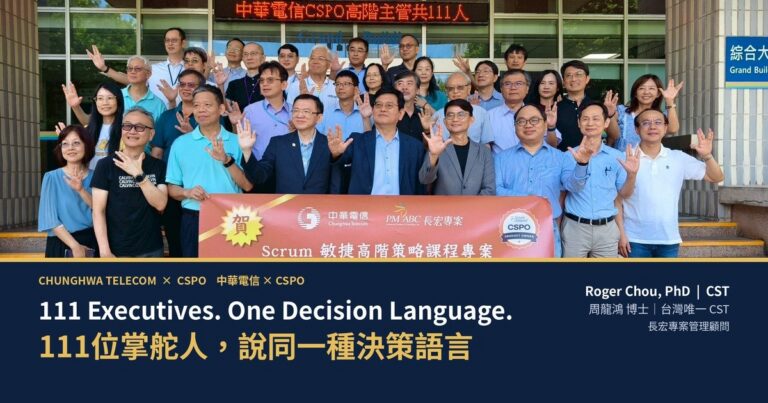
I used a facilitation tool I call the “Diamond Model” — divergence, the turbulence zone, convergence — to bring twenty-seven core executives to consensus on one decision within six months. The process was not comfortable. When I asked everyone to write down “what should we keep doing if we wanted this company to fail,” using two contrasting visuals — an apple tree and an axe — to force people to take a position, the silence in that room was more honest than any slide deck. During the vote, senior executives had to leave the room, because as long as a boss is still standing there, nobody dares to vote their real answer.
That vote is what led Nan Yi to decide it would no longer just sell books — it would build a “Learning Guardian Passport”: a product that follows a child from kindergarten through high school, recording the books they’ve read and the questions they’ve asked, replacing one-time book sales with a subscription model. That system is now live in multiple schools, and Nan Yi no longer needs to cut its workforce.
This isn’t a success story that’s already been written. It’s a transformation still in progress. And that’s exactly why it was worth bringing to Shanghai, to be tested in front of more agile practitioners.
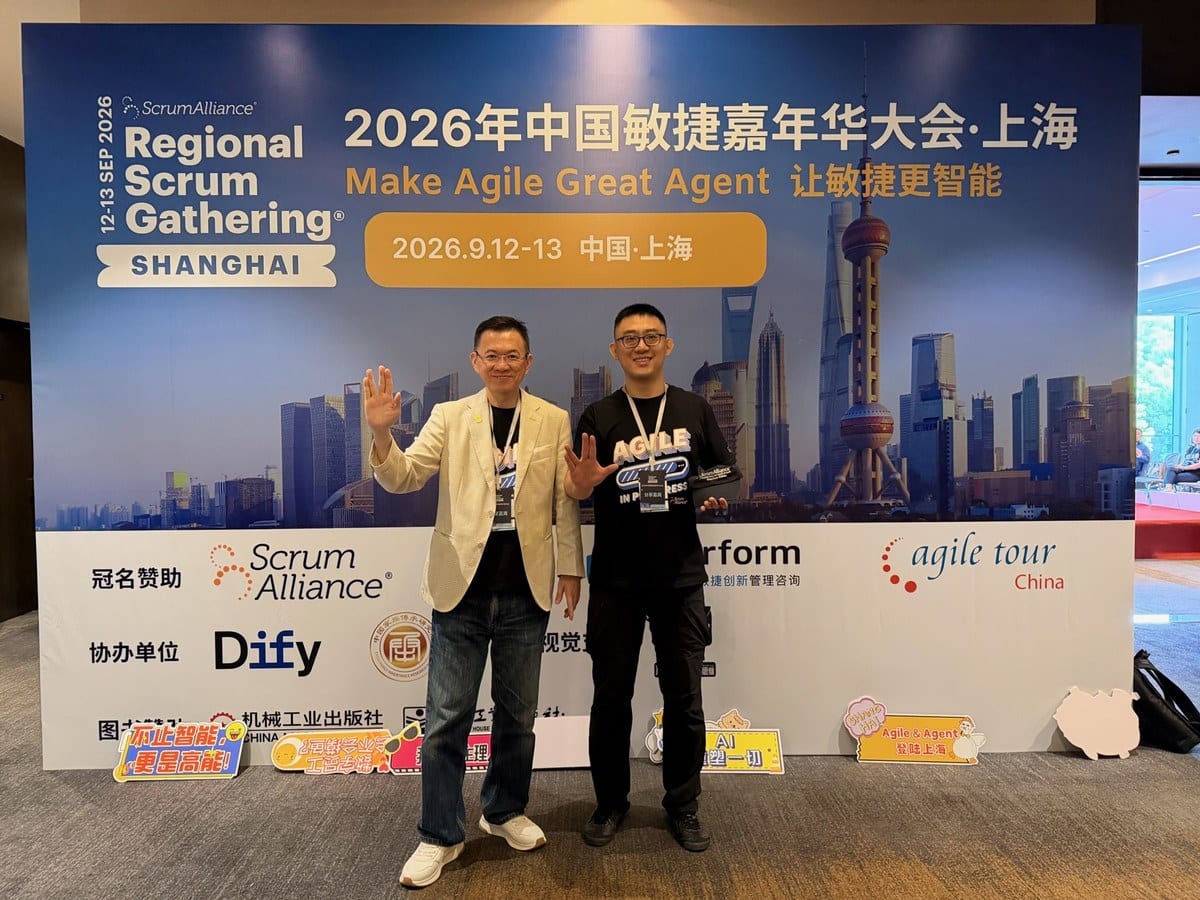
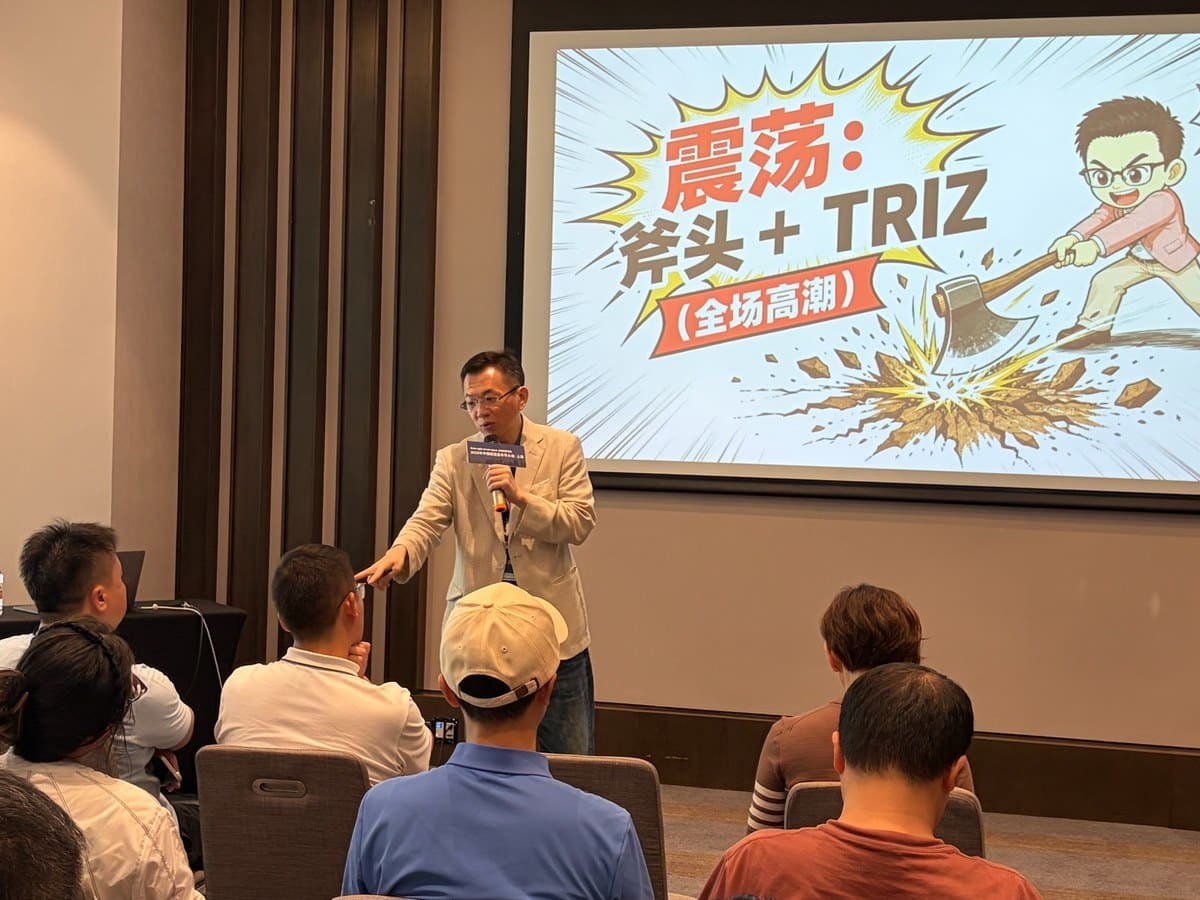
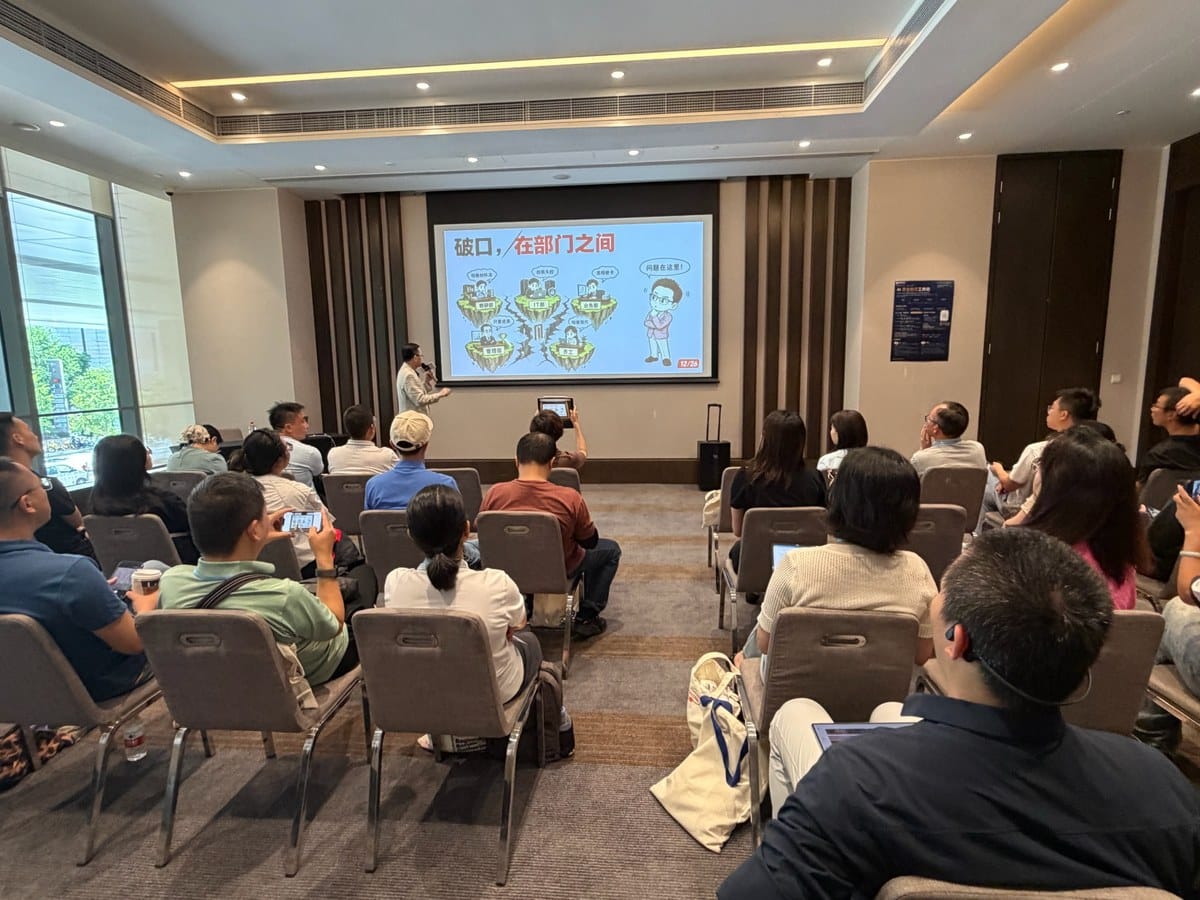
The Two Days That Wouldn’t Let Me Sit Still
I finished my talk, walked off the stage, and figured the main event of this trip was behind me. What actually kept me up was what I heard in the room over the next two days.
One technical lead described a new kind of product-development model at his company: no project management tools, no PM documents — the code repository itself is the single source of truth. Requirements, the business model, even the changing thoughts an engineer has day to day, all written into the same repository. A product that used to require a thirty-person team spanning PC and web now gets built by one PO and an agent, in two months. He said a single engineer’s output isn’t up thirty or fifty percent — it’s up by an entire order of magnitude.
He put it this way: you’ve driven a car at a hundred kilometers an hour, but have you ever driven one at two thousand? Inside that cockpit, you can’t see a thing — that’s the limit of any individual. And if you’re the one responsible for coordinating the whole thing, your organization’s topology has to be rewritten right along with it.
Another speaker said, half-joking: a few years ago, we learned Scrum as one PO managing a handful of people. Last year he figured one PO plus two people was enough, with the rest of the work handled by a hundred agents. This year he figures one PO can probably just run a whole fleet of agents directly — less hassle, less aggravation. The room laughed. Nobody actually took it as a joke.
I had brought a Taiwanese transformation case, ready to talk about how to redistribute decision rights. Shanghai’s agile practitioners were already asking a different question: once an agent’s execution capacity outstrips what any one person can even comprehend, how does Scrum itself get rewritten?
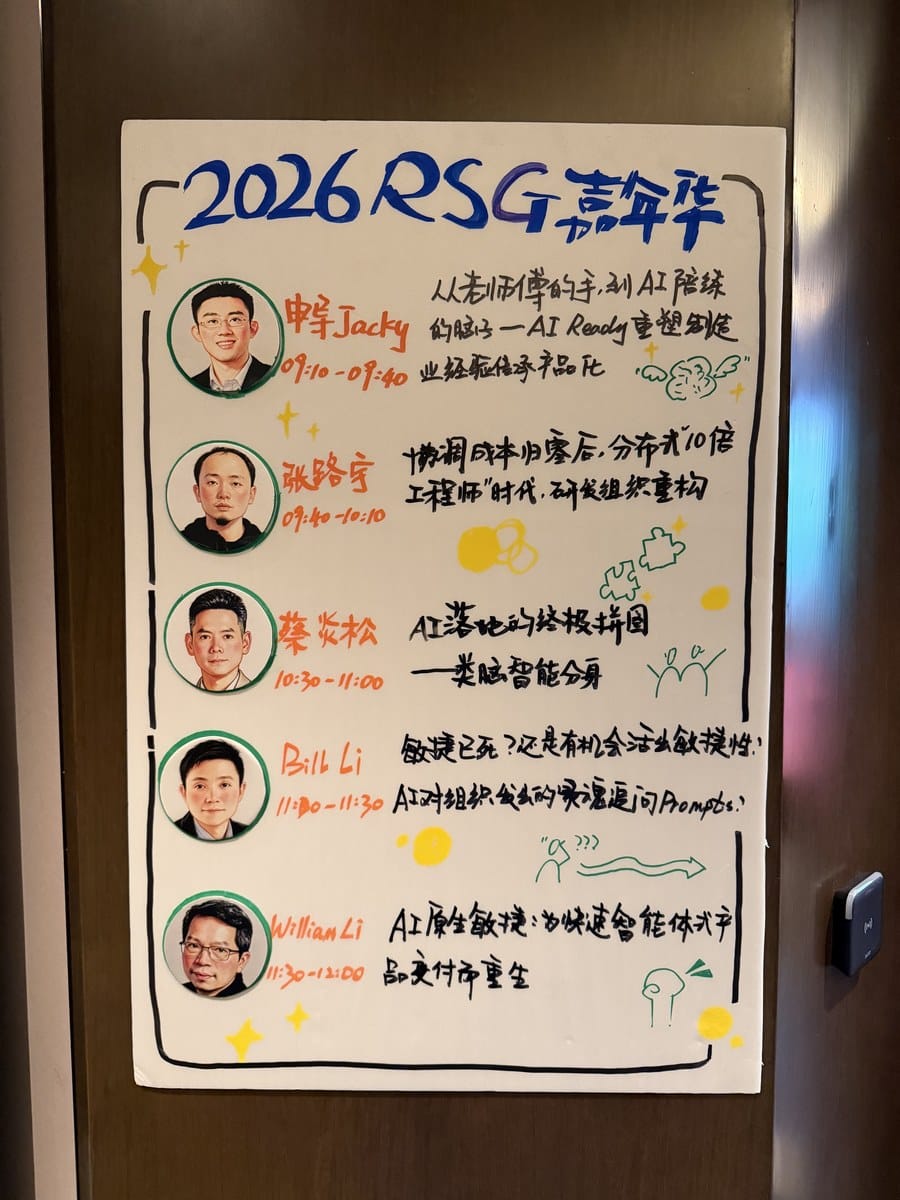
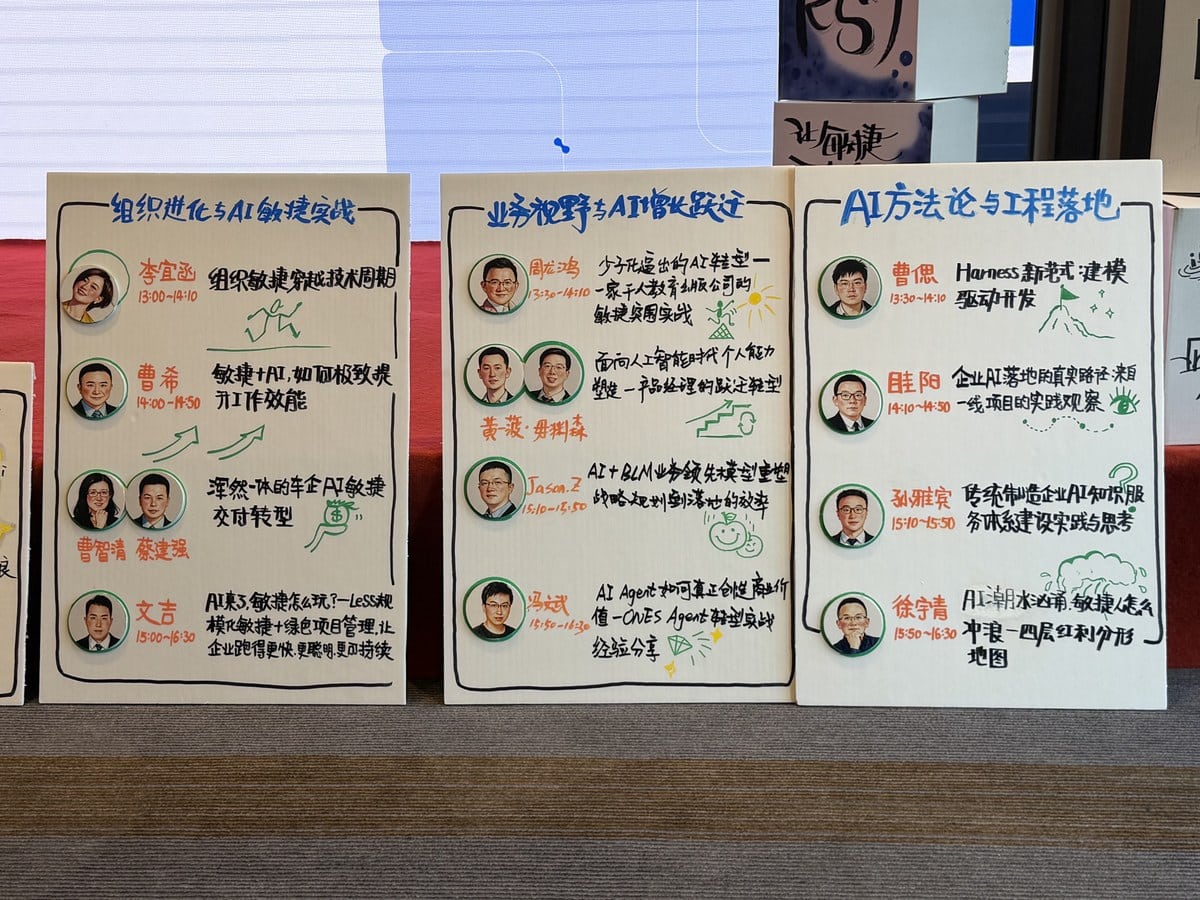
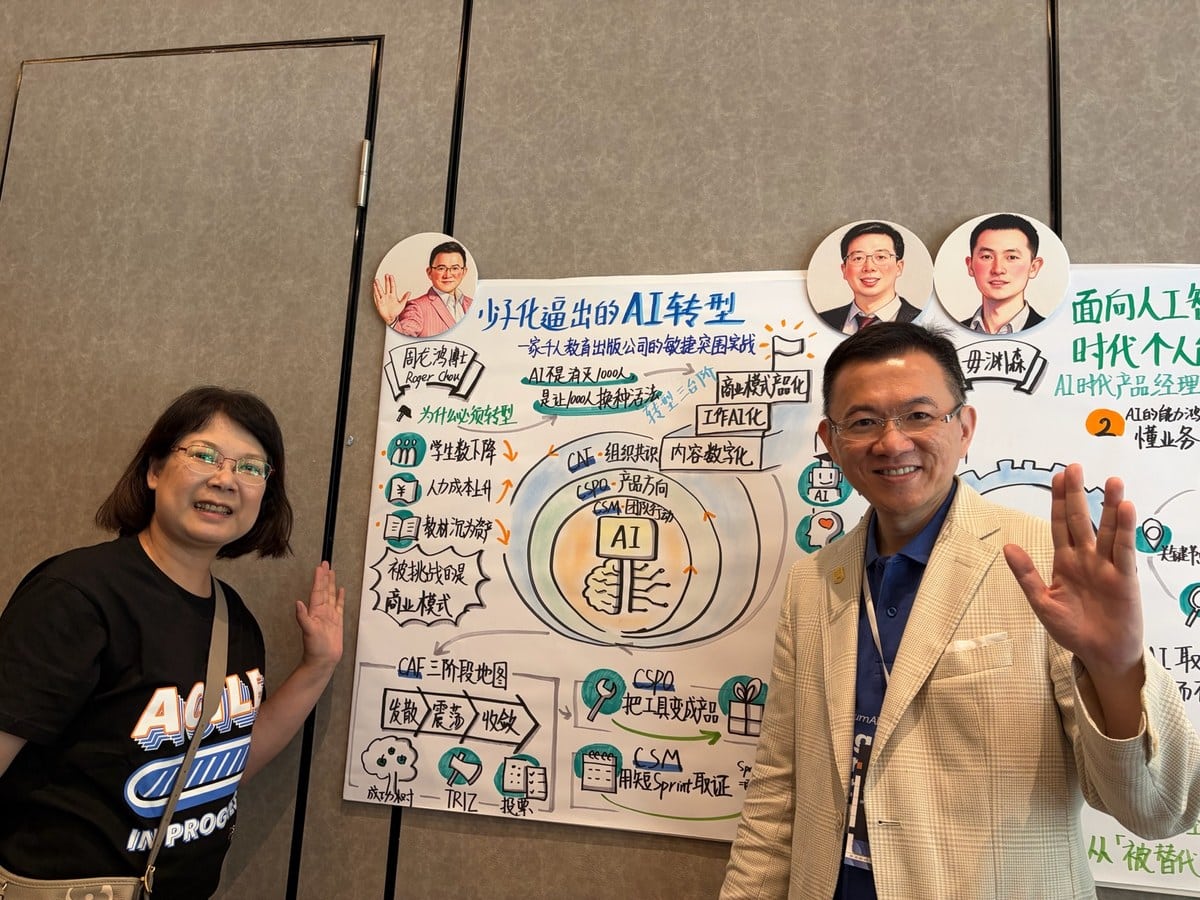
The two-day agenda was itself the most honest map of what was going on. Day one opened with a board on the wall: Jacky went first at 9:10, presenting “From the Master Craftsman’s Hand to the AI Sparring Partner’s Brain”; then came Zhang Luyu, Cai Yansong, and sessions from Bill Li and another speaker, William Li. On the afternoon’s track board, my own name was up there too — “The AI Transformation Forced by a Shrinking Birth Rate,” scheduled for 1:30 to 2:10 p.m., listed alongside seven or eight other speakers spanning three tracks: organizational agility, business vision and AI growth, and AI methodology with engineering delivery. Standing in front of that board, I realized for the first time, clearly, that this wasn’t just a conference running a stack of talks — an entire industry was pushing in the same direction, all at once.
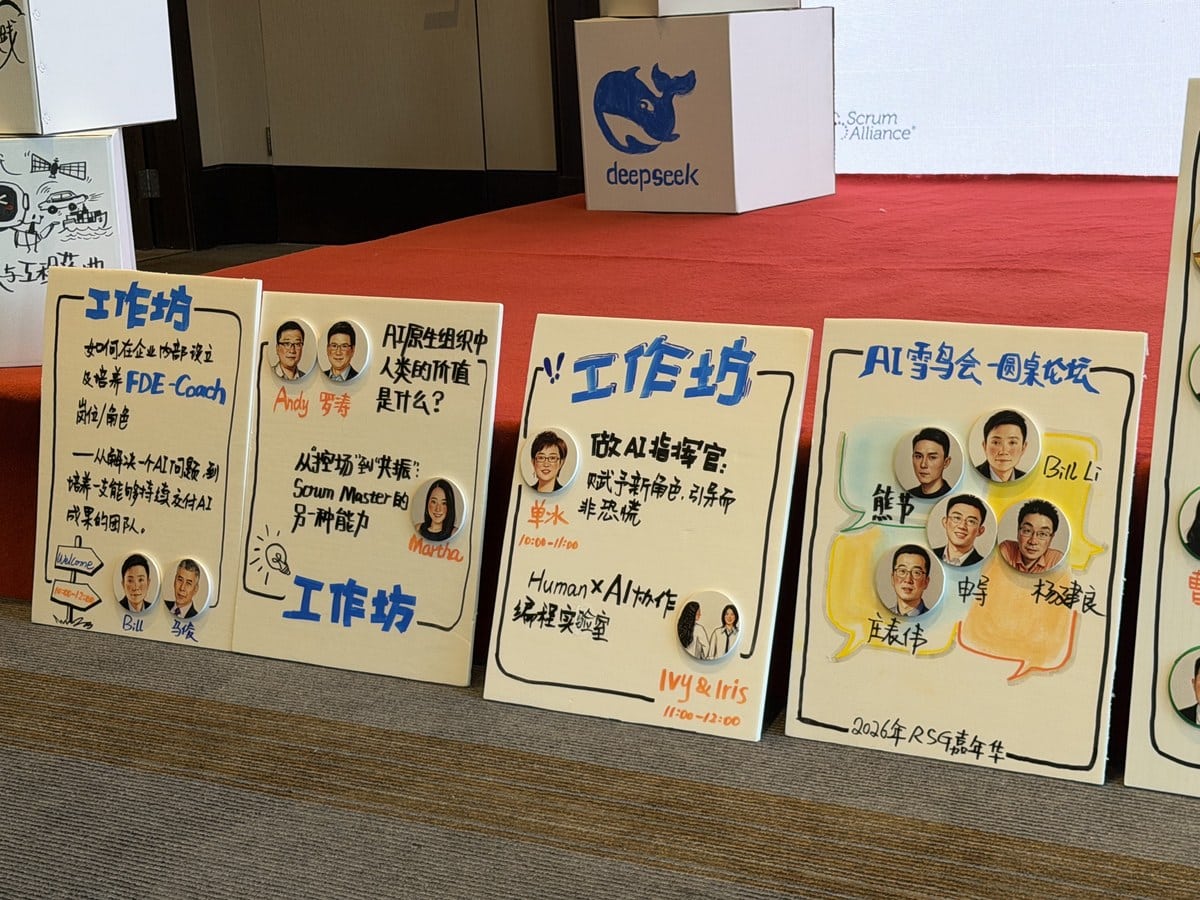
Day two morning laid out four workshop boards side by side: how to set up and grow a new “FDE-Coach” role inside a company; what a Scrum Master’s role becomes in an AI-native organization beyond just facilitating; how to teach people to be an “AI commander” instead of being dragged along by AI. The workshops themselves told you where the question had moved — nobody was debating whether to adopt AI anymore. The question was what role, specifically, a human stands in next to it.
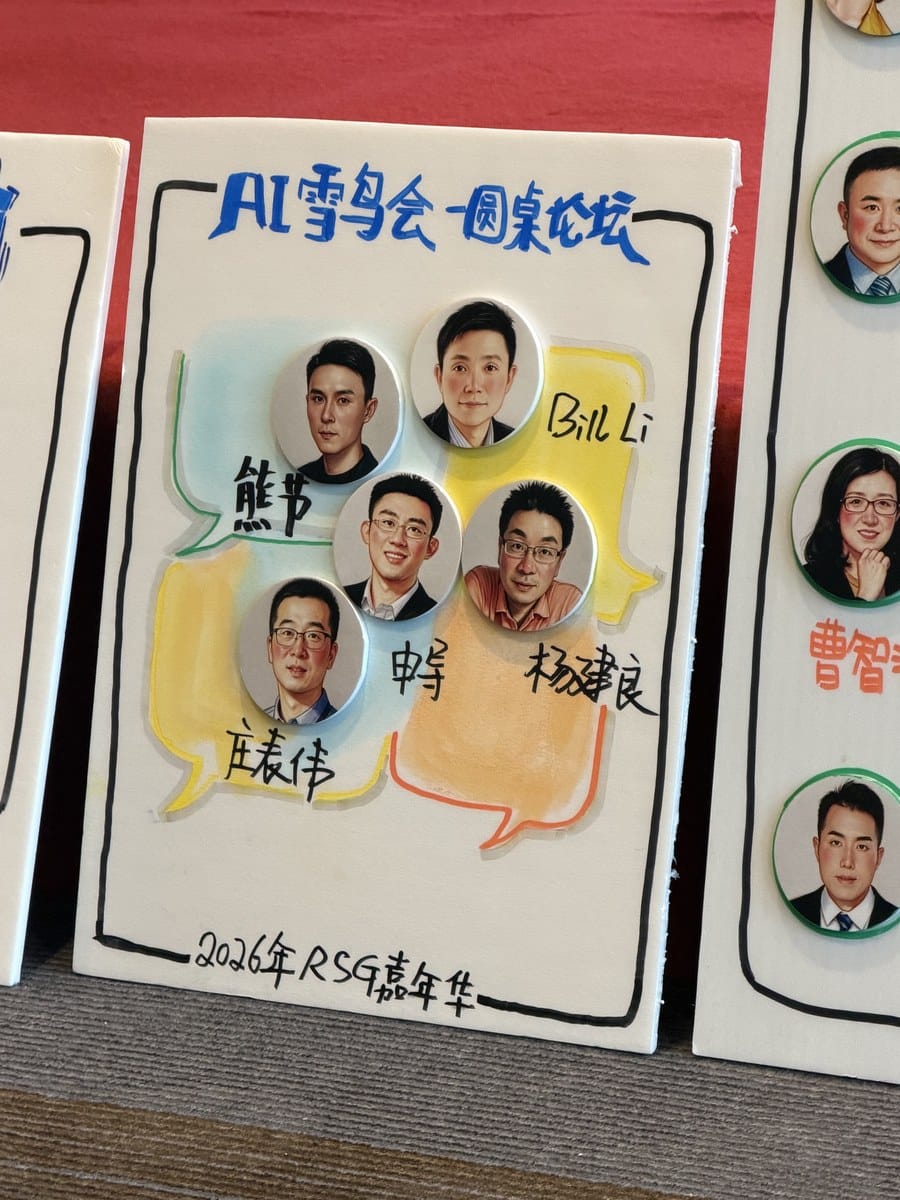
The last session, an “AI Snowbird” roundtable, put five people at the same table — Xiong Jie, Bill Li, Zhuang Biaowei, Jacky, and Yang Jianliang — and asked a blunt question: is agile already dead, or is it staying alive in a form we don’t yet recognize? I later realized this wasn’t a question the speakers had dreamed up on the spot — it ran through the whole conference as one of its throughlines. It’s the same question Bill Li asked in his own keynote, “Is Agile Dead? How to Live Out True Agility in the Age of AI” — just asked again, in a different room, by a different group of people.
Two Forces, One Shared Problem
Don’t mistake this for something as simple as “Taiwan focuses on management, China focuses on technology.” It isn’t.
I had just finished hosting a rare, globally unusual RSG positioned squarely around CEOs and senior executives, back in Taiwan. On the floor in Taipei, participants weren’t debating how to run Scrum events — they were debating how to execute strategy, how cross-functional teams make decisions together, how a product owner makes trade-offs on value, and whether senior executives are willing to be accountable for outcomes. This force is pulling agile up and out of delivery teams, into corporate governance and the boardroom table.
In Shanghai, I felt a different force at work — an enormous community of practitioners, AI technology evolving at a stunning pace, and an almost insatiable curiosity about AI agents and human-machine collaboration. The question on the floor there was: once a team includes not just people, but agents that can research, analyze, and even execute tasks on their own, how do Scrum’s roles, events, and accountabilities need to evolve?
What Taipei cares about is “who should be accountable for the outcome.” What Shanghai cares about is “once AI can already do this much, what’s actually left for a human to do.” Honestly, these are two faces of the same question.
The thing genuinely worth noting is this: AI can accelerate the work, but it cannot substitute for value judgment, accountability, or product decisions. What agile offers is exactly the governance structure that lets people keep hold of that accountability boundary while working alongside AI — whether you’re in a boardroom in Taipei or in an agent’s cockpit in Shanghai.
Taipei and Shanghai don’t need to be compared against each other. They’re closer to two pieces of the same puzzle — Asian agile. One brings agile into the decision table of CEOs and senior executives; the other accelerates the evolution of technology, product, and practice. What’s genuinely exciting is that these two forces are starting to meet.
Below the Stage, Agile Was Already Being Done in Front of You
If the talks on stage decided what this RSG was about, the people below the stage decided how long it would be remembered.
This RSG’s PO was Brenda. She opened by asking the whole room a question: “Do you know what a PO is?” Someone blurted out “Product Owner.” She laughed and clarified: I don’t need the translation, I want the meaning. That’s her style — she doesn’t accept the correct answer, only an answer someone actually thought about.
Brenda is also a visual-thinking teacher. Her online visual-thinking course has run for over a year and built up more than a hundred students. For this event, she picked out about nine of her strongest students — her “class reps” — and formed them into the conference’s live graphic-recording team. From the moment each talk began to the moment it ended, they sat below the stage translating the speaker’s content into a complete hand-drawn graphic panel in real time; by the time a speaker finished their last sentence, the panel on the wall was nearly finished too.
Brenda made a point of clarifying this on stage: “We don’t call this a bulletin-board sketch. We call it graphic recording — a very fancy international term.” What she’s been chasing for years in this community, she said, is a sense of being alive. AI can generate images fast, but that’s just technology — it has no feeling. What she wants is for someone in the room to actually understand what the speaker just said, draw it, and remember it.
The nine volunteers weren’t each drawing their own thing — together, they were accountable for the visual output of the entire conference. That, on its own, is a highly collaborative, real-time-delivering, fast-feedback agile team. While the speakers on stage were still explaining what a Sprint is, or what short-cycle validation means, Brenda and her nine volunteers had already done agile, live, below the stage.
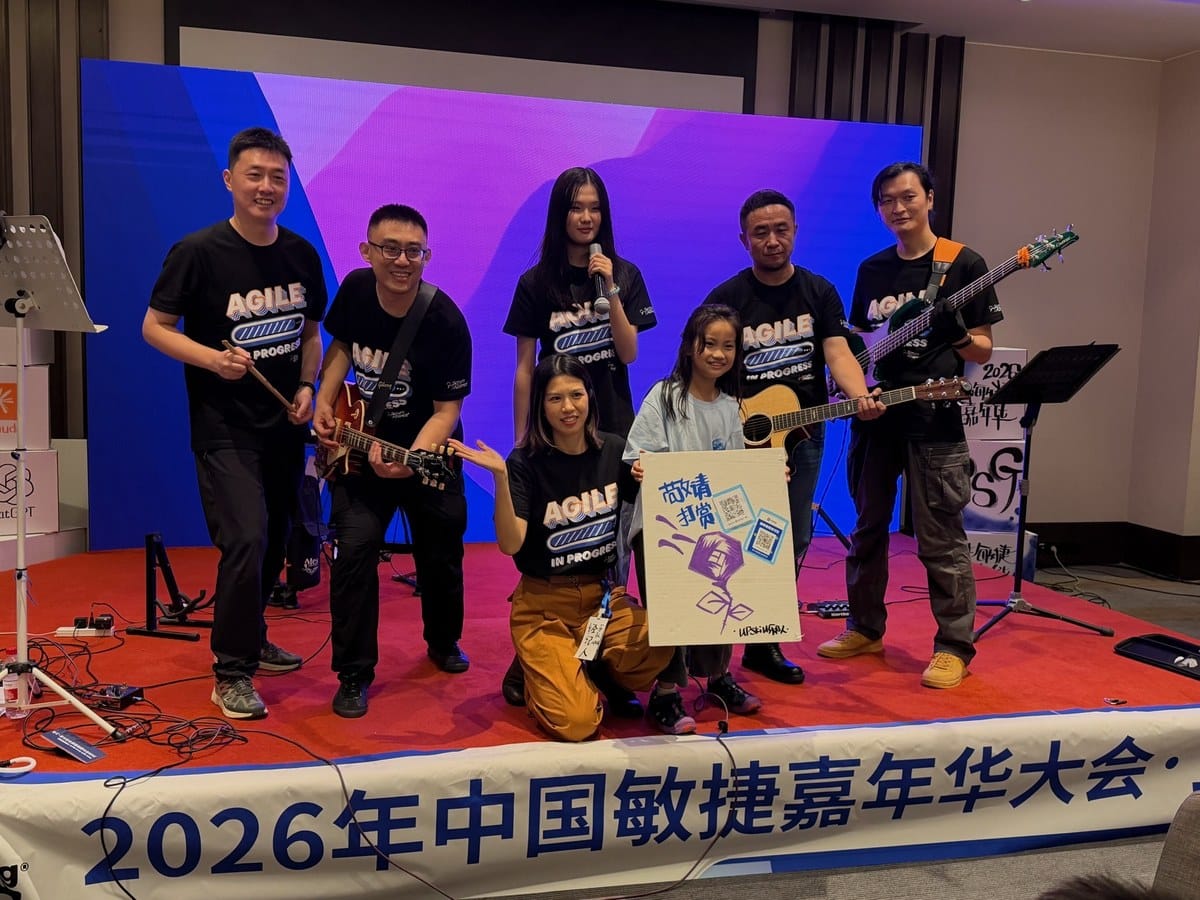
As the event wound down, Brenda called all the volunteers up on stage for a group photo and handed the applause to them. She closed with a line I’ve been turning over for days: “Who’s the next PO going to be? To be continued, I guess. Okay, I’m stepping down now — maybe it’ll be an agent.” The room laughed. But standing in front of an entire wall of hand-drawn panels, I couldn’t help wondering: if AI really could draw all this, could it draw that sense of being alive?
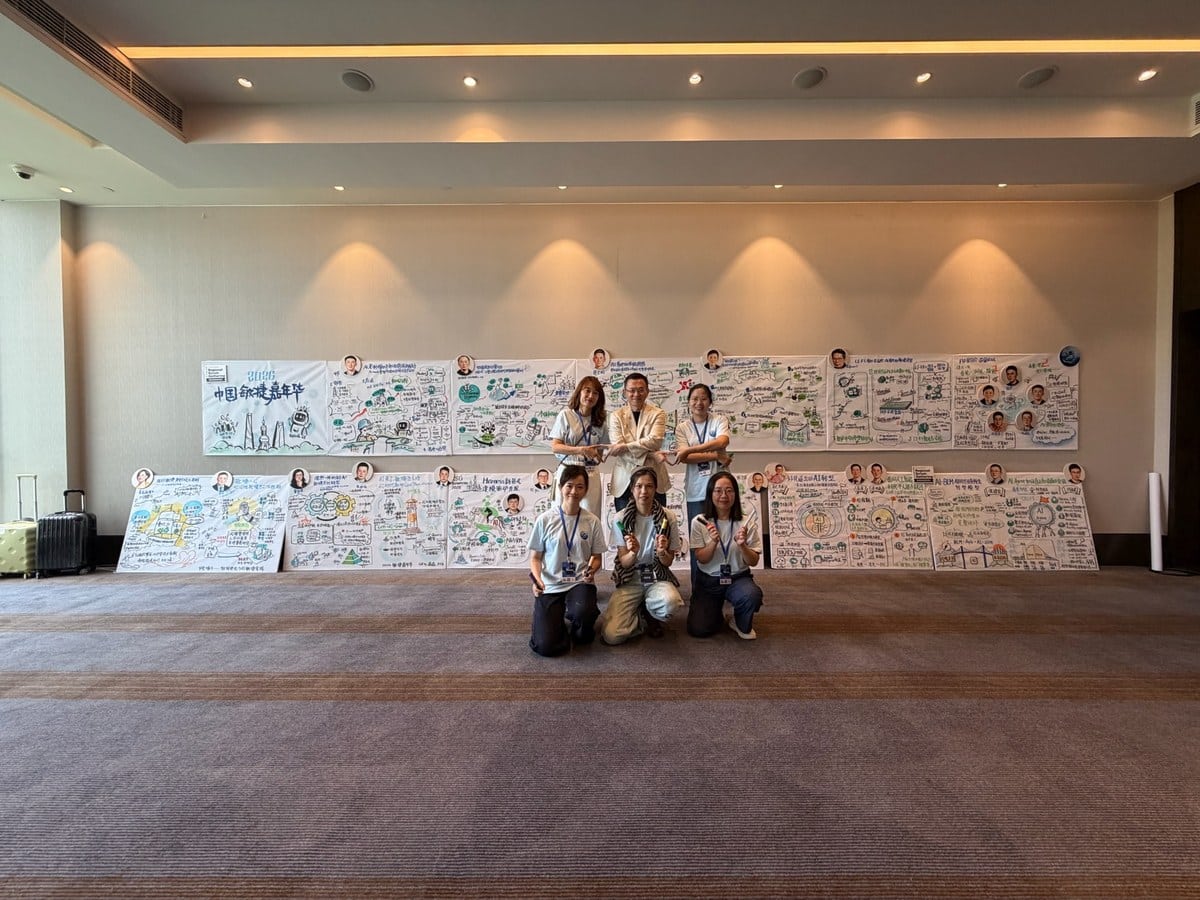
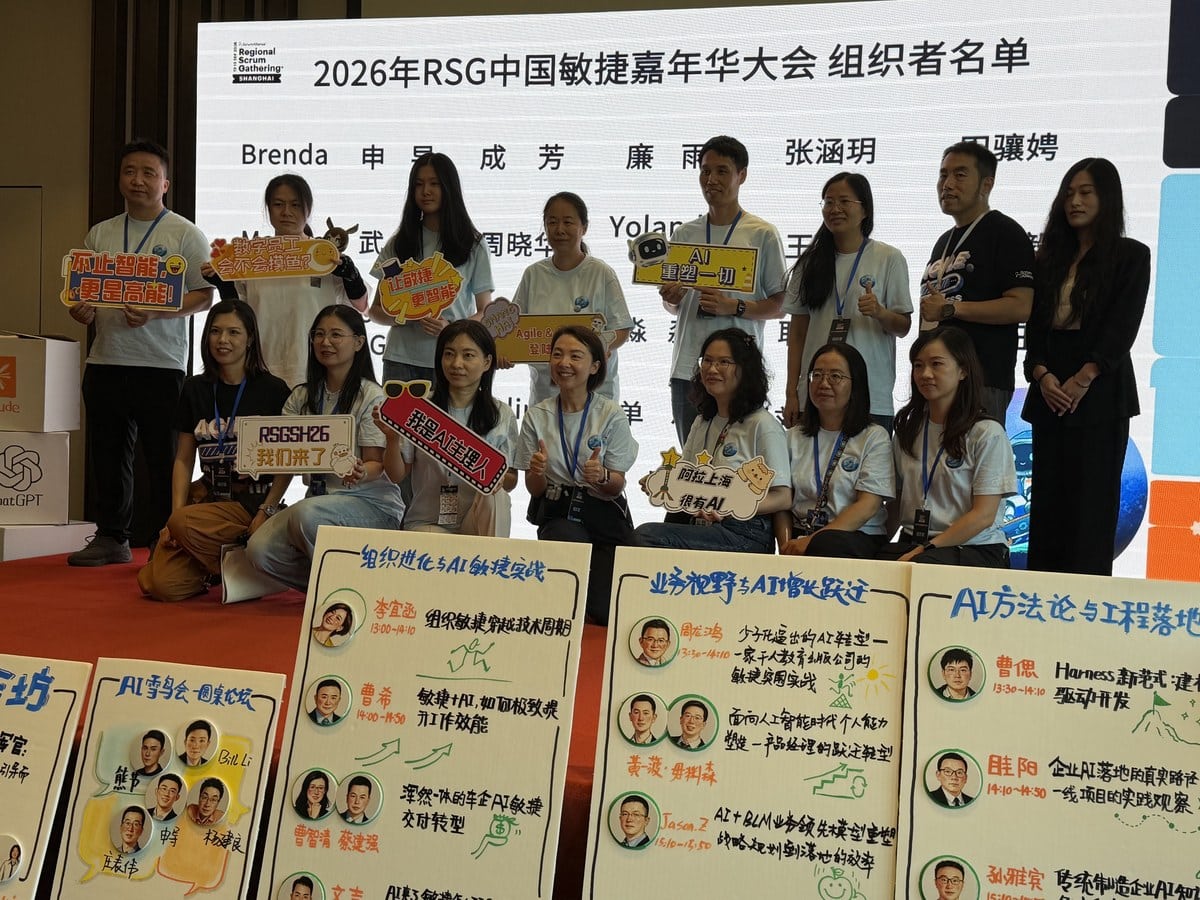
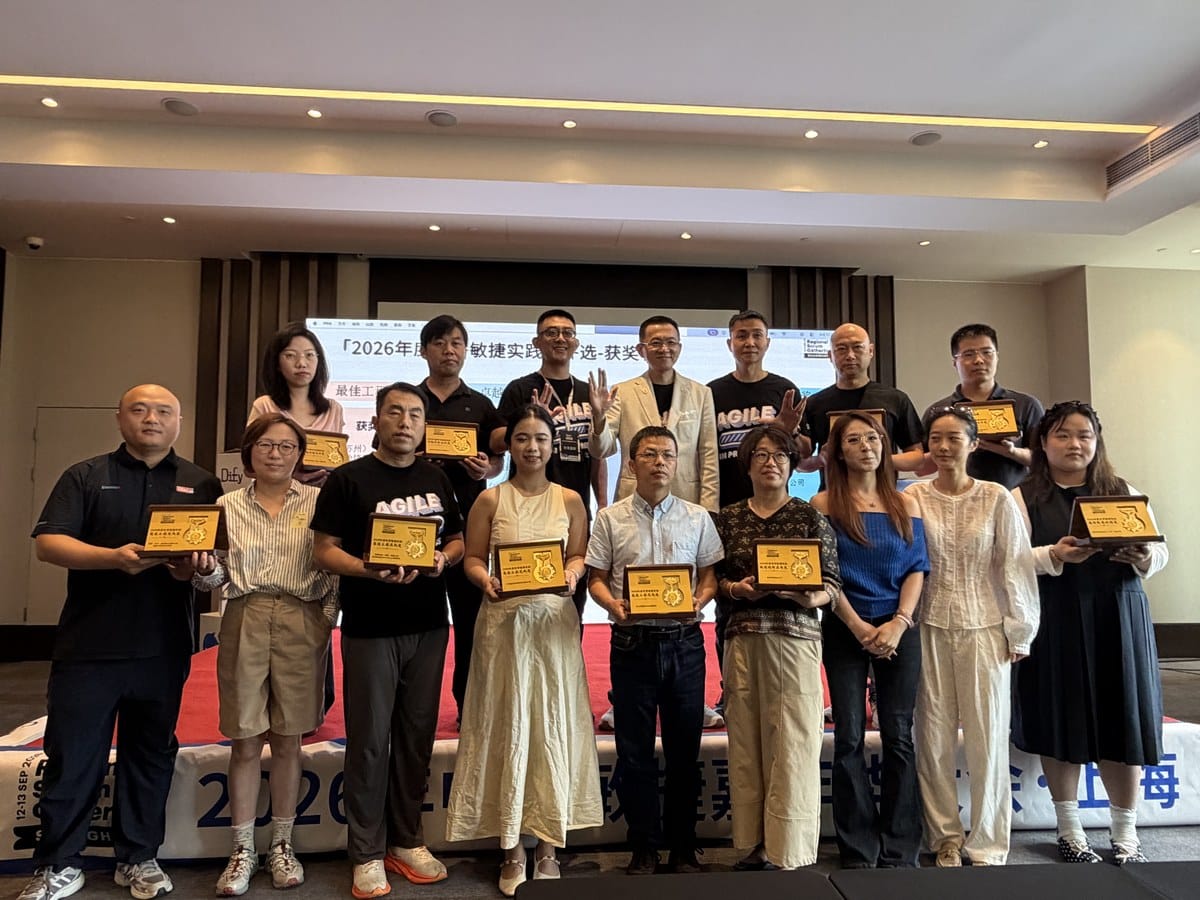
Running this conference took more than the people on stage. Before the doors even opened, the organizers called every volunteer organizer up for a group photo — Shen Yu, Cheng Fang, Lian Yu, Zhang Hanyue, Zhou Xiangting, and Brenda herself, more than a dozen people in matching pale blue T-shirts, holding up signs they’d written themselves. One read “Making Agile Even Smarter,” another “AI Reshapes Everything,” another “I Nominate Myself, AI Program Lead.” Nobody in the room was paid to be there. This entire RSG — from designing the agenda to running it on the day — was carried almost entirely by this group of volunteers.
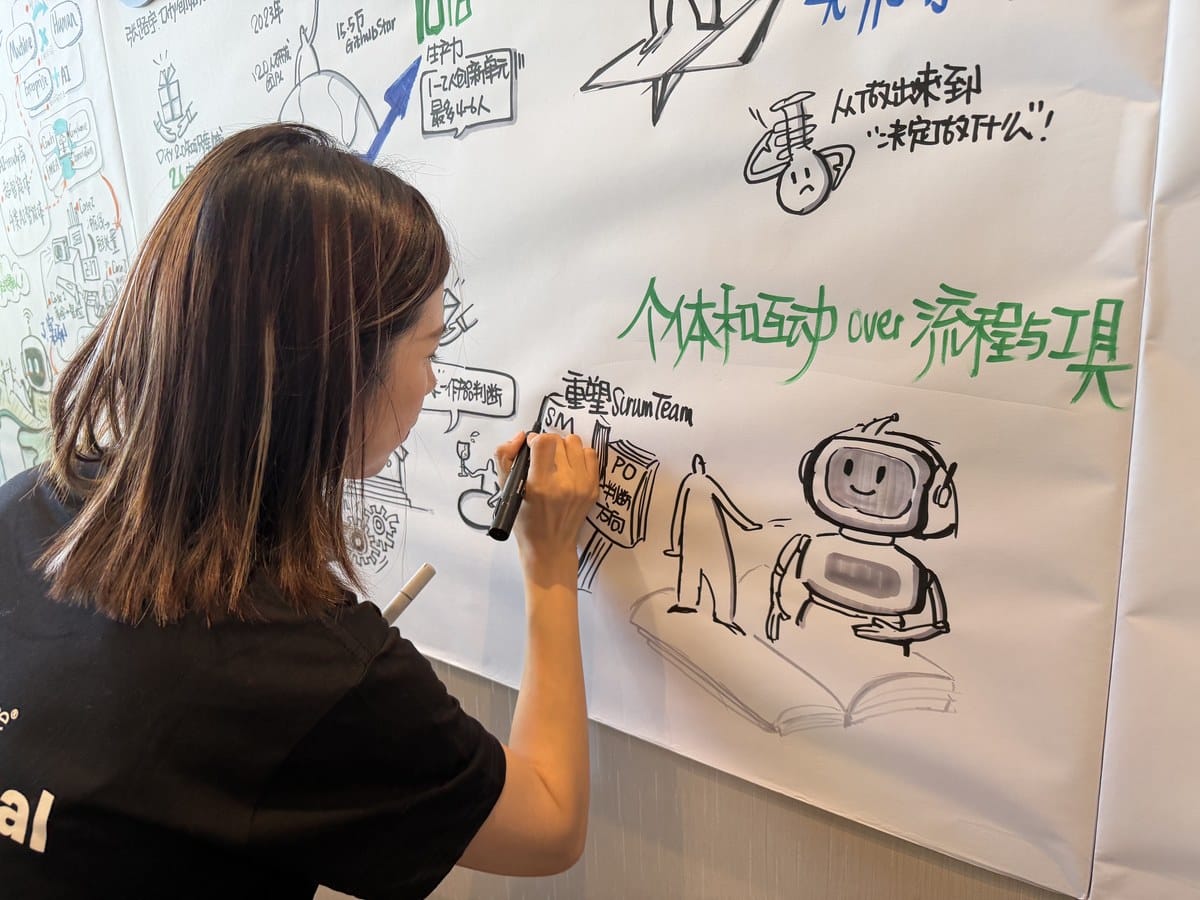
I later made a point of walking over to the wall to watch Brenda draw, herself. Her back to the crowd, marker in hand, she was sketching a person and a robot onto a huge sheet of paper at the same time, writing out “Individuals and interactions over processes and tools” beside them. That image answered the question of whether the Agile Manifesto still holds up in the AI era more directly than any slide could. The answer wasn’t argued into existence — Brenda drew it, stroke by stroke, with her own hand.
Three People, a Legacy Still Being Written
There’s one more photo from this trip that made me stop and stand still for a long time.
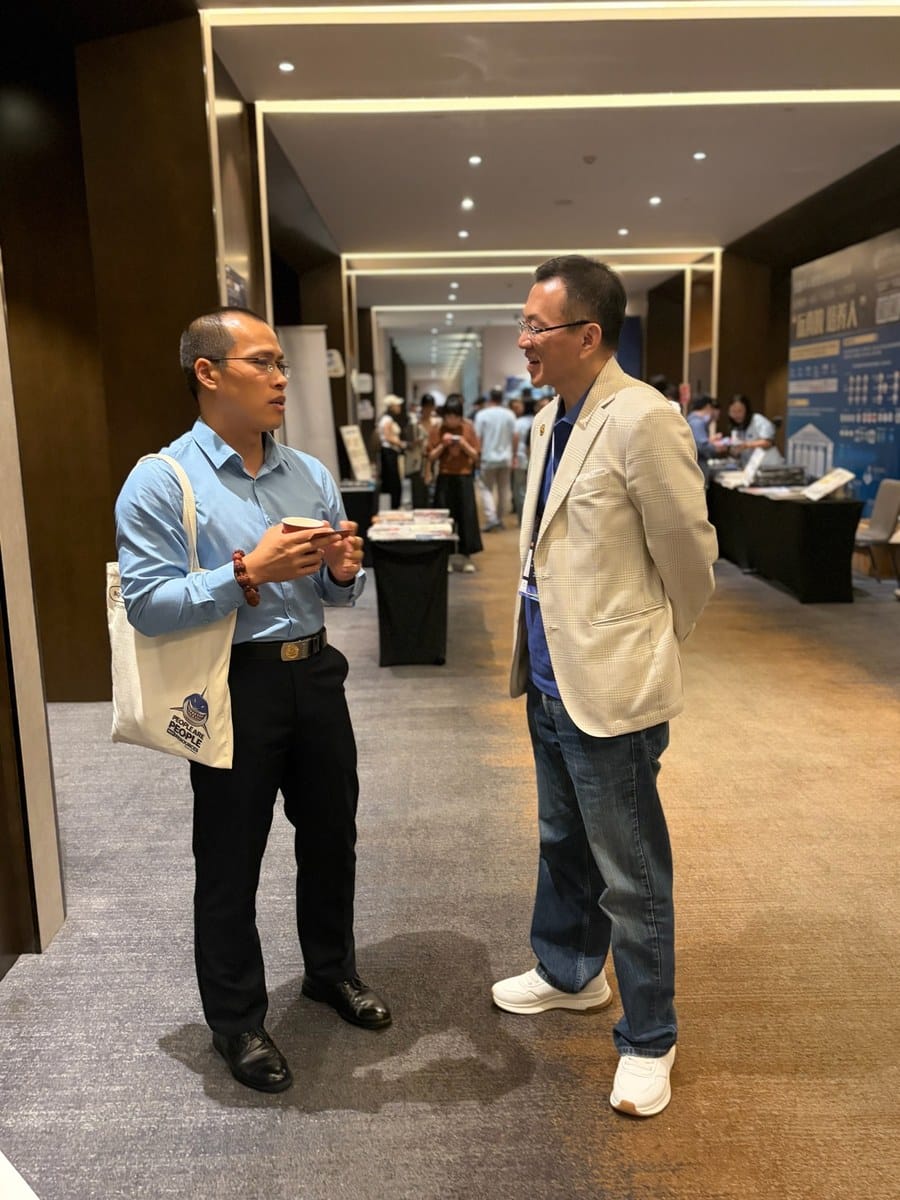
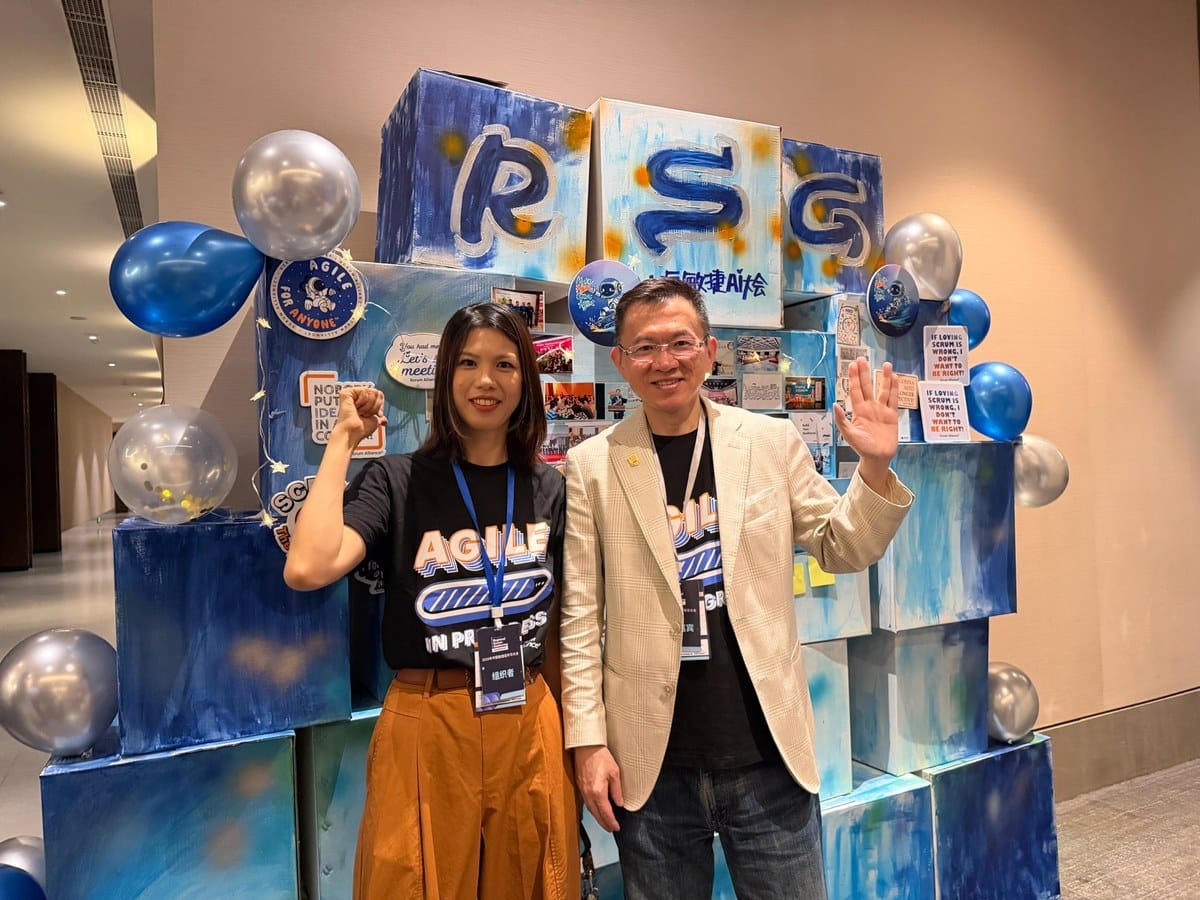
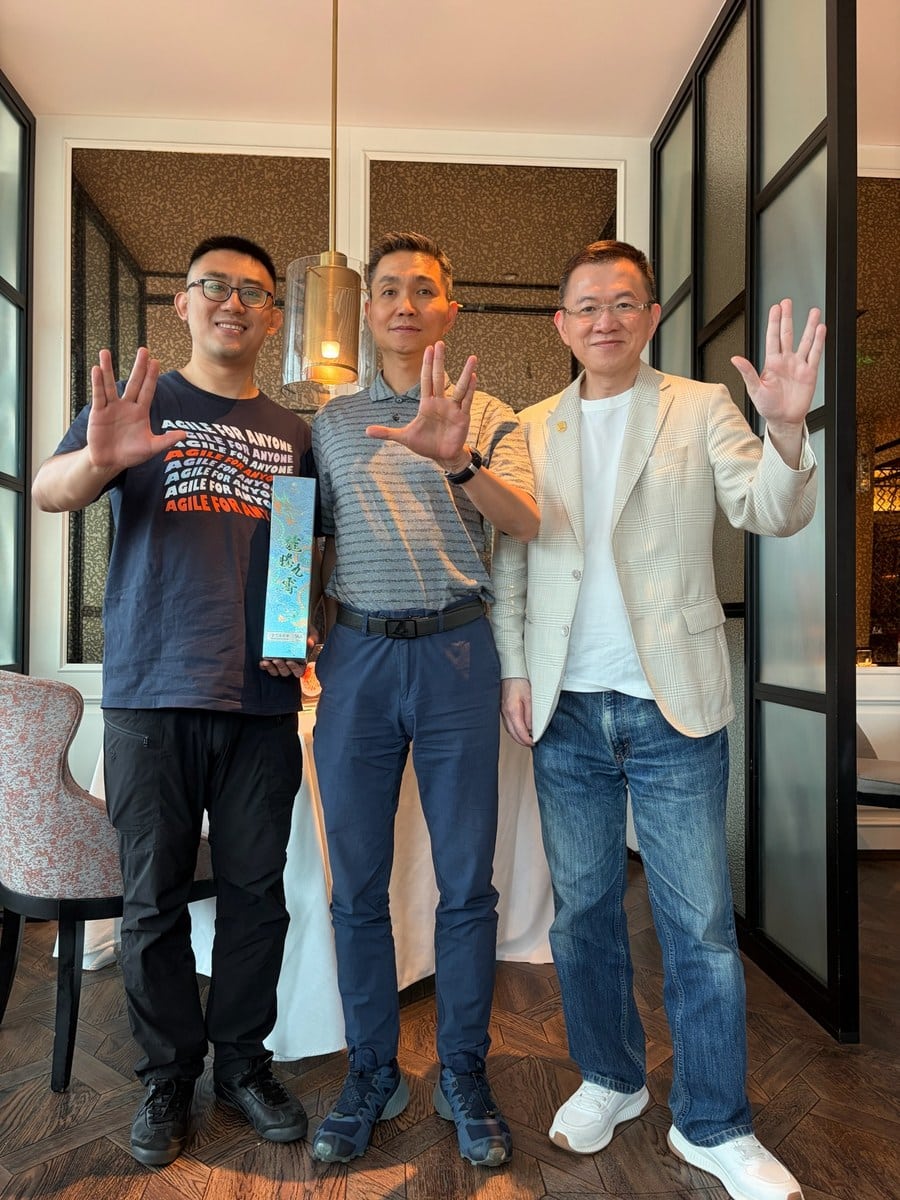
In Shanghai, I got to see my mentor, Bill Li, and Jacky, who has trained a great many CSMs. The three of us standing together wasn’t just a reunion photo to me — it felt like a snapshot of a whole chapter of Asian agile’s development.
I learned Scrum from those who came before me. Later, I tried to bring Scrum in Taiwan out of the IT department and into the decision-making rooms of CEOs, general managers, and senior executives. This time, I brought a real Taiwanese case of using agile to drive AI transformation to Shanghai.
Passing something down isn’t about repeating the previous generation’s answers more loudly — it’s about picking up their spirit and answering the next era’s questions. What those who came before us left us was never just a framework or a certification. It was the courage to keep challenging the status quo, to respect people, and to learn through evidence. Now that AI is starting to redefine work itself, that courage matters more than any tool.
The Unfinished Guide in Jacky’s Hands
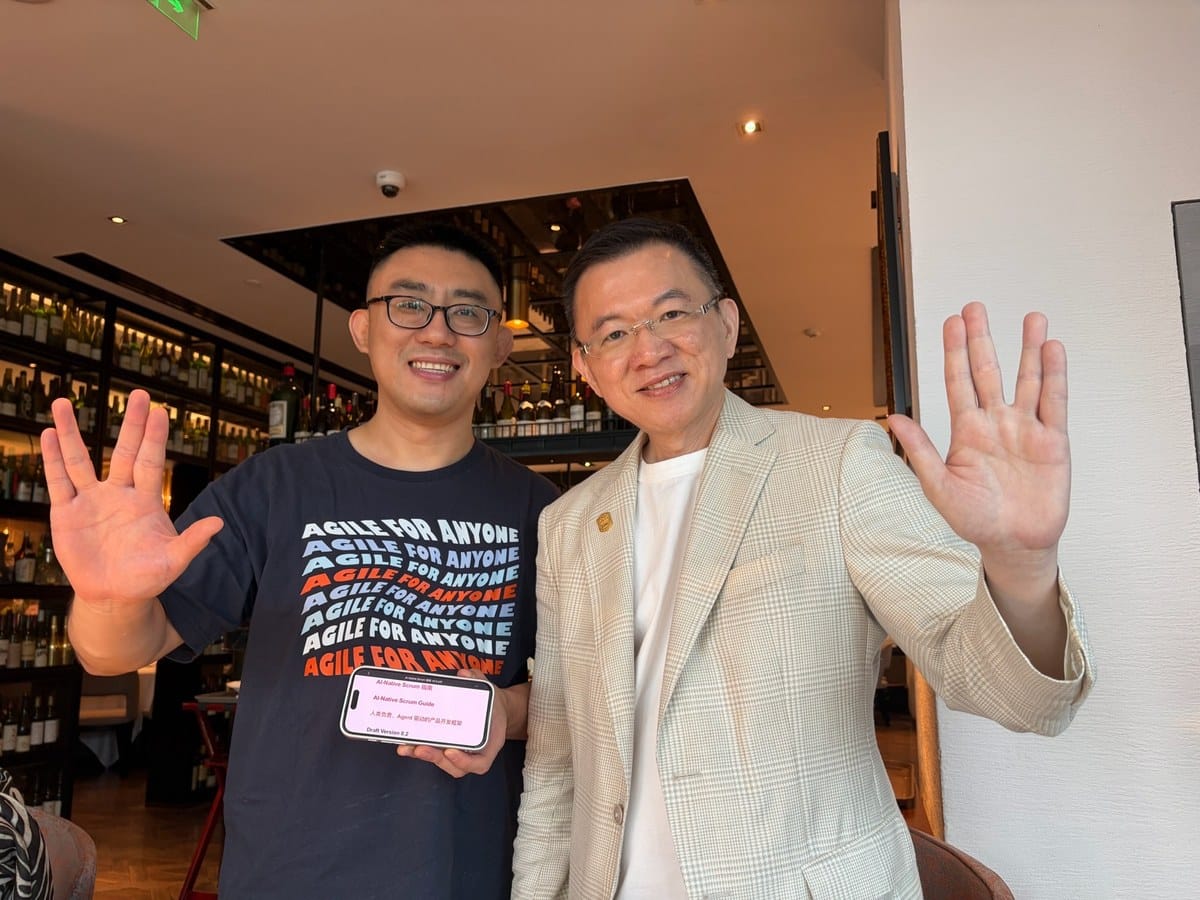
The thing from this trip I still can’t let go of is something Jacky has in hand that hasn’t been released yet — the “AI-Native Scrum Guide.”
It isn’t a list of AI tools bolted onto existing Scrum. What he’s actually doing is answering a more fundamental question from scratch: once agents can already research, analyze, plan, and even execute on their own, what’s left in a team that’s distinctly “human”? How do Scrum’s roles, events, artifacts, and accountabilities need to evolve?
There’s a line in the draft I’ve reread several times: humans hold accountability; AI does not hold ultimate accountability. Agents can be responsible for analysis, exploration, planning, execution, testing, monitoring, and iteration — but judgment, trade-offs, risk-bearing, and accountability can only rest with a human. The three roles — Product Owner, Developers, Scrum Master — haven’t been replaced, and Scrum hasn’t grown a fourth “Agent” role because of this. An agent is part of the team’s capability system, not a member of the team.
The draft breaks the work into three interlocking cycles: a Human Cycle responsible for direction, value, and trade-off judgment; an Agentic Cycle responsible for continuous execution and learning; and, in between, a Human-Agent Interaction Cycle that translates human intent into actions an agent can understand, and translates an agent’s output back into evidence a human can judge. It even proposes a very plain principle — not “a human must watch every step,” but “human judgment shows up only where judgment is actually needed.”
Jacky himself is very clear that this is only a second-draft prototype (labeled Draft Version 0.2 in the document itself) — it hasn’t even reached formal release yet, and he’s inviting anyone interested to join him and help finish it. What I saw wasn’t just a document. It was an early signal of something that could change Scrum’s future.
I can’t say whether this will become Scrum Alliance’s official direction going forward — that’s not a decision any one person gets to make, and it’s far too early to draw that conclusion. But as someone who sits on Scrum Alliance’s global board, I know one thing clearly: a signal like this is worth carrying back into the global community’s field of view, so more people can see it, discuss it, and put it to the test together. In the past, we translated Scrum into Asia’s languages. If this guide gets properly refined, Asia might not just be a translator anymore — it might get the chance to help define Scrum for the age of AI, for the first time.
From a Board Seat, What Can Asia Contribute
Looking at this through the lens of a Scrum Alliance global board member, what I care about isn’t which event was bigger, or which market’s approach is more mature. It’s what signal these two events, taken together, are sending.
Scrum’s next growth space may not lie in how a team runs a Sprint, but in how leaders confront the value trade-offs, organizational restructuring, and shifts in accountability that AI brings. Tools keep getting smarter, and that doesn’t make people less valuable — but corporate leaders have to answer more honestly: whom, exactly, are we solving what problem for? Which decisions can be handed to AI, and which accountabilities still have to rest with a human? Once efficiency rises sharply, is the time saved spent on layoffs, or on building the next growth curve?
This isn’t just a Nan Yi problem, and it isn’t just a problem for one RSG. It’s a problem the global agile community has to face together.
Asia shouldn’t be forever just a user of Western agile methods, either. We have large enterprises, fast-moving markets, cross-cultural organizations, and plenty of non-IT industries nobody originally thought Scrum applied to. Taiwan’s CEO decision table plus Shanghai’s AI proving ground — these real, complicated scenarios aren’t just friction against adopting agile. They may be the most valuable proving ground Asia can hand back to the global agile community.
In the past, we translated Scrum into Asia’s languages. The next step is to write Asian enterprises’ hands-on experience into the next chapter of global Scrum.
The Next Stop Isn’t a City
The night the Shanghai RSG ended, I stood outside the venue for a while.
Two days of talks about AI and agile on stage; nine volunteers below the stage turning it all into something you could see with your own eyes; the still-unfinished guide in Jacky’s hands, quietly possibly rewriting Scrum’s next decade — stack these images together, and they make me more certain of one thing than any single talk’s conclusion could: the next stop for Asian agile isn’t a city.
It happens at every leadership table willing to redistribute decision rights, take real accountability for product outcomes, and choose to use AI to create new value rather than simply cut costs. It happens in the hands of every volunteer willing to turn knowledge into something visible. It happens in every unfinished draft that its author is still willing to put out in public and let people test.
From Taipei to Shanghai, what I brought wasn’t a standard answer — it was an Asian case study still evolving. What I brought back wasn’t a conclusion about who did it better — it was a bigger question: now that agile has met fast-forward AI, are we ready to redefine the team, and redistribute accountability?
I’ve been to Shanghai before. This time, I brought Taiwan’s hands-on experience to share, and I’ve brought Shanghai’s new questions home.
Because a genuinely valuable exchange was never about who produced the answer — it’s about whether we can see the next direction, together.