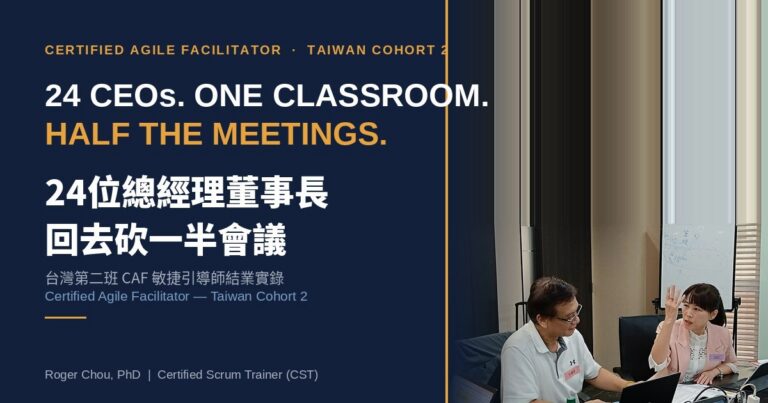
With 52 executives certified across two cohorts and a roadmap toward 100 across four, Chunghwa Telecom is elevating Scrum from team-level agility to executive product governance.

When most enterprises introduce Agile, the frontline team is the first to be seen. Stand-up meeting, Sprints, and Kanban boards, and delivery velocity are indeed vital. In large enterprises, however, the long-term success of Agile rarely depends on how fast teams deliver, but on whether senior leadership evaluates product trade-offs through a shared value system. Velocity can be trained, but a misaligned direction leaves no room for course correction.
In my first proposal letter to the President of Chunghwa Telecom for CSPO in 2025, I used a simple analogy:
CSM is like a supercar engine, driving the organization to move faster; CSPO is like a navigation system, guiding executives to determine where to go. Large enterprises cannot rely on speed alone; they must also have a clear direction.
On the afternoon of July 4, 2026, 24 executives passed certification in the second cohort. Chunghwa Telecom reaches milestone with 52 executives CSPO-certified. As everyone gathered in front of headquarters with a celebratory banner to take a group photo, I looked up at the LED ticker above the main entrance, which happened to display the corporate values of Chunghwa Telecom: Customer Trust, Innovation, and Accountability.
To be honest, it hit me right then: this corporation had already inscribed the core spirit of a Product Owner on its very walls. What we are doing now is equipping that spirit with a common decision-making mindset and language.
This is the true purpose behind Chunghwa Telecom’s initiative to certify 100 executives as CSPOs. It is not just the completion of a training course, but the transformation of Scrum from a team execution mindset and language, into an executive product governance for a large-scale enterprise.
From “Doing Things Right” to “Doing the Right Things”
CSM helps teams learn how to do things right.
However, CSPO persistently asks: Is the thing we chose to do in the first place truly right?
For large enterprises, this question is more critical than methodology. Day-to-day, executives face trade-offs involving multiple business groups, diverse product lines, varied stakeholder expectations, and finite resources rather than single isolated tasks.
Without a shared product value language, individual departments may exert immense effort, yet the corporate trajectory may still misalign.
The value of CSPO for executive leadership is not to turn them into hands-on Product Owners, but to empower them to make decisions based on product value, customer outcomes, and strategic prioritization.
In other words, CSPO serves executives not merely as a Product Owner credential, but as a universal language and mindset for corporate product governance.
Not a Single-Unit Training, but Shared Learning Across Decision Nodes
The uniqueness of Chunghwa Telecom’s CSPO initiative lies not only in the numbers, but in the breadth of participating units and the seniority of participating leaders.
Participants spanned Headquarters, multiple Business Groups, Operational Branches, Technical Divisions, Research Institutes, and Key Functional Departments. Levels ranged from Senior Executive Leadership, Business Group Executives, Branch Managers, and Functional Department Heads to Executive Successors.
This demonstrates that it is neither a localized effort nor an isolated departmental workshop. It represents the construction of a shared executive language across Headquarters, Business Groups, Branches, and Product Decision Nodes.
This is why this case study stands out for the global Agile community. While many corporate Agile deployments remain confined to team levels, project silos, or IT divisions, Chunghwa Telecom chose a different roadmap: establishing a common product governance language among executives, and then cascading that language across various business units.

52 Certified Across Two Cohorts: Governance Density is the Real Key
With four cohorts planned to reach the target of 100 certified leaders, two cohorts have now been completed with 52 executives in position.
Having coached executives across various industries, gathering 52 top executives in the same class for CSPO is a rare governance event globally. Yet beyond the headcount, the real metric is governance density.
When only a few managers understand CSPO, which remains an individual skill.
When 52—and eventually 100—executives share a common understanding of product value, prioritization, customer outcomes, and cross-departmental collaboration, it becomes an organizational language and mindset.
Once all four cohorts complete training and 100 executives earn the certification of CSPO, it won’t just represent 100 certifications—it will be 100 product decision nodes beginning to align on a single, shared value language.
This is paramount for large-scale enterprises, where every executive decision impacts resource allocation, product direction, cross-functional synergy, and long-term competitiveness. When decision nodes adopt this shared language, Agile evolves from a team methodology into an enterprise-wide governance capability.
Not Teaching Scrum, but Designing Decision Stress Tests
Executives do not need more Scrum jargon. It generates limited executive value if it simply defines terms like Product Backlog, Sprint, or Stakeholder.
The true value lies in introducing authentic corporate product trade-offs into the classroom—allowing leaders to practice navigating competing perspectives, distinct KPIs, cross-business group dynamics, and customer value trade-offs within a safe yet real-world environment.
Thus, the core design centered not only teaching knowledge but also testing the Decision Stress.
The course covered cross-business group domain challenges, including rewards ecosystems, corporate enterprise pricing, international network services, mobile business services, and computing power infrastructure. These scenarios reinforced one clear reality: Product decisions at Chunghwa Telecom cannot be made in isolation by any single department. They require synthesis across market dynamics, customer needs, technical architecture, operations, platforms, policy, and corporate strategy.
These are challenges that process alone cannot solve; they require decision-makers sitting at the same table, conversing in a shared language of value.

This is the true value of executive-level for CSPO: transforming Scrum from a classroom framework into a governance language and mindset for product selection, prioritization, and execution.
Executives Learning Together Sends a Strong Leadership Signal
Another key indicator of this initiative was that executives did not merely attend passively; top business leaders personally led their teams in participation. This carries immense significance.
In large enterprises, executive willingness to learn together is often more consequential than the curriculum itself, because collective learning aligns how decisions are discussed rather than merely aligning knowledge.
The value of executives attending class together lies in returning to the same shared language when facing future strategic trade-offs.
Honestly, in all my years of executive coaching, scenes like this are rare. During the two-day workshop, Vice Presidents became so deeply engaged in debating product prioritization that when break time came, they stayed glued to the whiteboard. It was no longer just a class—it was a room full of decision-makers choosing to get on the exact same page.

This defines the true purpose of executive-level CSPO training. It is not about turning leadership into tactical Product Owners within Scrum teams, but about equipping them at a higher level with capabilities in product governance, value prioritization, and cross-departmental integration.
From Individual Certification to Enterprise-Grade Capability Assets
When all four cohorts conclude and 100 executives attain CSPO certifications, it marks not the end of a training initiative, but the establishment of an enterprise-grade capability asset.
True maturity in talent development is measured not just by course completion rates, but by how effectively these capabilities are retained, sustained, and institutionalized.
While certification validity may seem like a mere administrative matter, it actually reflects an organization’s commitment to preserving its shared language over the long term. If this executive product language is allowed to fade away after two years, the enterprise loses far more than credentials—it loses hard-earned executive consensus.
Therefore, incorporating CSPO into formal certification and recertification frameworks is not about providing training subsidies—its true purpose is to institutionalize this product decision-making capability across the enterprise.
A course will inevitably end, but when a shared language is preserved through institutionalization, it becomes a permanent asset driving continuous enterprise transformation.

The Next Growth of Scrum Wave Belongs at the Executive Table
Chunghwa Telecom’s case offers a powerful insight to the global Agile community beyond training 100 executives in Taiwan.
It demonstrates how Scrum can transition from team-level agility to executive product governance.
In the past, Scrum’s home court has been at the team level—focusing on collaboration, delivery, and continuous improvement. Yet in an era of AI, platform ecosystems, and cross-functional innovation, Scrum’s next growth frontier lies not merely in more teams learning how to Sprint, but in more executives learning to make decisions through the language of product value.
Chunghwa Telecom’s journey—spanning Headquarters to core operational units, senior leadership to successor pipelines, and training courses to institutional policy—offers a compelling model for the global Agile community:
The next frontier of Agile lies not at the execution layer, but at the executive product decision-making layer.
The ultimate value of CSPO lies not merely in cultivating more Product Owners, but in empowering senior leadership to establish a shared language for product governance.
This is why Chunghwa Telecom stands out, serving as a new paradigm contributed by Taiwan’s Agile community to the world.

Appendix: Participant Reflections & Testimonials
Mr. Chiu / Vice President, Kaohsiung Branch, Chunghwa Telecom
Over the past two days of intensive training, we indeed absorbed and learned a wealth of professional methodologies and practical skills regarding Agile development.
However, in my opinion, I believe the core value of learning lies not in classroom comprehension, but in returning to our posts and truly putting these principles into practice within our organization—only then can the real benefits of Agile management truly manifest.
Therefore, I hope all leaders and colleagues present today will join hands to gradually introduce this excellent Agile management framework and mindset into our respective operational units. Through its practical implementation, we aspire to elevate overall project execution efficiency and organizational performance to new heights.
Looking ahead, I encourage everyone to actively engage in cross-departmental exchanges and share experiences unreservedly. I believe practice makes perfect with any management tool; only through continuous hands-on trial and application can we make this workflow truly operational, better tailored to our daily business, and ultimately achieve a higher level of mastery.
Mr. Huang / Vice President, Hsinchu Branch, Chunghwa Telecom
Participating in this core training of CSPO has been immensely rewarding. Having been involved in cross-institutional project meetings within the company in recent years under traditional large-scale project management frameworks, I spent these past two days constantly reflecting: how can our traditional models effectively connect with and adapt to an Agile mindset?
As is widely recognized, Chunghwa Telecom possesses a deep-rooted corporate culture and established workflows; embedding the spirit of Agile into our project management is certainly not an overnight task. Through this course, I was exposed to practical tools such as incremental management as well as the slicing and reallocation of business value. However, to truly practice and internalize these concepts, I personally still need to delve deeper into the instructor’s philosophy after class, using books and study materials to further refine and adapt my own management mindset.
Currently, my operational scope has expanded to frontline units, and I personally look forward to driving the practical implementation of this Agile framework at the frontline. Frontline operations involve many complex systems and features, making precise slicing and sizing through Agile tools a real-world challenge. While ideal Agile frameworks must inevitably be adapted to local contexts during execution, I will make every effort to put them into practice.
Ms. Huang / Principal Administrator, Chairman Office, Chunghwa Telecom
It has been quite a while since I last undertook a professional certification assessment. Having participated in this two-day training, I deeply appreciate the tangible value and technical rigor behind this certification; it is by no means a course to be taken lightly, as both the assessment and practical exercises are highly demanding. I am truly grateful to the company for providing us with such a valuable professional development opportunity.
Looking from Chairman Chien’s perspective, if the company can cultivate 100 outstanding managers equipped with a CSPO mindset in the future, it will bring a profound impact on the organization. I believe this can significantly accelerate the overall momentum of company business, and more importantly, enable teams to focus more precisely on core priorities aligned with corporate strategic objectives. When facing complex business demands, if managers possess the clarity to prioritize and even the courage to make trade-offs at crucial moments, it holds vital significance for both product development and organizational efficiency.
Personally, it has been an absolute honor to work and strive alongside such outstanding leaders and colleagues from across the company. Although my hands-on experience in this field may not match that of the senior leaders present, I have benefited immensely over these two days—both from the foundational knowledge shared by Dr. Roger Chou and the collaborative skills practiced in the workshop exercises. I hope we can all put this Agile mindset into practical implementation in our daily work, and I look forward to fully leveraging what I have learned to drive our future business initiatives ahead.
Ms. Chou / Principal Administrator, Business Management Department, Chunghwa Telecom
It is my honor to have the opportunity to participate in this training course.
Collaborating closely and striving alongside all of you during these two intensive days of coursework and hands-on exercises has been an extraordinary learning journey for me. Beyond providing rich professional knowledge, this course offered something far more precious: the practical experience of teamwork and collective problem-solving. I deeply treasure the opportunity to exchange perspectives and share this memorable experience of working toward a common goal with outstanding colleagues from across various business units.
Finally, I would like to express special thanks to Teacher Roger for his thoughtful arrangements over these two days of training. From the design of the overall curriculum to the practice of various real-world case studies, we have benefited immensely; at the same time, we are very grateful for the professional guidance provided by the instructor at every step. In the future, we will also strive to apply what we learned in the classroom to our daily work.
Ms. Lin / Director, Corporate Communications Department, Chunghwa Telecom
Among the many training programs I have attended over the years, Dr. Roger Chou’s teaching methodology was itself a flawless demonstration of Agile in practice. Within the overall course architecture, he guided us in a rhythmic, structured, and goal-oriented manner, enabling us to advance through each exercise with high efficiency and strictly on schedule.
Participating in this course was also an excellent opportunity for observation and learning. During group collaboration, I found my teammates to be exceptionally talented, each coming from distinct professional domains; the clash of our perspectives truly broadened my horizons. This experience of continuously absorbing diverse ideas like a sponge was, in my view, the most precious takeaway from this training.
Reflecting on our daily business, our frontline workflows were often constrained by cumbersome administrative routines and operational chores—especially as our team typically acts as the final leg, responsible for downstream execution and promotion. This often left us lacking a clear core basis for judgment during process optimization when faced with items that were hard to let go of or when unsure what to sacrifice. The greatest revelation from this course was the necessity of having the courage to make trade-offs. Faced with multiple choices, we must always anchor our decisions back to our original business objectives to truly realize the core value of Agile. Looking ahead, I hope to continue learning alongside everyone and translate the spirit and methodology acquired here into tangible improvements in our daily work.
Mr. Liao / Deputy Managing Director, Mobile Network Operation & Maintenance Department, Network Technology Group, Chunghwa Telecom
These past two days of training have been incredibly fulfilling and inspiring. Back in graduate school, my advisor once told me: ‘When you walk alongside outstanding people, even the air feels fresh and invigorating.’ Over these two days, I truly felt that atmosphere. It has been an absolute honor to learn alongside so many distinguished executives and cross-departmental colleagues. I am also deeply grateful to Dr. Roger Chou for sharing his expertise so generously and leading us deep into the realm of Agile thinking; I have benefited immensely.
Returning to our daily operations, the core strategic goal for the team I lead this year is driving operational intelligence—specifically, the smart transformation of base station maintenance and inspection workflows. By leveraging the Agile methodologies and core principles learned over these past two days, we aim to tangibly optimize our existing processes, boost execution efficiency, and generate higher business value for the company while maintaining exceptional quality.
Mr. Yen / Director, Data Development Department, Chunghwa Telecom
These past two days of training were exceptionally intense and rigorous, putting our brainpower to a real test as we absorbed a massive volume of dense knowledge and insights in a short timeframe.
Nevertheless, I view this rich course content as a valuable asset that can be brought back to the organization and implemented alongside the entire team. By introducing these methodologies, we aim to deliver more concrete and significant outcomes for our group. Under Chunghwa Telecom’s existing development framework, progress and timelines were traditionally measured across quarters or even full years. If we can successfully integrate an Agile mindset and workflow into our operations, it will undoubtedly render our future development efforts far smoother and more efficient.
In the past, our development process leaned toward traditional Waterfall, meaning teams typically had to wait until the end of a long development cycle to validate final deliverables. This often led to a common dilemma: once a product was fully built, subsequent adjustments, maintenance, or decommissioning posed immense challenges. In contrast, introducing Agile mechanisms—as emphasized in class—allows us to identify potential issues at a very early stage. While this does not mean products will never require adjustments or decommissioning, it drastically shortens the error cycle for each iteration and test, achieving early detection and rapid refinement.
As Chunghwa Telecom sequentially cultivates 50 or even 100 CSPOs equipped with executive mindsets, the company’s culture and operations will undergo a profound transformation. The foremost shift lies in leadership’s control over product delivery timelines—moving from a quarterly mindset to precise monthly management. Furthermore, each product increment will align with the core CSPO spirit by delivering clear, concrete outputs every week, rather than blindly chasing glossy quarterly KPIs. I believe this shift in mindset and execution will pave the way for a smooth, company-wide Agile cultural transformation.
Mr. Chen / Director (Ph.D. in Law), Chunghwa Telecom
As someone who had never been exposed to Agile management knowledge before, after participating in the two-day intensive course arranged by the company and taught by Dr. Roger Chou, I not only established a basic concept of Scrum Agile management, but also understood during the hands-on process how to apply Scrum methods to case studies, experiencing the approach of learning and applying Agile management through “learning by doing”.
Reflecting on my past work experience in my previous unit, project execution and management were often disrupted by unforeseen changes. Teams could easily lose direction amid the client’s numerous ad-hoc tasks and consulting requests, overlooking the project’s baseline goals and core value while leading to burnout and low morale. Learning Scrum Agile management taught me that through Sprints—incorporating timeboxes, Sprint Planning, Daily Scrums, and Sprint Reviews—we can break projects into distinct events, managing them with agility and flexibility to respond effectively to new client requirements.
In my current role handling internal legal affairs, I must align with various business and project initiatives while responding to business units with agility. As the company adopts Scrum Agile management across more projects, legal support will need to adapt accordingly. The Scrum approach can also be introduced into our department’s current and upcoming projects to ensure timely execution. Looking ahead, I plan to share Scrum methodologies with my colleagues, hoping to boost our team’s performance and deliver better service to business units. My sincere thanks to the company for this excellent learning opportunity, and to Teacher Roger for his brilliant delivery.
Mr. Chiu / Deputy Managing Director, Chunghwa Telecom
Through this training course for Scrum and CSPO, I deeply appreciate Scrum’s core management philosophy: value-driven execution, rapid feedback, continuous improvement, and cross-team collaboration. Compared to traditional project management, it significantly enhances team agility and work transparency. For network planning and design, whether introducing new technologies, driving network construction, coordinating across units, or managing innovative projects, mechanisms like Sprints, Backlogs, and Reviews can accelerate requirement clarification and validation, boosting both execution efficiency and quality.
Moving forward, I will apply Scrum thinking to departmental initiatives and project management, leveraging short-cycle goal setting, continuous reviews, and rolling adjustments to enhance team execution and organizational agility. Furthermore, I will prioritize introducing this framework to projects involving Gen Z team members, employing an autonomous, transparent, and collaborative management approach to foster creativity and accountability. My ultimate aim is to progressively integrate Scrum’s core values—Openness, Focus, Commitment, Respect, and Courage—into our departmental culture, embedding continuous improvement and value creation into the DNA of our network planning and design team.
Mr. Hsieh O-Chieh / Director, Chunghwa Telecom
After unifying the six states, Emperor Qin Shi Huang(First Emperor of Qin) promoted “unified script and standardized track gauge,” establishing a foundation for cross-regional collaboration through the standardization of written language, measurements, and systems; this not only strengthened governance efficiency, but also fostered economic and cultural exchanges, exerting a profound and far-reaching influence on the continuation and development of Chinese civilization.
Reflecting on the past, various units had differing operational workflows, requirement management approaches, and quality verification standards, which resulted in disparities in the height, depth, and breadth of service and product deliverables, impacting overall value creation. After intensively participating in this CSPO course, I gained a deeper realization of Emperor Qin Shi Huang’s governance mindset of “unifying standards first, then scaling up”.
Agile transformation follows the exact same logic. Enterprises must place a shared vision and customer value at their core, establishing aligned systems, workflows, and product management frameworks so that every member clearly understands their responsibilities and goals. The Product Owner is not merely a requirement manager, but the helmsman of product value—much like the steersman of a dragon boat, guiding the team toward a common destination. The development team, through self-management, cross-functional collaboration, and continuous improvement, incrementally brings that product vision to life—embodying the true Agile spirit of “frequent iterations, rapid execution, and continuous delivery”.
Subsequently, through seed trainees continuously spreading Scrum and product mindsets to establish a common language, shared standards, and joint goals, the organization can maintain alignment alongside flexibility—thereby uniting the strength of all employees to jointly build Chunghwa Telecom’s next golden decade.