
What Makes Kickoff Meetings Expensive Isn’t the Two Hours — It’s the Three Months After
A traditional manufacturing client I was coaching was preparing to launch their two most important agile projects at the same time. Three things were happening in the room simultaneously: psychological safety was thin and no one was speaking truthfully; over a dozen leaders each had their own version of “success”; and previous meetings had turned into four-way shouting matches between the PO, engineering, sales, and marketing.
These leaders weren’t unprofessional. Every single one of them was deeply experienced.
But they were sitting at the same table, speaking different languages.
“Held” ≠ “Aligned”: The Quietly Expensive Meeting
A lot of CEOs tell me their company runs kickoff meetings just fine. My observation: holding one isn’t the same as aligning. Walking through the agenda is one thing. Whether the team actually leaves pointing in the same direction is another.
What’s truly expensive isn’t the two-hour meeting itself. It’s the three months that follow, where every department runs on its own version of success—until you finish the first Sprint and realize the entire project needs to be redone. That opportunity cost is more expensive than any agile training fee.
“Kickoff” Isn’t About Starting Work — It’s About Aligning One Version of Success
The first thing I said in the facilitation was: A kickoff isn’t about starting work. It’s about creating success together.
It sounds abstract, but it solves a very concrete problem. Most kickoff meetings fail not because the agenda is incomplete, but because every person walks into the room carrying their own version of “success”—and nobody notices that the room is full of different visions.
It’s not that there’s no consensus. It’s that everyone thinks there is one.
That’s the most dangerous moment in the meeting.
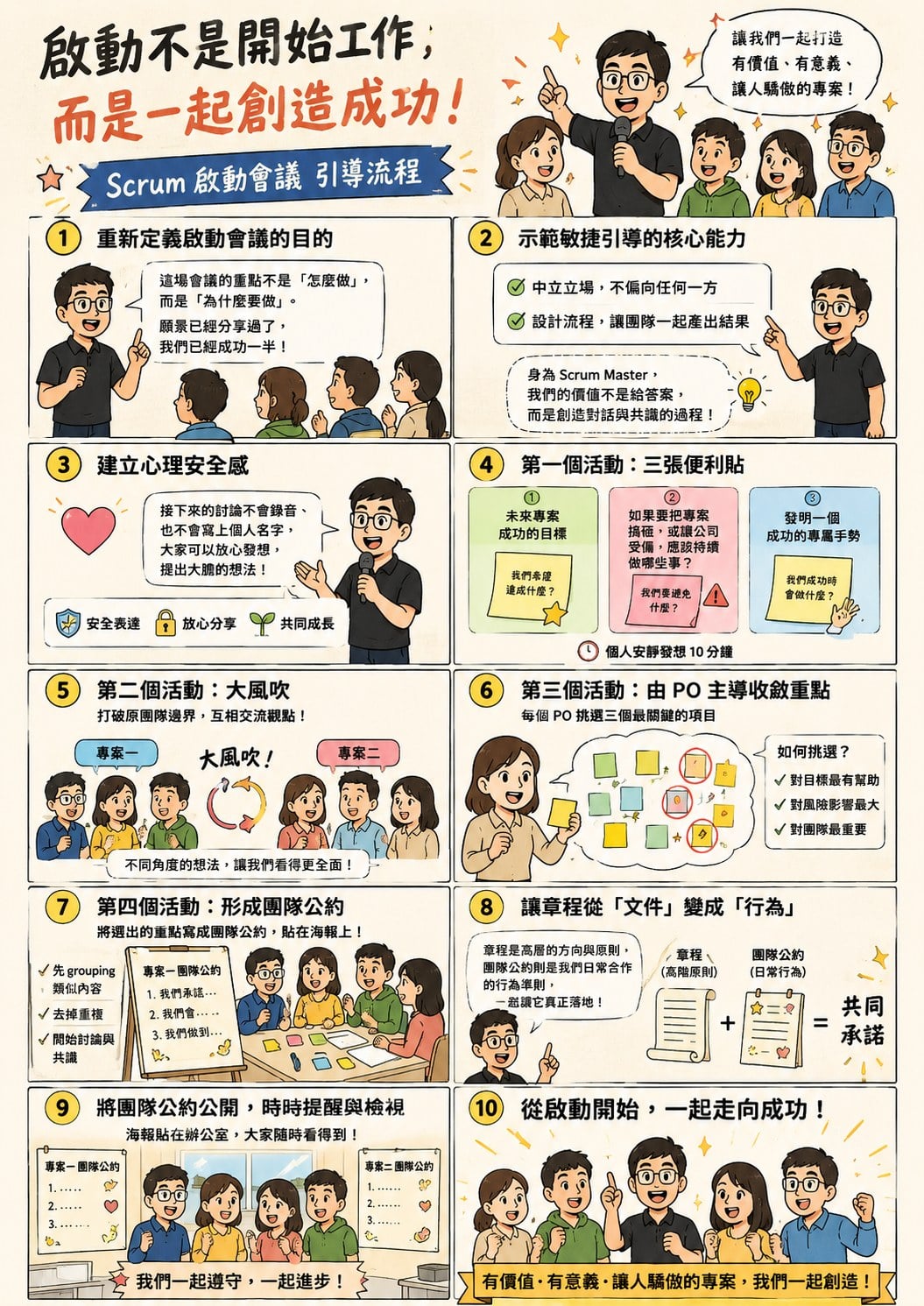
Two Rounds of Three Sticky Notes — Aligning Departments on One Version of Success
Three Sticky Notes: Positive Target, Reverse Thinking, Shared Symbol
The first activity I designed was the “success tree”—three sticky notes per person: What does success look like for this project? If you wanted to sabotage it or sink the company, what would you keep doing? Invent a hand sign for what success means to your project.
Sounds simple. But here’s what you find—on the “success target” sticky note, different departments wrote completely different things. One leader wrote “system launches on time.” Another wrote “users actually want to use it.” A third wrote “30% revenue growth from external markets.”
The third sticky—the hand sign—shifted the room’s energy. People got creative, narrowed it down to four candidates, and put it to a vote. The moment the team picked their shared success sign, the whole room was smiling. From that day on, whenever the team is frustrated, after every meeting, in group photos, or celebrating wins, they all flash the same sign.

Psychological Safety Isn’t a Slogan — It’s Four Specific Design Choices
What made this facilitation work wasn’t the activities alone. It was four design choices that gave people real psychological safety: no recording, anonymous submissions, executives can’t see the voting process, and the facilitator stays neutral with no commentary.
Four small details. They’re what let truth into the room.
A lot of companies can’t run a useful kickoff meeting—not because the process is wrong, but because truth never enters the room. When everyone feels “if I say something honest, I’ll be remembered, I’ll be punished later,” the meeting can only stay on the surface.
After Musical Chairs, Department Walls Came Down
The second activity was musical chairs. The rule: after every shuffle, you cannot sit next to someone from the same project.
I didn’t do this for icebreaking. I did it because in a group that has never genuinely talked to each other, you have to physically force them into different seats.
When the head of engineering ends up next to the VP of sales, when the PO sits across from marketing, they start asking each other very basic questions they’ve never asked before—what metric do you actually care about? Does this goal even make sense to you?
This isn’t about clever tools. It’s about the power of a designed environment.
The Moment the PO Converged, Three Sides Aligned
The third activity was led by the PO: pick a topic from the sticky notes, brainstorm with the entire project team, then converge everything into three dimensions—what helps the goal most, what carries the highest risk, and what’s most effective for the team—to produce the team agreement.
Whoever Owns It, Converges It: Scrum’s Sharpest Edge
This means the right to define success shifts from “everyone discusses” to “the Product Owner owns it.” It’s the sharpest edge of Scrum philosophy: whoever owns it, converges it.
I watched that PO standing at the whiteboard, making trade-offs in front of every department for the first time.
For three full seconds, the room went silent. Then a vice president nodded.
When a Charter Becomes Behavior — The Moment the Agreement Hit the Wall
The fourth activity was the team agreement. I asked each group to take what they’d discussed and post it as a poster.
Agreement vs. Charter: Where Behavior Actually Begins to Change
A team agreement isn’t a charter.
A charter is written, rational, beautifully worded—but it’s issued top-down. An agreement is something the team aligns on together, has flexibility to revise, and revisits over time.
They later took that poster and pinned it to their office wall, so everyone walking in could see it. As the project ran retrospectives, they kept updating it.
A lot of companies have charters. Charters don’t change behavior. What changes behavior is a poster the team put up themselves and chose to live by.
Real Facilitation Isn’t About Making Decisions for the Team
By the time those 50 minutes were up, a meeting that used to turn into a shouting match felt completely different. Not because everyone suddenly became rational—but because, for the first time in that room, they had a sense of shared ownership.
After years of agile facilitation, I keep seeing the same thing—
Real facilitation isn’t about deciding for the team. It’s about making the team want to create together, and feel ownership of the outcome.
What CAF Training Is Really About: Designing a Space Where Truth Can Surface
That’s the core of CAF training: not techniques, not workflows—but how to design a space where truth can surface, where consensus can emerge, and where ownership can actually be shared.
Anyone can learn the tools. Designing the environment is a structural capability.
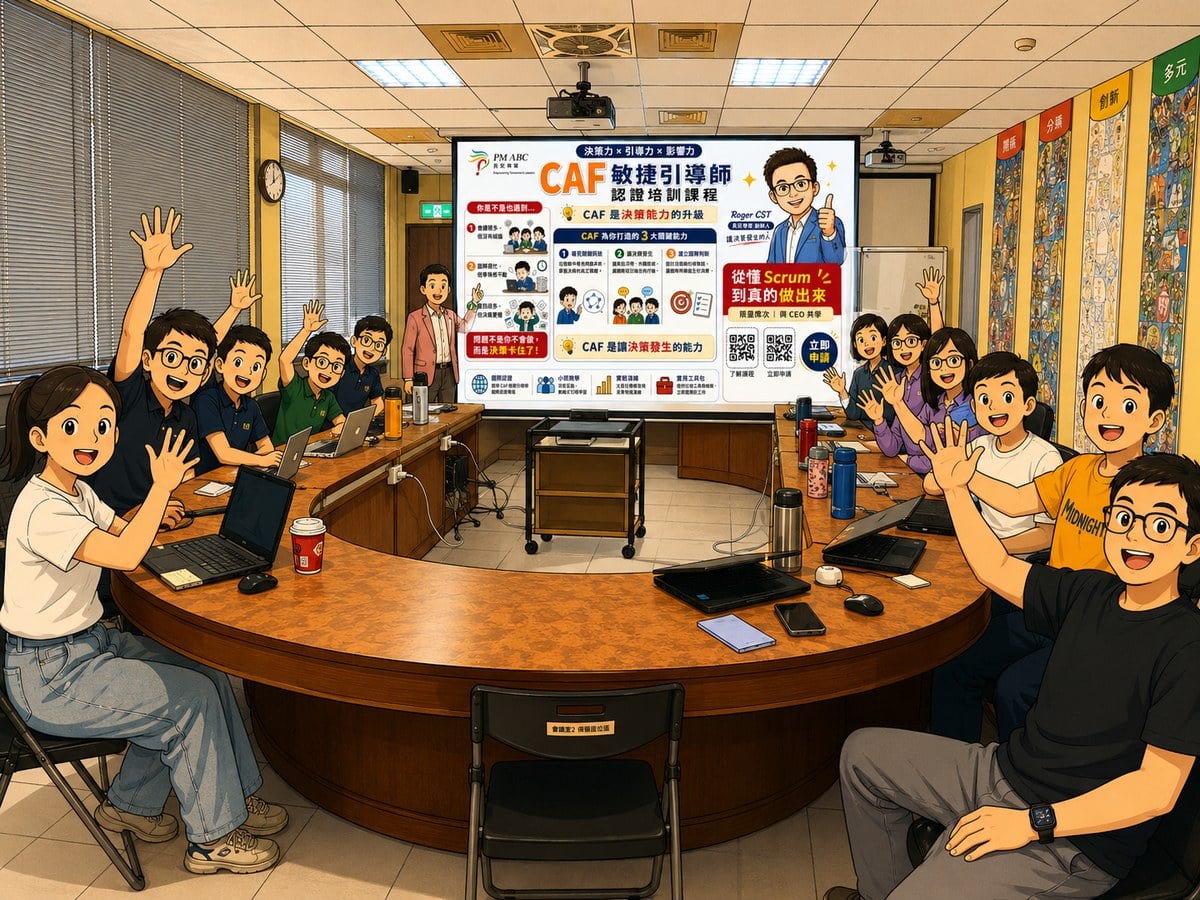
Closing: 50 Minutes That Bought a Project’s Future Direction
After the kickoff ended, leaders rated the meeting with strong satisfaction scores. But what convinced me that real change had happened wasn’t the score on the day. It was that three months later, the team agreement is still pinned on the team’s office wall.
The value of a kickoff meeting is never on the day itself. It’s in the three months, the six months, and the project’s full lifecycle ahead—whether the team still remembers the direction they set that day.
The Cost Gap Between Two Choices, and Why CEOs Underestimate It
If your organization is preparing to launch an important agile project, you have two options: let the meeting “finish,” or let the meeting “deliver direction.”
The cost gap between those two choices is far larger than most CEOs estimate.
Many CEOs tell me they’re waiting for a better moment to bring in this kind of facilitation capability. My observation: the waiting itself is one of the most expensive decisions an organization can make.
This can be designed.
And the starting point is a group of senior leaders willing to walk into a CAF training room themselves and rethink something basic—in uncertain times, a kickoff isn’t a ritual. It’s the first stress test of an organization’s decision-making capability.
What the CEO and the VP Said Afterwards
After the meeting, the CEO told me: “Today wasn’t like the usual ‘meet-and-disperse’ kickoff.”
He explained that previous kickoffs had agendas, slides, and division of work—but the real issues never surfaced. Everyone assumed there was alignment, when in fact every department was thinking about success differently.
What stood out, he said, was that this was the first time the team genuinely asked: “What are we actually trying to accomplish together?”
What stuck with him most was the shared success sign the team created. What started as an activity ended up becoming a symbol the whole team carried forward. The first time everyone made that sign together was also the first time it felt like “we are on the same side.”
The most important thing, he believed, was the team agreement. It wasn’t just an output—it was a way of confronting upfront the friction, conflict, and collaboration issues every team eventually runs into. Putting them on the table at the start of a project is what gives the team a chance to operate more transparently and consistently later.
A vice president added: “You used a few activities that looked simple on the surface, but the entire team’s state shifted completely.”
He pointed out that without the facilitation, the day would’ve gone the usual way—leaders taking turns reporting, wrapping up, and going back to their own versions. But this time was different. Issues that no one would normally voice surfaced on their own.
His closing line stayed with me—
“We used to think kickoff meetings were about division of work. Today I realized the real point is getting everyone willing to head in the same direction first.”
This can be designed.
And designing it is the core practice of CAF Agile Facilitator training.
Register: https://www.pm-abc.com.tw/Member/Registration_SCRUM