
Most PMPs Aren’t Stuck on Project Skills — They’re Stuck Speaking the Old Language
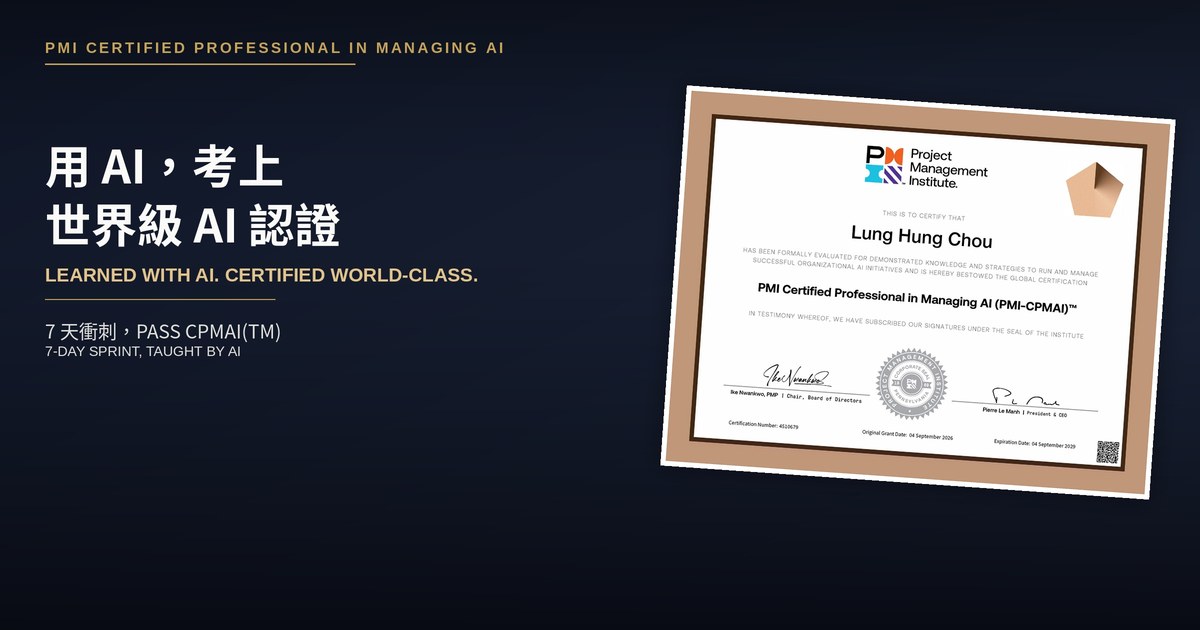
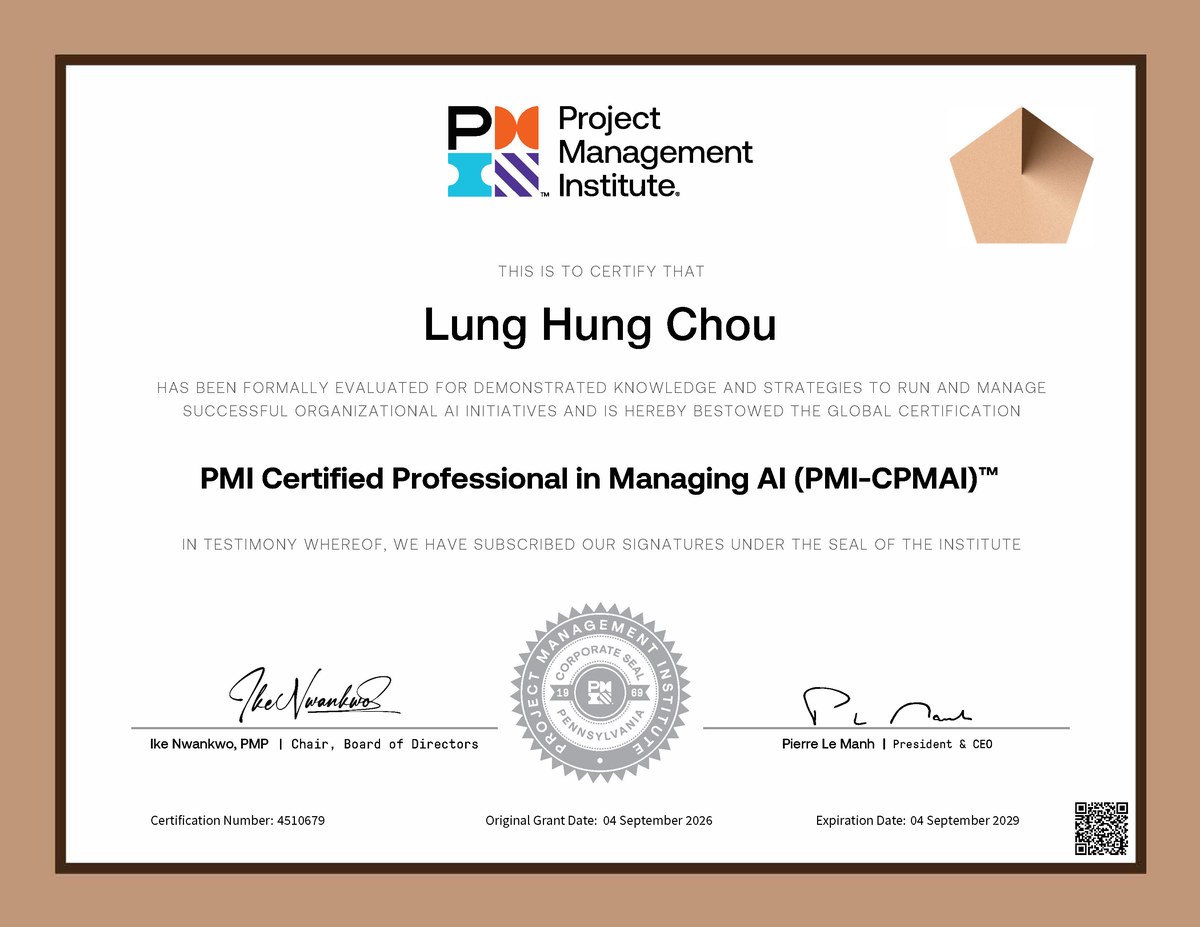
At 11:45 PM on September 4, 2026, the screen showed “PASS.” Honestly, I wasn’t that excited — I already hold CST, PfMP, PgMP, PSM3+PSPO3, and ICF-PCC, plus a drawer full of certificates that’s grown into the dozens. By rights, one more shouldn’t move the needle. But this one was different.
The difference wasn’t the difficulty — it was the logic behind how this certification was designed. PMI built it with no work experience required and no prerequisite PMI certifications — a rare setup among PMI’s twelve certifications. But that’s not because this certification carries less weight. It’s because AI project management is still too new a field, and PMI wants to unify the world’s language for “how to manage AI projects” as fast as possible, rather than spending a decade filtering out who’s qualified. In other words, this certification doesn’t test your tenure — it tests whether you’ve caught up with the judgment this new language demands.
Most PMPs don’t get stuck on the fundamentals of project management — scheduling, risk, stakeholders: PM-ABC Inc.’s PMs could do that in their sleep. What actually stops them is that AI projects aren’t “one more technical tool” — they rewrite the entire decision logic: business need determines whether and how you build AI at all, data quality becomes a matter of life and death, models drift, and explainability becomes part of stakeholder management. Try leading an AI project in the language of PMP, and you’ll find conversations that simply don’t connect — not because you’re not skilled, but because you’re still speaking a language that never accounted for AI, in a world AI has already rewritten.
And this isn’t a PMP-only blind spot. Plenty of PM-ABC Inc. PMs also hold PMP, CSM, and CSPO — equally fluent running waterfall with the left hand and Scrum with the right. But where AI projects trip people up has nothing to do with “Waterfall vs. Agile.” Whether you were trained on Gantt charts or burndown charts, AI projects test an entirely different axis, one nobody ever taught: AI needs, in the end, start from business needs. On this axis, Business Understanding alone accounts for 26% of the exam — more than data, more than the model — and only then come questions like whether your data can be trusted, whether a model is ready to ship, and who calls the stop when bias shows up. Neither the PMP body of knowledge nor the Scrum Guide covers this axis. That’s exactly why CPMAI exists: it’s not settling the old Agile-vs-Waterfall argument — it’s filling the one gap every PM, regardless of camp, hasn’t filled yet.
AI projects can’t be planned end-to-end like a Waterfall project, and they can’t just run on a standard Agile framework either. Requirements, data quality, model performance, and business value all have to be confirmed through repeated experimentation. PMP gives you the full view of managing a project; CSM builds the agile mindset for operating under uncertainty; CPMAI handles the data, the model, the validation, and the governance. That’s why I’d recommend learning CSM first, then CPMAI — it’s the only way to actually turn AI from a technical experiment into a business outcome.
What This Certification Actually Tests
Let me be precise about what this certification actually is, so it doesn’t sound like I’m selling something vague. CPMAI originated when PMI acquired Cognilytica in September 2024, folding the existing industry CPMAI methodology into its own certification portfolio; on September 30, 2025, PMI officially renamed it from “Cognitive Project Management in AI” to “PMI Certified Professional in Managing AI,” putting its own brand on it. I earned my certificate less than a year after it carried the PMI name.
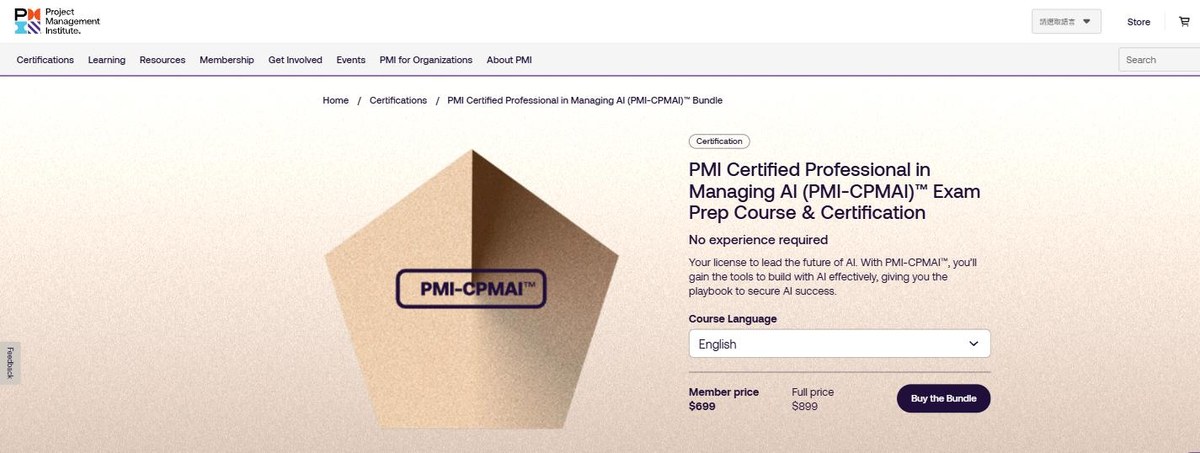
The exam itself isn’t complicated: 120 questions, 160 minutes, ten language options on the official site, including Traditional Chinese. The whole methodology runs through six phases: Business Understanding, Data Understanding, Data Preparation, Modeling, Evaluation, and Operationalization — note that it starts with Business Understanding, not data or modeling, and that ordering is no accident. The questions don’t test coding or algorithm comparisons — they test situational judgment: “As the newly assigned PM, what should you do FIRST?” — the same underlying logic as PMP questions, just staged on an AI set. PMI recommends 20 to 40 hours of preparation — realistically, a workload any working professional can chip away at in spare moments.
This certification’s openness isn’t an accident — it’s strategy. PMI priced it at $699 for members and $899 at full price — that price already includes the exam fee — and deliberately included Traditional Chinese as a language option. Both signals point to the same thing: PMI wants every PM in the world using the same language, the same methodology, to lead AI projects — the faster that common standard takes hold, the faster the risk of AI projects spinning out of control gets contained. For PMI, this is a strategy for building a global standard. For you, it means something else: this methodology is learnable right now, and the way you learn it can be a lot easier than you’d expect.
If you want to gauge exactly where this certification sits, you can compare it to Taiwan’s most popular AI certification — the Ministry of Economic Affairs’ iPAS “AI Application Planner.” iPAS is Taiwan’s only government-backed AI competency certification, with nearly 20,000 cumulative test-takers, and both its visibility and corporate recognition are rising fast. But the two exams weigh different things: iPAS is closer to “do you understand the basics of AI and the nuances of applying generative AI” — both subjects are concept-based, and pass rates keep sliding, with one sitting’s Subject One pass rate dropping just past twenty percent. CPMAI tests whether you can apply a methodology to carry an AI project from start to finish — six phases, all the way through to operations and governance after a model ships. Placing the two in the same tier isn’t a stretch; CPMAI simply comes with a full methodology skeleton you can drop straight into a real project, not just a one-time knowledge check.
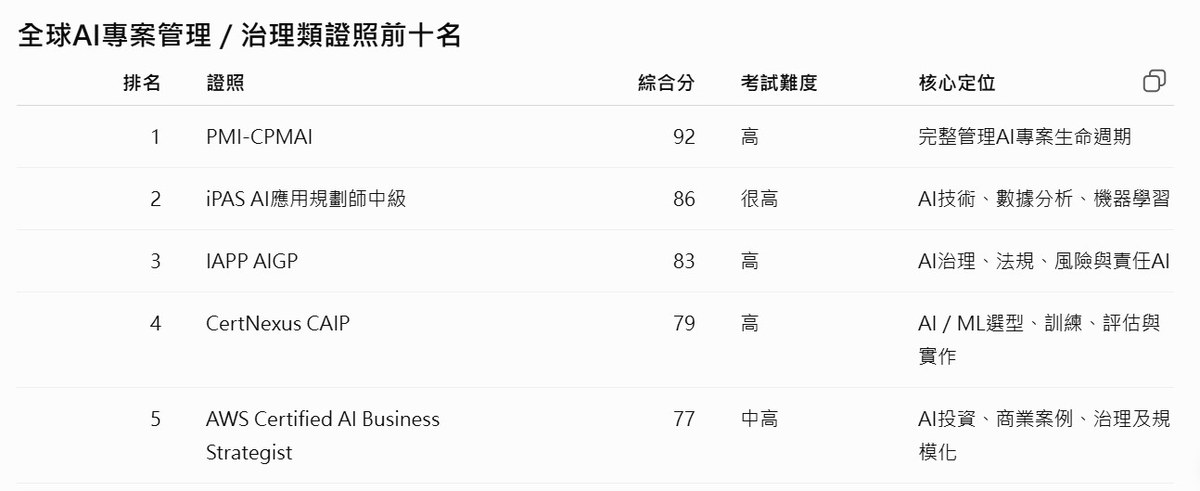
I’m not saying this to flatter myself — you don’t have to take my word for it. Open whatever AI you use and ask it this exact question: “Compare all AI project management certifications worldwide. Where does CPMAI rank? Relative to Taiwan’s hardest professional exam, the iPAS AI Application Planner, just give me the top ten.” Whichever AI you ask, the answer points the same direction — this certification sits in the upper tier among its peers.
If you want to know exactly how dense this certification’s terminology gets, don’t take my word for it — spend five minutes with the official CPMAI glossary yourself and see how many of the terms you actually recognize.
PMI-CPMAI Glossary: Open the glossary
Honestly, the difficulty here isn’t just my own impression. Many of the best test-takers I know among my students needed two attempts before passing; the line they all land on afterward is the same: this is genuinely hard. Studying from PMI’s official materials alone, the scope is too broad (about 1,700 pages) to pin down what actually matters; Even buying PMI’s own official question bank to practice — scoring 85 — still wasn’t enough to pass. This certification is designed to be wide open at the entrance — that doesn’t mean it’s easy. Low barrier, high difficulty.
I Didn’t Find Seven Extra Days — I Clawed Them Back From My Calendar
Looking only at the calendar, preparing for this certification took me nearly a month. But that line is misleading, so let me lay out what actually happened: within that month, I ran the full-day RSG Taipei on August 15, coached six enterprise agile projects at the same time, and taught a two-day CAF course. None of that got cut — none of it could be cut; that’s my regular work, not time I cleared out specifically for an exam.
The actual time I spent sitting down with materials, writing practice questions, time that genuinely counts as “preparation” — after subtracting everything else — came to seven days, six hours a day, forty-two hours total. That number happens to land at the upper edge of PMI’s recommended 20-to-40-hour range — except I carved those forty-two hours out of a month packed with RSG, six coaching engagements, and a CAF course, not a month I cleared to focus.
I’ve walked this exact psychological block myself, so I know where it sits: most people don’t get stuck on ability — they get talked out of it first by the thought, “I’m this busy right now, how could I possibly find time for a certification.” But the real question was never whether you have the time. It’s whether you’re willing to claw those seven days back from your calendar.
I Didn’t Memorize — I Had AI Teach Me the Whole Framework in Language I Could Actually Understand
My approach to preparing was completely different from how I studied for PfMP or PMI-RMP. Back then, it was reading handouts, highlighting, memorizing frameworks. This time, I rewrote CPMAI’s six phases into my own system of analogies — for Business Understanding, I pictured it as “building a magic treehouse”: lay the foundation first, recruit your crew, and get clear on why you’re building the treehouse at all; for data governance, I pictured “the secret library at a school of magic” — who’s allowed to borrow, what they’re allowed to borrow, and whether anyone’s watching.
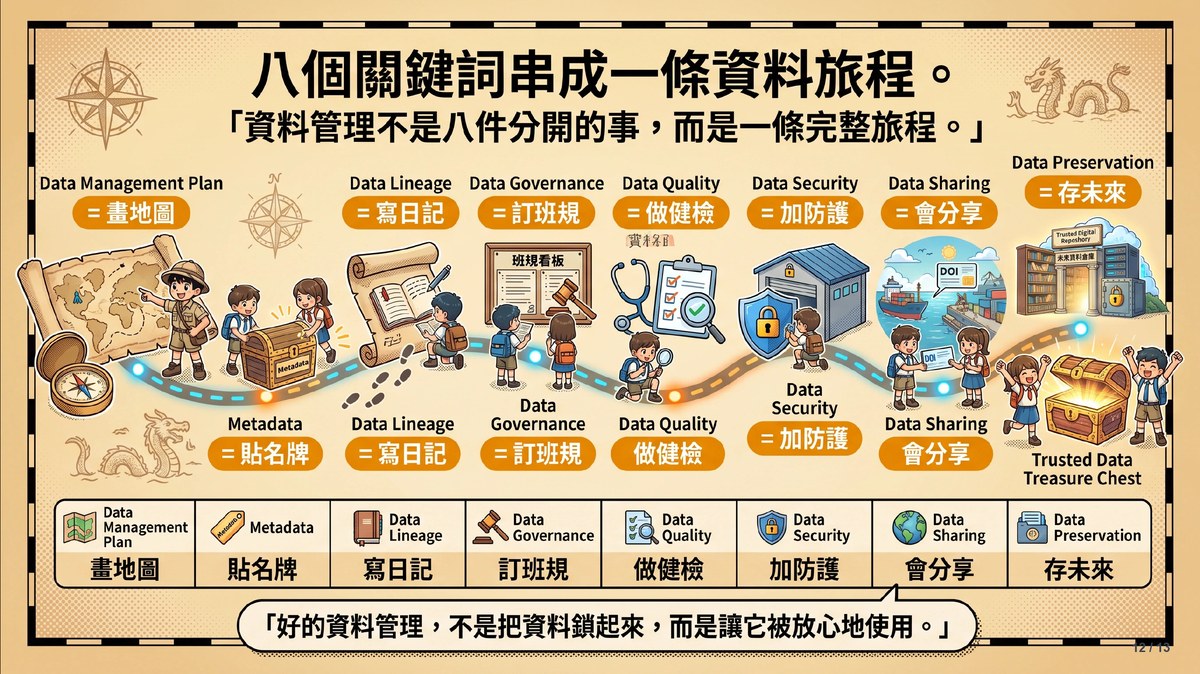
The hardest document in data governance — the DMP (Data Management Plan) — is written dense and long in the official materials, so I broke it into eight keywords strung along one path: draw the map, tag it, keep a diary, set the rules, run the checkup, add the lock, share it, and preserve it for the future. Each step maps to a real technical action (Metadata, Data Lineage, Data Governance, Data Quality, Data Security, Data Sharing, Data Preservation) — but said once in plain, everyday language, it sticks ten times better than memorizing English acronyms. Good data management was never about locking data away — it’s about making it safe enough to use. I only truly understood that sentence after I passed.
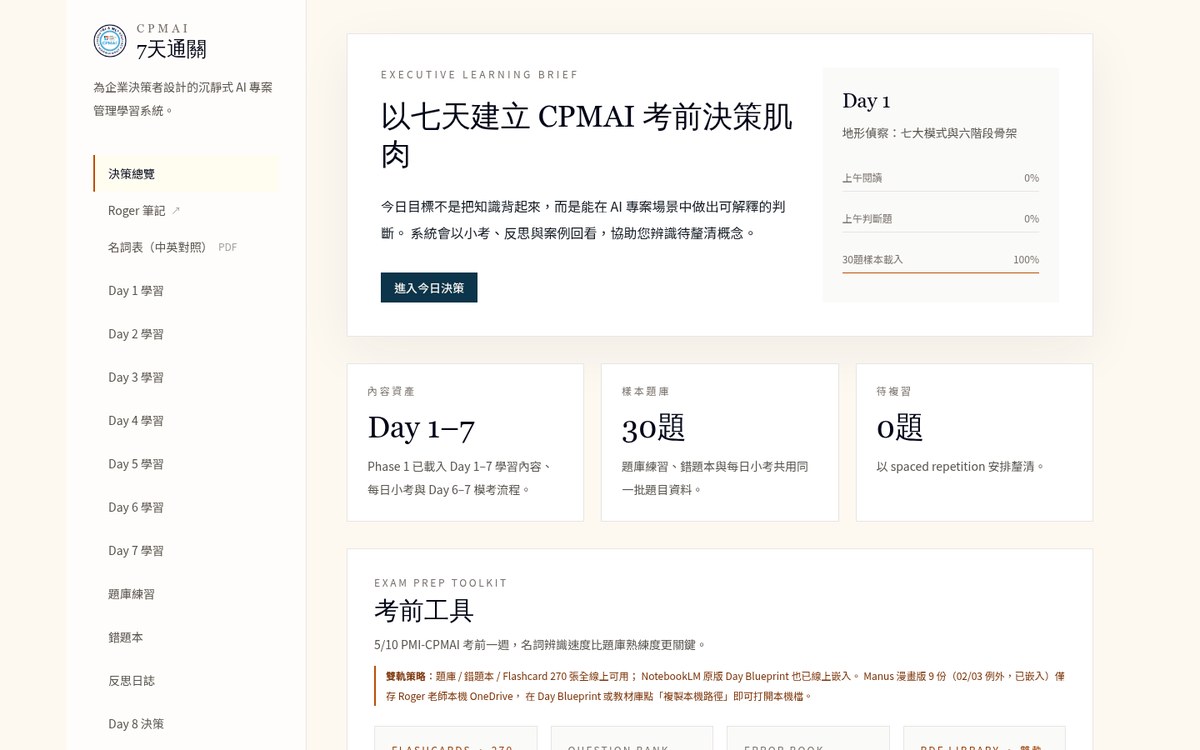
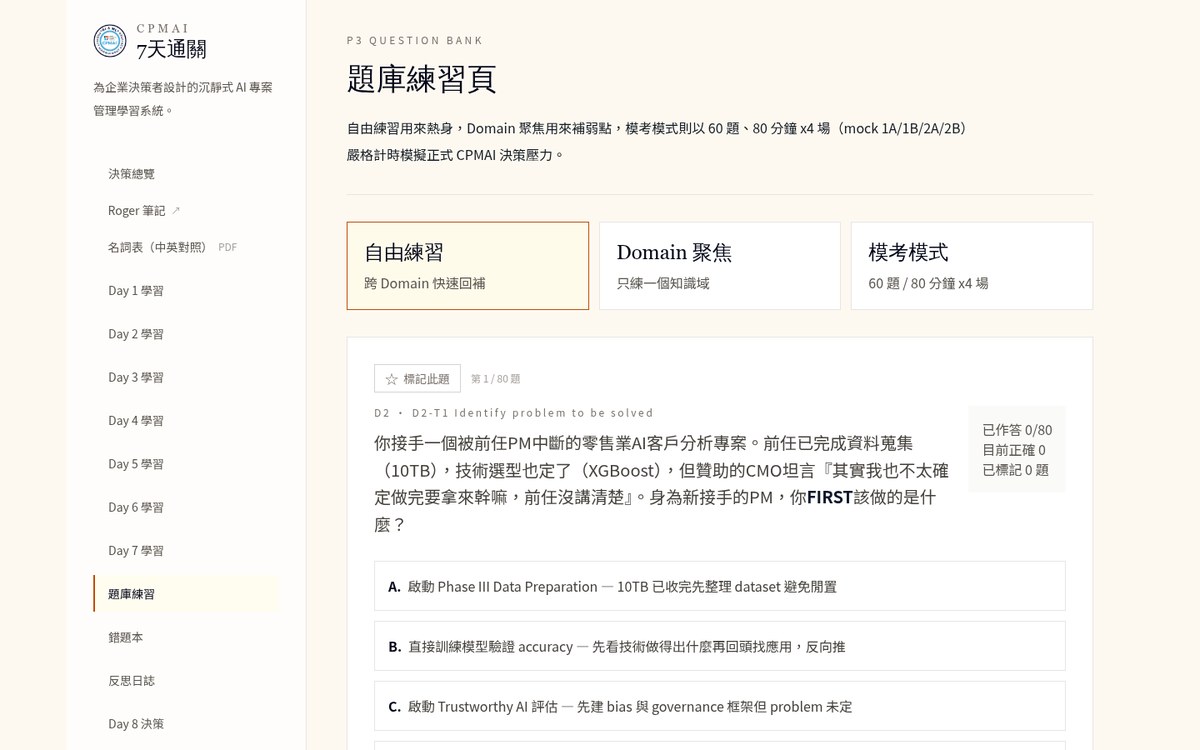
For every abstract technical term, I had AI teach it to me the way you’d explain it to a child: F1 score — AI told me to picture a goldfish-catching contest, where accuracy (Precision) and not missing any fish (Recall) combine into your final score; data drift — AI said it’s like customers suddenly craving spicy food while the robot keeps stubbornly cooking the same bland soup. Honestly, this wasn’t for fun — it’s because I know from experience: if you can explain something with an analogy, you actually understand it; memorizing the definition alone falls apart the moment a scenario question shows up on the exam.
Later I turned this into a message and shared it with a friend who was also preparing for a professional certification:
Hi there,
My CPMAI prep journey was genuinely fascinating. The AI field is packed with jargon, models, and metrics that aren’t easy for someone without a technical background to grasp at first.
So I made AI my personal tutor: I had it turn the official materials into comics, then explain every technical term in language even a child could understand. Whenever a concept got too complex, I’d ask it for a different analogy until it actually clicked.
In the end, I passed the exam, and scored well above the passing bar. This experience proved something to me: we’re not just learning about AI — we can use AI to learn and prepare for certifications, period. When dense material gets translated into language that fits how you think, the barrier to learning drops dramatically.
So AI wasn’t just my exam subject — it was the study partner that got me the certification. I believe the same principle would work for a high-difficulty security certification like CISSP too.
This method — make AI your tutor, break the material into analogies you can actually follow — isn’t limited to CPMAI. In theory, the same logic applies to any dense, jargon-heavy professional certification.
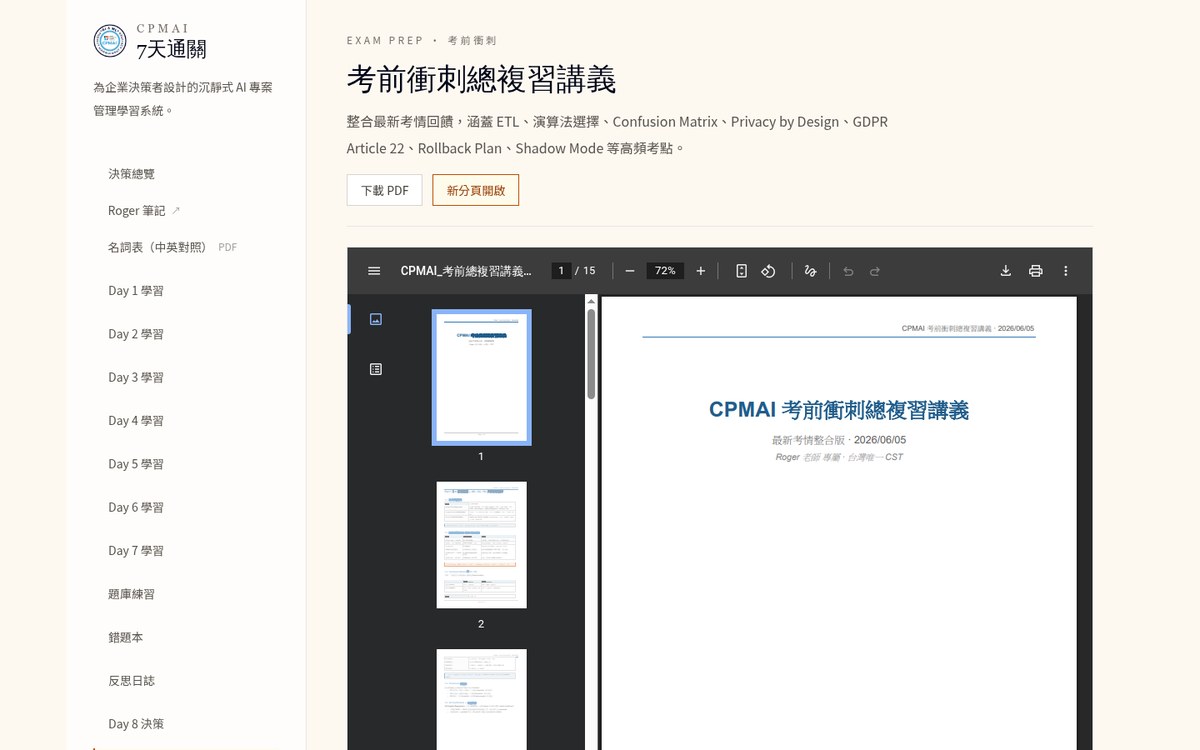
For practice questions, I had several people who’d already passed cross-check my work — every time I built a new MVP question set, I’d immediately have AI refine the question strategy, rather than waiting to finish the whole set before reviewing. I remember thinking at the time that this method is the exact same logic I’ve used for years teaching CSM and CSPO students: real learning isn’t memorizing the answer — it’s turning the moment you got something wrong into the basis for your next judgment call.
Translating the Five Domains Into Five Levels Even a Child Would Understand
CPMAI’s exam blueprint is actually five domains, each weighted differently — most people see the English names and want to give up, but broken apart, it’s really just five levels in a game.
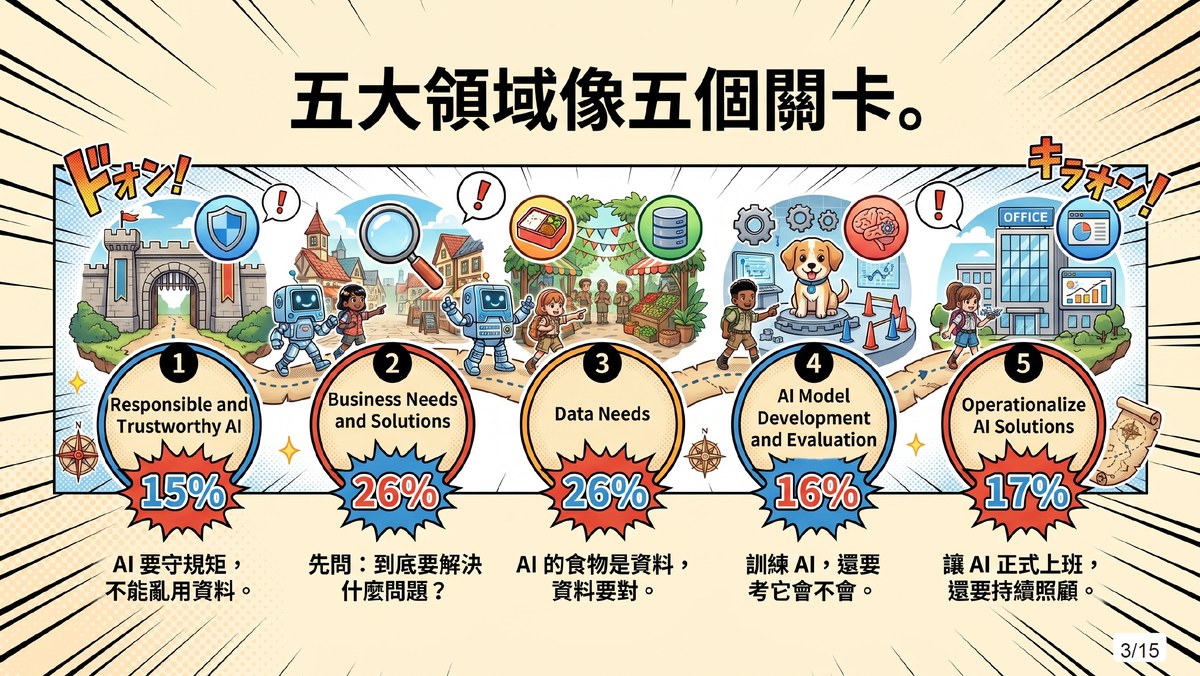
Level 1, Responsible and Trustworthy AI, worth 15%: AI helped me translate this as “the righteous class monitor” — a class monitor’s job isn’t tracking who has the best grades, it’s tracking who’s following the rules. This domain governs whether AI can be trusted and whether data gets misused — it’s the ethical baseline of the entire exam.
Level 2, Business Needs and Solutions, worth 26%: AI helped me translate this as “the clever strategist” — before going to battle, a strategist never rushes in; they first ask exactly which battle you’re fighting and who the enemy is. Most AI projects don’t fail because the model wasn’t accurate enough — they fail because nobody clearly defined “what problem are we actually solving” at the start. This is also why AI needs must ultimately start from business needs — no matter how accurate your model is, solving the wrong problem is wasted effort.
Level 3, Data Needs, worth 26%: AI helped me translate this as “the ruthless master buyer” — AI’s food is data, and a buyer’s job is making sure the ingredients are fresh and the sourcing is clean. If the data’s wrong, no chef, however skilled, can save what comes out of the kitchen later.
Level 4, AI Model Development and Evaluation, worth 16%: AI helped me translate this as “the chef tasting in the kitchen” — you can’t send a dish straight out to the dining room; the chef has to taste it, adjust the seasoning, confirm the guests will like it. This level maps to training the model — and then testing whether it actually works.
Level 5, Operationalize AI Solutions, worth 17%: AI helped me translate this as “the restaurant’s grand opening” — opening night isn’t the finish line, it’s a new beginning; after opening, you still have to handle complaints, maintain quality, and stay on top of it every day. This level maps to operations and monitoring after the model goes live.
Add the five levels together and you get the exact sequence a real AI project actually goes through: start with the ethical baseline, then ask what problem you’re solving, then get the ingredients (data) ready, build the model and taste-test it, and finally open for business and tend to it daily. I test-taught this logic to a group of PM-ABC Inc. students once, and even PMs with zero technical background could, after hearing these five levels, say, “Oh, so an AI project runs on the same logic as opening a restaurant” — that’s exactly what I mean: if you can explain it with an analogy, you actually understand it. These five analogies, honestly, are things I pulled out of AI one question at a time — AI knows the technology, but getting it to translate that technology into language a child would understand still takes you constantly pushing back with “simpler, please.”
PMI’s Own Numbers Say It More Directly Than I Can
I’m not the only one who feels this way. After years coaching enterprises, what scares me most isn’t a client who doesn’t understand agile — it’s a client who understands the logic perfectly well and still thinks, “we’ll deal with that later.” So rather than making my own case for whether CPMAI is worth pursuing, let’s just look at PMI’s own published numbers and let the data speak.
PMI estimates the world will need 30 million new project professionals by 2035; the median salary for U.S. PMP holders is $135,000, roughly 24% higher than for those without the certification; and in just the first five months of 2026, PMP certifications grew 36% — signaling that the market isn’t cooling, it’s accelerating its filter for who gets to stay. A PMI learning-division executive made a point I think nails it: AI is accelerating the obsolescence of “skills that can be replaced by tools,” while simultaneously driving up the premium on “judgment — the durable capability.”
In plain terms: AI isn’t going to replace PMs. AI is going to replace the PMs who, beyond tracking schedules and chasing progress, can’t articulate any judgment at all. What CPMAI tests is exactly that “judgment” — whether data can be trusted, whether a model is ready to ship, when a risk calls for pulling the plug. This certification is designed to be wide open at the entrance, but the payoff sits squarely in the middle of the trend PMI itself keeps pointing to.
How Close Is This to PM-ABC Inc.’s PMs?
If you just finished your PMP and are still building up your project portfolio at PM-ABC Inc., the problem you’re facing usually looks like this: clients start asking about AI-related needs, and your toolkit has no framework for it, so you end up giving vague answers. If you’re a senior PM who’s already run several projects, what you’re feeling might be a different kind of stall — you know how to manage a project, but the moment a client mentions a model, data, or an algorithm, you instinctively hand the reins to the technical team and become the person who just tracks the schedule.
I’ve watched this moment play out too many times: at the conference table, a client drops the line, “we’re thinking about bringing in AI here,” and a senior PM freezes for three seconds before handing the lead over to the technical person sitting nearby. Those three seconds are the real cost — not a lack of ability, but the instant when the authority to speak quietly changed hands. CPMAI addresses exactly this: it hands the judgment on AI projects back to the PM. It’s not asking you to learn to code — it’s asking you to reclaim the authority to say whether this project should move forward at all.
Conclusion: AI Wasn’t Just My Exam Subject — It Was My Study Partner
Most people think you take a certification exam to prove you understand something. But what struck me more this time was something else: I didn’t learn this field on my own — AI taught it to me, step by step. That might matter more than one more certificate. If someone with my non-technical background can use AI to learn a world-class methodology for managing AI projects, then what AI can help every PM at PM-ABC Inc. learn is probably more than any of us are ready to admit.
I really am good at using AI, but I don’t position myself as an AI instructor — AI evolves too fast; the tool I teach today might be obsolete tomorrow. My core capability has always been agile, and how to use AI to amplify what agile delivers — genuinely helping organizations solve problems and produce results. So for the upcoming talk at 網軟, I’ll still keep agile as the throughline, not simply teach AI tools.
Honestly, though, my current learning system is still too “Roger-specific” — a lot of the analogies and angles are tuned to how I personally think, and they’re not yet ready to hand straight to someone else. What I want to do next is turn it into a genuine self-study system for PM-ABC Inc.’s PMP holders, so you don’t have to retrace the same path I had to feel my way through. Give me another month for that.
I’ve walked with you through PMP, CSM, and CSPO. This time, I want to walk the path myself first, get it fully worked out, then come back, put up the signposts, and bring everyone along.